Japanese ChinCharacteristics, history, training and care
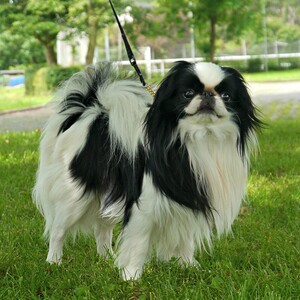
Japanese Chin. · Joliot / Wikimedia Commons, CC BY-SA 3.0. Cropped and resized.
The Japanese Chin is a small companion dog with a broad head, a very short muzzle and a long, silky coat, white with black or red markings. According to old records, its ancestors reached the Japanese court in 732. The FCI standard describes it as intelligent, gentle and charming.
Quick facts
| Common name | Japanese Chin (Japan Chin, Japanese Spaniel) |
| Scientific name | Canis lupus familiaris |
| Country of origin | Japan |
| Official recognition | FCI, definitively since 2 December 1957 (group 9, companion dogs; standard no. 206); also recognised by the AKC |
| Lifespan | 10–12 years, according to the AKC |
| Size (males) | about 25 cm at the withers; 3–5 kg according to the AKC |
| Size (females) | slightly smaller than males |
| Coat type | Long, straight, silky |
| Common colours | White with black or red markings |
| Energy level | Moderate |
| Suited to an apartment? | Yes |
| Temperament | Intelligent, gentle, charming, loyal |
| Tendency to aggression | Very low |
| Good with children | Average; it is a small, delicate dog |
| Good with other animals | Very good with other dogs, according to the AKC |
| Genetic predispositions | Luxating patella, cataracts, epilepsy, heart murmurs, GM2 gangliosidosis |
- Primary category:Dog breeds
- Explore this animal's categories:
History and origin
The FCI standard says that, according to old records, the Chin's ancestors were presented to the Japanese court in 732 by the rulers of Korea, of the Silla dynasty. For another hundred years many such dogs reached Japan, and envoys sent to China and to the kingdom of Po Hai brought them back directly.
Under the shogun Tsunayoshi Tokugawa (1680–1709), the breed was kept as a companion dog in Edo Castle. In 1613 a British captain, Searles, took a Chin to England, and in 1853 the American Commodore Perry took several to the United States; two of them were given to Queen Victoria.
How the breed developed
- 732 – The breed's ancestors are presented to the Japanese court.
- 1613 – A Chin reaches England, brought by Captain Searles.
- 1680–1709 – The breed is kept in Edo Castle.
- 1853 – Commodore Perry takes several dogs to the United States.
- 2 December 1957 – The FCI recognises the breed.
- 4 April 2016 – The current FCI standard is published.
Breed rating
| Feature | Stars |
|---|---|
| Training and intelligence | ★★★☆☆ |
| Easy to train | ★★★☆☆ |
| Intelligence | ★★★★☆ |
| Independence | ★★★☆☆ |
| Stubbornness | ★★★☆☆ |
| Behaviour and temperament | ★★★★★ |
| Affectionate with family | ★★★★★ |
| Friendly with children | ★★★☆☆ |
| Good with other dogs | ★★★★★ |
| Good with cats and other animals | ★★★★☆ |
| Loyalty | ★★★★★ |
| Tendency to be aggressive | ★☆☆☆☆ |
| Tendency to bark | ★★☆☆☆ |
| Needs and care | ★★★☆☆ |
| Shedding | ★★★☆☆ |
| Needs frequent grooming | ★★☆☆☆ |
| Activity and lifestyle | ★★★☆☆ |
| Energy level | ★★★☆☆ |
| Daily exercise needs | ★★★☆☆ |
| Suited to apartment life | ★★★★★ |
| Health and longevity | ★★★☆☆ |
| Life expectancy | ★★★★☆ |
| Predisposition to genetic diseases | ★★★☆☆ |
| Working abilities and uses | ★★★☆☆ |
| Good guard dog | ★★★☆☆ |
| Good companion dog | ★★★★★ |
Indicative rating: 5 stars means the highest level. It is based on the ratings the American Kennel Club gives the breed and on the FCI standard.
Physical characteristics
It is a small, elegant dog with a broad face. The AKC says its large, round, dark eyes give it “a look of astonishment”, while the rich mane and the plumed tail, carried over the back, complete the picture.
General appearance
The skull is broad and rounded, and the nose is very short, in line with the eyes. The long coat covers the whole body except the face and forms rich feathering on the ears, neck, thighs and tail.
| Feature | Japanese Chin |
|---|---|
| Size | Small |
| Height at the withers | males: about 25 cm; females: slightly smaller |
| Weight | 3–5 kg, according to the AKC |
| Coat | Long, straight, silky |
| Head | Broad and rounded, with a very short nose |
| Tail | Plumed, carried over the back |
The coat is white with black or red markings. The standard prefers the markings to be placed symmetrically around the eyes and on the ears, with a broad white blaze from the muzzle to the top of the head.
Training and socialisation
The FCI standard describes it as intelligent, gentle and charming. The AKC says that, having been bred purely as a companion, its only job has been to delight and comfort its people.
It is often called “cat-like”. The AKC says training is easy if you make it think it is only doing what it wants.
Tips for effective training
- Make training a game. Work with patience and rewards.
- Keep it on the lead outdoors. The AKC says it may refuse to listen when it sees something interesting.
- Be careful with young children. It is a small, delicate dog.
- Avoid the heat. Its short muzzle makes it sensitive to high temperatures.
Activity needs and lifestyle
The AKC says it is a fairly active little dog that enjoys leisurely walks and exploring a fenced yard. The breed is an excellent choice for life in a flat.
| Activity | How often | Why it matters |
|---|---|---|
| Leisurely walks on the lead | daily | Exercise and exploring |
| Indoor play | daily | Keeps it active |
| Exploring a fenced yard | several times a week | Curiosity |
Tips for a balanced life
- It is well suited to a flat.
- In summer, walk it in the morning and evening.
- Do not let it loose outdoors without a lead.
Care and health
Coat and skin care
The AKC says the long, silky coat is surprisingly easy to maintain: it needs brushing once a week and a bath about once a month. The nails grow very quickly and should be trimmed regularly.
Common health problems
The AKC says the breed is generally healthy, and responsible breeders screen their dogs for:
| Condition | Description | Common symptoms |
|---|---|---|
| Patellar luxation | The kneecap slips out of place | Suddenly holds a hind leg up for a few steps, then uses it again |
| Cataracts | The lens of the eye becomes cloudy | “Milky” eye, sees less and less well |
| Epilepsy | Repeated neurological seizures | Trembling, convulsions |
| Early-onset heart murmurs | Heart problems that appear early | Tires quickly, breathes with difficulty |
| GM2 gangliosidosis | A fatal inherited neurological disease; carriers are identified by a DNA test | Unsteady gait, trembling, loss of coordination |
| Brachycephalic syndrome | The airways are narrowed by the short muzzle | Noisy breathing, tires quickly, copes poorly with heat |
Other care
- Clean the folds around the eyes every day.
- Brush its teeth often.
- Trim the nails regularly.
Diet and nutrition
The AKC says some dogs gain weight easily, so calories and weight should be watched.
Tips for a healthy diet
The table gives a starting estimate, calculated with the formula from the Merck Veterinary Manual. The first two calorie columns show the calories per day for a healthy adult dog. The last column shows what this means in dry food with 3,500–4,000 kcal per kilogram.
| Dog's weight | Calories per day (neutered) | Calories per day (not neutered) | Dry food per day (approximate) |
|---|---|---|---|
| 3 kg | 260 kcal | 290 kcal | 65–83 g |
| 4 kg | 320 kcal | 360 kcal | 80–103 g |
| 5 kg | 370 kcal | 420 kcal | 92–120 g |
- Give its food in two or three small meals a day.
- Treats count towards the daily portion.
- Choose small kibble suited to small breeds.
Foods to avoid
Some human foods are dangerous for dogs: chocolate, coffee, grapes and raisins, onions, garlic, xylitol (a sweetener used in chewing gum), macadamia nuts and alcohol.
Reproduction and development
Physical and emotional maturity
In dogs, sexual maturity usually comes between 6 and 12 months. Small breeds become adults faster than large ones, usually at around one year.
Mating and pregnancy
Pregnancy lasts about 63 days, counted from ovulation. Mating a female on her first heat is not recommended. The FCI standard requires that only healthy dogs of typical breed appearance are used for breeding.
Caring for the puppies
In small breeds, a litter has 3–4 puppies on average. The puppies are very small and fragile in the first weeks, so they must be kept warm and handled with care. Socialisation starts early: gentle handling, everyday noises and new people.
Interesting facts
- “A look of astonishment”. This is how fans of the breed describe the expression of its eyes.
- Like a cat. It is often compared to a cat.
- A gift for Queen Victoria. Two of the dogs brought by Perry were given to the Queen.
- A castle dog. It was kept in Edo Castle in the time of the shogun Tsunayoshi.
- More than 1,200 years old. Old records place its ancestors in Japan in 732.
In popular culture
Queen Alexandra and Punch
Alexandra of Denmark, later Queen of Great Britain, was painted in 1893 with her Chin, named Punch, Wikipedia notes.
Frequently asked questions
Is the Japanese Chin a spaniel?
No. It is sometimes called the Japanese Spaniel, but it is a companion dog, not a hunting dog.
How big does it get?
Males measure about 25 cm at the withers; the AKC gives 3–5 kg.
Is it suited to an apartment?
Yes, the AKC considers it an excellent choice for a flat.
How long does it live?
The AKC gives 10–12 years.