LandseerCharacteristics, history, training and care
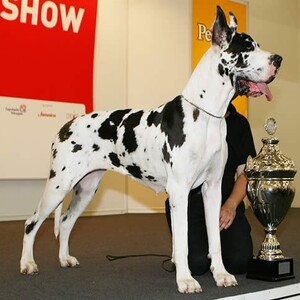
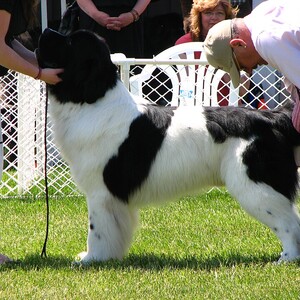
Landseer. · Blake Handley / Wikimedia Commons, CC BY 2.0. Cropped and resized.
The Landseer is a very large, tall and powerful dog, white with black patches and a long, soft coat. It is a relative of the Newfoundland, recreated from the dogs painted by Edwin Landseer in the 19th century. In continental Europe it is considered a separate breed; the FCI classifies it as a guard and companion dog.
Quick facts
| Common name | Landseer |
| Scientific name | Canis lupus familiaris |
| Country of origin | Germany and Switzerland |
| Official recognition | FCI, definitively since 24 August 1960 (group 2, mountain molossoid breeds; standard no. 226) |
| Lifespan | No published data for the breed; very large breeds live 8–13 years on average |
| Size (males) | 72–80 cm at the withers |
| Size (females) | 67–72 cm at the withers |
| Coat type | Long, straight, dense, soft, with an undercoat |
| Common colours | White with black patches |
| Energy level | Moderate |
| Suited to an apartment? | No |
| Temperament | Guard and companion dog |
| Tendency to aggression | Low; aggressive dogs are disqualified |
| Good with children | No specific data |
| Good with other animals | No specific data |
| Genetic predispositions | Muscular dystrophy (COL6A1 gene); hip dysplasia and bloat, as in all giant dogs |
- Primary category:Dog breeds
- Explore this animal's categories:
History and origin
Wikipedia says the Landseer descends from the dogs used by fishermen in the Newfoundland and Labrador region of Canada. White and black Newfoundland dogs were painted in the Victorian era by several artists, but above all by Edwin Landseer, whose name was already being used for them by 1896.
In the 20th century, black dogs became more popular, and in the 1930s breeders tried to recreate the dogs in Landseer's paintings. This is how the breed came about. In 1960 a separate club for tall Landseer dogs was founded in Germany. In Britain and North America, the Landseer is only a colour variety of the Newfoundland.
How the breed developed
- 19th century – Edwin Landseer paints white and black Newfoundland dogs.
- 1896 – The name Landseer is already used for these dogs.
- The 1930s – Work begins to recreate the dogs in the paintings.
- 1960 – The breed club is founded in Germany.
- 24 August 1960 – The FCI recognises the breed.
Breed rating
| Feature | Stars |
|---|---|
| Training and intelligence | ★★★☆☆ |
| Easy to train | ★★★☆☆ |
| Intelligence | ★★★☆☆ |
| Independence | ★★★☆☆ |
| Stubbornness | ★★★☆☆ |
| Behaviour and temperament | ★★★★☆ |
| Affectionate with family | ★★★★☆ |
| Friendly with children | ★★★☆☆ |
| Good with other dogs | ★★★☆☆ |
| Good with cats and other animals | ★★★☆☆ |
| Loyalty | ★★★★☆ |
| Tendency to be aggressive | ★★☆☆☆ |
| Tendency to bark | ★★☆☆☆ |
| Needs and care | ★★★☆☆ |
| Shedding | ★★★☆☆ |
| Needs frequent grooming | ★★★☆☆ |
| Activity and lifestyle | ★★★☆☆ |
| Energy level | ★★★☆☆ |
| Daily exercise needs | ★★★☆☆ |
| Suited to apartment life | ★☆☆☆☆ |
| Health and longevity | ★★★☆☆ |
| Life expectancy | ★★☆☆☆ |
| Predisposition to genetic diseases | ★★★☆☆ |
| Working abilities and uses | ★★★★☆ |
| Good guard dog | ★★★★☆ |
| Good companion dog | ★★★★☆ |
Indicative rating: 5 stars means the highest level. The breed has no AKC profile, so the rating is based on the FCI standard.
Physical characteristics
The standard says it should give the impression of a tall, powerful and well-balanced dog. The legs are longer than in the black Newfoundland, especially in males.
General appearance
The head is broad and massive, without wrinkles, with a noble expression. Except on the head, the coat is long, as straight as possible and dense, soft to the touch, with a good undercoat, though less dense than in the black Newfoundland. Wikipedia says it is taller, has less mass and a longer head than the Newfoundland.
| Feature | Landseer |
|---|---|
| Size | Very large |
| Height at the withers | males: 72–80 cm; females: 67–72 cm |
| Coat | Long, soft, with an undercoat |
| Colour | White with black patches |
| Head | Broad, massive |
| Legs | Longer than in the Newfoundland |
The base colour is pure white, with clear black patches on the body and croup. The collar, chest, belly, legs and tail are white.
Training and socialisation
The FCI standard classifies it as a guard and companion dog and disqualifies aggressive or overly shy dogs.
Like any very large dog, it needs early socialisation and consistent training so that it stays easy to control as an adult.
Tips for effective training
- Start early. A giant dog must be trained from puppyhood.
- Use rewards. Gentle training gives good results.
- Teach it to walk on the lead. It is very strong.
- Socialise it. With new people, dogs and places.
Activity needs and lifestyle
As a very large dog, it needs calm daily walks. Puppies must not be overexerted, so that their joints are not harmed.
| Activity | How often | Why it matters |
|---|---|---|
| Walks on the lead | daily | Moderate exercise |
| Swimming | in summer | Its relatives were water dogs |
| Time in a large yard | daily | Space |
Tips for a balanced life
- It needs a house with a large yard.
- In summer, keep it out of the heat.
- Moderate exercise for puppies.
Care and health
Coat and skin care
The long, dense coat should be brushed several times a week, and daily during moulting periods. The standard says that, when brushed against the grain, it falls naturally back into place.
Common health problems
No large health studies have been published for the breed. Wikipedia says a 2015 study found a gene called COL6A1 in some Landseers with muscular dystrophy. As with any giant dog, these are worth watching for:
| Condition | Description | Common symptoms |
|---|---|---|
| Muscular dystrophy | A hereditary muscle disease (COL6A1 gene) | Muscle weakness, difficulty walking |
| Hip dysplasia | The hip joint forms incorrectly and, over time, arthritis develops | Limping, difficulty getting up or jumping, hip pain |
| Gastric dilatation-volvulus (bloat) | The stomach fills with gas and may twist; this is a veterinary emergency | Swollen belly, trying to vomit without success, drooling, restlessness |
Other care
- Check the ears regularly.
- Dry it thoroughly after a bath or a swim.
- Trim the nails regularly.
Diet and nutrition
A giant dog needs food suited to very large breeds, especially while it is growing.
Tips for a healthy diet
The table gives a starting estimate, calculated with the formula from the Merck Veterinary Manual. The first two calorie columns show the calories per day for a healthy adult dog. The last column shows what this means in dry food with 3,500–4,000 kcal per kilogram.
| Dog's weight | Calories per day (neutered) | Calories per day (not neutered) | Dry food per day (approximate) |
|---|---|---|---|
| 50 kg | 2,110 kcal | 2,370 kcal | 530–680 g |
| 60 kg | 2,410 kcal | 2,720 kcal | 600–780 g |
| 70 kg | 2,710 kcal | 3,050 kcal | 680–870 g |
- Split the food into two meals a day to reduce the risk of bloat.
- Do not let it run right after a meal.
- Puppies need growth food suited to very large breeds.
Foods to avoid
Some human foods are dangerous for dogs: chocolate, coffee, grapes and raisins, onions, garlic, xylitol (a sweetener used in chewing gum), macadamia nuts and alcohol.
Reproduction and development
Physical and emotional maturity
In dogs, sexual maturity usually comes between 6 and 12 months, but in large breeds it can be delayed until about two years. Very large breeds become adults only at around 2 years.
Mating and pregnancy
Pregnancy lasts about 63 days, counted from ovulation. Mating a female on her first heat is not recommended. The FCI standard requires that only healthy dogs of typical breed appearance are used for breeding.
Caring for the puppies
In large breeds, a litter has around 7 puppies on average. The puppies grow very fast, so they need growth food suited to large breeds. Socialisation starts in the first weeks.
Interesting facts
- Named after a painter. The name comes from the English painter Edwin Landseer.
- Recreated from paintings. Breeders wanted to recreate the dogs in the pictures.
- Breed or colour? In Europe it is a breed; in Britain and America it is only a colour of the Newfoundland.
- Taller than the Newfoundland. It has longer legs and less mass.
- Patches on white. The colour comes from the gene for a piebald coat.
In popular culture
Edwin Landseer's paintings
Wikipedia mentions Edwin Landseer's paintings of white and black Newfoundland dogs, such as “A Distinguished Member of the Humane Society” (1838), which inspired the recreation of the breed.
Frequently asked questions
What is the difference between the Landseer and the Newfoundland?
The Landseer is taller, with longer legs, and is always white and black.
How big does it get?
Males measure 72–80 cm and females 67–72 cm at the withers.
Where does the name come from?
From the painter Edwin Landseer.
Is it a guard dog?
The FCI classifies it as a guard and companion dog.