Miniature Bull TerrierCharacteristics, history, training and care
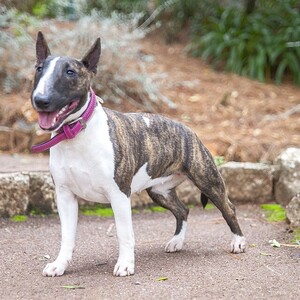
Miniature Bull Terrier. · Darmaninjl / Wikimedia Commons, CC BY-SA 3.0. Cropped and resized.
The Miniature Bull Terrier is the small variety of the Bull Terrier: a muscular terrier with a square body and an egg-shaped head, unique among breeds. It stands no more than 35.5 cm at the withers. The standard describes it as courageous, full of spirit, playful, even-tempered and particularly good with people, although stubborn.
Quick facts
| Common name | Miniature Bull Terrier |
| Scientific name | Canis lupus familiaris |
| Country of origin | United Kingdom |
| Official recognition | FCI, definitively since 5 July 2011 (group 3, bull type terriers; standard no. 359); also recognised by the AKC |
| Lifespan | 11–13 years, according to the AKC |
| Size (males) | no more than 35.5 cm at the withers; no weight limit |
| Size (females) | no more than 35.5 cm at the withers; no weight limit |
| Weight | 8–12.5 kg, according to the AKC |
| Coat type | Short, flat, harsh, glossy |
| Common colours | White; coloured: black brindle, red, fawn, tricolour |
| Energy level | High |
| Suited to an apartment? | Yes, with daily exercise |
| Temperament | Courageous, cheerful, playful, even-tempered, stubborn |
| Tendency to aggression | Low towards people |
| Good with children | Average |
| Good with other animals | Average |
| Genetic predispositions | Lens luxation, subaortic stenosis, mitral valve dysplasia, kidney disease, deafness |
- Primary category:Dog breeds
- Explore this animal's categories:
History and origin
The FCI standard says James Hinks was the first to fix the type of the Bull Terrier in the 1850s, choosing the egg-shaped head. A smaller Bull Terrier has been known since the early 19th century, but it fell out of fashion before the First World War and was removed from the Kennel Club register in 1918.
In 1938, Colonel Richard Glyn and a group of breeders set out to revive the small variety. Wikipedia says the breed descends from the extinct English White Terrier, the Dalmatian and the Bulldog, and that the first documented mention dates from 1872.
How the breed developed
- Early 19th century – A smaller Bull Terrier is known.
- 1850s – James Hinks fixes the type of the Bull Terrier.
- 1918 – The small variety is removed from the Kennel Club register.
- 1938 – Colonel Richard Glyn begins reviving the breed.
- 5 July 2011 – The FCI recognises the breed.
Breed rating
| Feature | Stars |
|---|---|
| Training and intelligence | ★★★☆☆ |
| Easy to train | ★★★☆☆ |
| Intelligence | ★★★★☆ |
| Independence | ★★★★☆ |
| Stubbornness | ★★★★★ |
| Behaviour and temperament | ★★★★☆ |
| Affectionate with family | ★★★★★ |
| Friendly with children | ★★★☆☆ |
| Good with other dogs | ★★★☆☆ |
| Good with cats and other animals | ★★☆☆☆ |
| Loyalty | ★★★★★ |
| Tendency to be aggressive | ★★☆☆☆ |
| Tendency to bark | ★★★★★ |
| Needs and care | ★★★☆☆ |
| Shedding | ★★☆☆☆ |
| Needs frequent grooming | ★☆☆☆☆ |
| Activity and lifestyle | ★★★★☆ |
| Energy level | ★★★★☆ |
| Daily exercise needs | ★★★★☆ |
| Suited to apartment life | ★★★★☆ |
| Health and longevity | ★★★☆☆ |
| Life expectancy | ★★★★☆ |
| Predisposition to genetic diseases | ★★★☆☆ |
| Working abilities and uses | ★★★★☆ |
| Good guard dog | ★★★★☆ |
| Good companion dog | ★★★★☆ |
Indicative rating: 5 stars means the highest level. It is based on the ratings the American Kennel Club gives the breed and on the FCI standard.
Physical characteristics
The AKC says that, with its square body and egg-shaped head, it looks like no other breed. It is a small, muscular, strong, active and fearless terrier. The standard sets no weight limit, but the dog should look solid for its size and always be balanced.
General appearance
The head is long, strong and deep right to the end of the muzzle; seen from the front, it is egg-shaped and well filled, with no hollows. The coat is short, flat, even and harsh to the touch, with a fine gloss; a soft undercoat may appear in winter.
| Feature | Miniature Bull Terrier |
|---|---|
| Size | Small |
| Height at the withers | no more than 35.5 cm |
| Weight | 8–12.5 kg (AKC) |
| Coat | Short, harsh, glossy |
| Head | Egg-shaped |
| Body | Square, muscular |
In white dogs, the coat is pure white; skin pigmentation and markings on the head are not penalised. In coloured dogs, colour predominates, brindle being preferred; black brindle, red, fawn and tricolour are accepted. Blue and liver are highly undesirable.
Training and socialisation
The AKC says that, as a typical terrier, it needs a trainer with a firm hand and a gentle voice, plenty of patience and a good sense of humour. It is very intelligent, curious and independent, but likes to please its person once it understands what you want.
Many owners recommend clicker training. Whatever the method, the tone should stay cheerful. The AKC compares it to the “class clown” or to an adorable toddler full of mischief.
Tips for effective training
- Be firm but gentle. It is stubborn.
- Try clicker training. Many owners recommend it.
- Keep your sense of humour. It is full of mischief.
- Be careful with exercise in puppies. They can suddenly go lame.
Activity needs and lifestyle
The AKC says exercising a Mini Bull can be tricky: puppies need enough activity to keep their muscle tone, but they are prone to “sudden lameness” because of their weight, dense muscles, rapid growth and the fact that they are always on the go.
| Activity | How often | Why it matters |
|---|---|---|
| Walks | daily | Muscle tone |
| Controlled play | daily | High energy |
| Brain games | several times a week | It is very curious |
Tips for a balanced life
- It can also live in an apartment.
- Limit jumping in puppies.
- In winter, its short coat does not protect it from the cold.
Care and health
Coat and skin care
The AKC says it does not need much grooming: regular baths and a weekly brush with a soft brush or a grooming mitt. Its strong nails grow quickly and should be trimmed regularly, and the ears should be checked often.
Common health problems
The AKC says it is generally healthy, but a few problems can occur. Tail chasing can be a sign of a neurological disorder.
| Condition | Description | Common symptoms |
|---|---|---|
| Lens luxation and glaucoma | The lens moves out of place; pressure in the eye rises | Red, painful, cloudy eye |
| Subaortic stenosis | Narrowing where blood leaves the heart | Heart murmur, tires quickly |
| Mitral valve dysplasia | The heart valve forms incorrectly | Coughing, laboured breathing |
| Kidney disease | The kidneys do not work properly | Great thirst, frequent urination |
| Deafness | Loss of hearing, usually from birth | Does not respond to sounds |
| Patellar luxation | The kneecap slips out of place | Suddenly holds a hind leg up for a few steps, then uses it again |
Other care
- Ask for the heart, kidney, hearing and eye tests.
- Check the ears regularly.
- Trim the nails regularly.
Diet and nutrition
The AKC says some Mini Bulls gain weight easily, so calories and weight should be watched.
Tips for a healthy diet
The table gives a starting estimate, calculated with the formula from the Merck Veterinary Manual. The first two calorie columns show the calories per day for a healthy adult dog. The last column shows what this means in dry food with 3,500–4,000 kcal per kilogram.
| Dog's weight | Calories per day (neutered) | Calories per day (not neutered) | Dry food per day (approximate) |
|---|---|---|---|
| 8 kg | 530 kcal | 600 kcal | 130–170 g |
| 10 kg | 630 kcal | 710 kcal | 160–200 g |
| 12.5 kg | 740 kcal | 840 kcal | 180–240 g |
- Give it its food in two meals a day.
- Treats count towards the daily portion.
- A dog is at the right weight when you can feel its ribs without pressing hard.
Foods to avoid
Some human foods are dangerous for dogs: chocolate, coffee, grapes and raisins, onions, garlic, xylitol (a sweetener used in chewing gum), macadamia nuts and alcohol.
Reproduction and development
Physical and emotional maturity
In dogs, sexual maturity usually comes between 6 and 12 months. Small breeds become adults faster than large ones, usually at around one year.
Mating and pregnancy
Pregnancy lasts about 63 days, counted from ovulation. Mating a female on her first heat is not recommended. The FCI standard requires that only healthy dogs of typical breed appearance are used for breeding.
Caring for the puppies
In small breeds, a litter has 3–4 puppies on average. The puppies are very small and fragile in the first weeks, so they must be kept warm and handled with care. Socialisation starts early: gentle handling, everyday noises and new people.
Interesting facts
- An egg-shaped head. Seen from the front, the head is shaped like an egg.
- No weight limit. The standard limits only the height.
- The “class clown”. The AKC compares it to the class clown.
- Saved in 1938. Colonel Richard Glyn revived the breed.
- It barks quite a bit. The AKC gives it top marks for barking.
Frequently asked questions
How does it differ from the Bull Terrier?
It is the small variety, no more than 35.5 cm; otherwise, the two are very similar.
How much does it weigh?
The standard sets no limit; the AKC gives 8–12.5 kg.
Is it easy to train?
It is intelligent but stubborn; the AKC recommends firmness, gentleness and patience.
How long does it live?
The AKC gives 11–13 years.