Cardigan Welsh CorgiCharacteristics, history, training and care
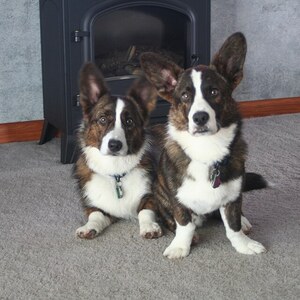
Cardigan Welsh Corgi. · RdRnnr / Wikimedia Commons, CC BY-SA 3.0. Cropped and resized.
The Cardigan Welsh Corgi is a low-set, long herding dog from Wales, one of the oldest breeds in the British Isles. It looks like its relative, the Pembroke Welsh Corgi, but has a long, bushy tail like a fox's. It is alert, affectionate, intelligent and adapts easily.
Quick facts
| Common name | Cardigan Welsh Corgi |
| Scientific name | Canis lupus familiaris |
| Country of origin | United Kingdom (Wales) |
| Official recognition | FCI, definitively since 12 November 1963 (group 1, cattle dogs; standard no. 38); also recognised by the AKC |
| Lifespan | 12–15 years |
| Size (males) | ideally 30 cm at the withers; about 14–17 kg |
| Size (females) | ideally 30 cm at the withers; about 11–15 kg |
| Coat type | Short or medium, harsh, weather-resistant, with a good undercoat |
| Common colours | Blue merle, brindle, red, sable, tricolour; with or without white |
| Energy level | Moderate to high |
| Suited to an apartment? | Yes, with daily walks and without lots of stairs |
| Temperament | Alert, active, intelligent, even-tempered |
| Tendency to aggression | Low |
| Good with children | Good, especially if socialised |
| Good with other animals | Good |
| Genetic predispositions | Hip dysplasia, progressive retinal atrophy, degenerative myelopathy (rare); back problems |
- Primary category:Dog breeds
- Explore this animal's categories:
History and origin
The name “corgi” means “dwarf dog” in Welsh. The Cardigan Welsh Corgi is one of the two corgi breeds from Wales and one of the oldest breeds in the British Isles. It herded poultry, sheep and cattle.
At first, The Kennel Club registered the two types of corgi as a single breed, in 1925. In 1928 they were recognised as different varieties, and from 1934 they were shown separately.
How the breed developed
- December 1925 – The Corgi Club is founded in Carmarthen; The Kennel Club registers corgis as a single breed.
- 1926 – A separate club is founded for the Cardigan.
- 1928 – The Cardigan and the Pembroke are recognised as different varieties.
- 1934 – The two breeds are shown separately.
- 12 November 1963 – The FCI recognises the breed.
- 2006 – The official name becomes Cardigan Welsh Corgi.
Breed rating
| Feature | Stars |
|---|---|
| Training and intelligence | ★★★★☆ |
| Easy to train | ★★★★☆ |
| Intelligence | ★★★★☆ |
| Independence | ★★★☆☆ |
| Stubbornness | ★★★☆☆ |
| Behaviour and temperament | ★★★★☆ |
| Affectionate with family | ★★★★☆ |
| Friendly with children | ★★★★☆ |
| Good with other dogs | ★★★☆☆ |
| Good with cats and other animals | ★★★☆☆ |
| Loyalty | ★★★★★ |
| Tendency to be aggressive | ★☆☆☆☆ |
| Tendency to bark | ★★★★★ |
| Needs and care | ★★★☆☆ |
| Shedding | ★★★☆☆ |
| Needs frequent grooming | ★★☆☆☆ |
| Activity and lifestyle | ★★★★☆ |
| Energy level | ★★★★☆ |
| Daily exercise needs | ★★★★☆ |
| Suited to apartment life | ★★★☆☆ |
| Health and longevity | ★★★★☆ |
| Life expectancy | ★★★★☆ |
| Predisposition to genetic diseases | ★★☆☆☆ |
| Working abilities and uses | ★★★★☆ |
| Good sheepdog | ★★★★☆ |
| Good companion dog | ★★★★★ |
Indicative rating: 5 stars means the highest level. It is based on the ratings the American Kennel Club gives the breed and on the FCI standard.
Physical characteristics
It is a sturdy, tough and mobile dog, long in relation to its height, with short legs and a deep chest. The AKC says it is a powerful worker, surprisingly fast and graceful.
General appearance
The ears are erect and fairly large for the size of the dog. The tail, like a fox's brush, is long and reaches almost to the ground. The eyes have a gentle, alert but watchful expression. In blue merle dogs, one or both eyes may be blue.
| Feature | Cardigan Welsh Corgi |
|---|---|
| Size | Small, with short legs |
| Height at the withers | ideally 30 cm |
| Weight | males: about 14–17 kg; females: about 11–15 kg |
| Coat | Short or medium, harsh, with undercoat |
| Ears | Erect, fairly large |
| Tail | Long, like a fox's brush |
The accepted colours are blue merle, brindle, red, sable, tricolour with brindle points and tricolour with red points, with or without white on the head, neck, chest, belly, legs and tail tip. White should not predominate.
Training and socialisation
It is intelligent and trainable, and the AKC says it is a loyal, alert watchdog with a “big-dog” bark.
Early, ongoing socialisation is very important. The AKC recommends training classes that the whole family attends.
Tips for effective training
- Keep socialising it. New people, places and situations, throughout its life.
- Do not tolerate unwanted behaviour. Correct it calmly, from the start.
- Work on barking. It has a powerful bark and uses it often.
- Try dog sports. It does well at agility, tracking, obedience and, naturally, herding.
Activity needs and lifestyle
The AKC describes it as a very adaptable dog: it happily goes on hikes, but will also settle quietly beside you on the sofa. It needs daily walks around the neighbourhood.
| Activity | How often | Why it matters |
|---|---|---|
| Walks around the neighbourhood | daily | Exercise and socialisation |
| Play and training | daily | Keep its mind active |
| Hikes or dog sports | weekly | Burn off energy |
Tips for a balanced life
- Do not let it jump off the bed or sofa: its long back is vulnerable.
- Lots of stairs can be a risk for its back.
- In summer, black dogs heat up faster in the sun.
Care and health
Coat and skin care
One thorough brushing a week is enough. The AKC says it should not be clipped short in summer: a proper coat helps it regulate its temperature. The hair under the paws can be trimmed so that it brings less dirt into the house.
Common health problems
The AKC says the breed is generally very healthy. Responsible breeders test their dogs for:
| Condition | Description | Common symptoms |
|---|---|---|
| Hip dysplasia | The hip joint forms incorrectly and, over time, arthritis develops | Limping, difficulty getting up or jumping, hip pain |
| Progressive retinal atrophy | The retina gradually degenerates and can lead to blindness | Sees less and less well, especially at night |
| Degenerative myelopathy | A rare disease of the spinal cord, in very old dogs | Gradual weakness of the hind legs |
| Intervertebral disc disease | A disc between the vertebrae ruptures and presses on the spinal cord | Back or neck pain, unsteady walking on the hind legs; in severe cases, paralysis |
Other care
- Trim the nails regularly.
- Brush its teeth regularly.
- At the first sign of back pain, go to the vet.
Diet and nutrition
The AKC says Cardigans put on weight very easily, so their weight must be watched carefully. Weigh it regularly.
Tips for a healthy diet
The table gives a starting estimate, calculated with the formula from the Merck Veterinary Manual. The first two calorie columns show the calories per day for a healthy adult dog. The last column shows what this means in dry food with 3,500–4,000 kcal per kilogram.
| Dog's weight | Calories per day (neutered) | Calories per day (not neutered) | Dry food per day (approximate) |
|---|---|---|---|
| 11 kg | 680 kcal | 760 kcal | 170–220 g |
| 14 kg | 810 kcal | 910 kcal | 200–260 g |
| 17 kg | 940 kcal | 1,050 kcal | 240–300 g |
- Give it two smaller meals a day, not one large one.
- Do not overdo the treats, even if it can hear a cheese wrapper from 50 metres away.
- The dog is at the right weight when you can easily feel its ribs with your fingertips.
Foods to avoid
Some human foods are dangerous for dogs: chocolate, coffee, grapes and raisins, onions, garlic, xylitol (a sweetener used in chewing gum), macadamia nuts and alcohol.
Reproduction and development
Physical and emotional maturity
In dogs, sexual maturity usually comes between 6 and 12 months. Small breeds become adults faster than large ones, usually at around one year.
Mating and pregnancy
Pregnancy lasts about 63 days, counted from ovulation. Mating a female on her first heat is not recommended. The FCI standard requires that only healthy dogs of typical breed appearance are used for breeding.
Caring for the puppies
In small breeds, a litter has 3–4 puppies on average. The puppies are very small and fragile in the first weeks, so they must be kept warm and handled with care. Socialisation starts early: gentle handling, everyday noises and new people.
Interesting facts
- The tail sets it apart. The simplest way to tell a Cardigan from a Pembroke: the Cardigan has a tail.
- “Corgi” means “dwarf dog”. The name comes from the Welsh language.
- It has a big dog's bark. The AKC says that, although it is small, it has the bark of a big dog.
- It does “zoomies” around the house. When it is happy, it suddenly races around the house and over the sofa.
- Blue eyes only in merles. Blue eyes are allowed only in blue merle dogs.
Frequently asked questions
What is the difference between the Cardigan and the Pembroke Welsh Corgi?
The Cardigan has a long tail like a fox's, while the Pembroke has no tail.
How big does it get?
It measures around 30 cm at the withers and weighs about 11–17 kg.
Does it put on weight easily?
Yes, very easily. Its weight must be watched carefully.
Can it live in an apartment?
Yes, if it goes out every day and does not climb lots of stairs.
How long does it live?
Its life expectancy is 12–15 years.