Guinea pigCavia porcellus — domestic cavy
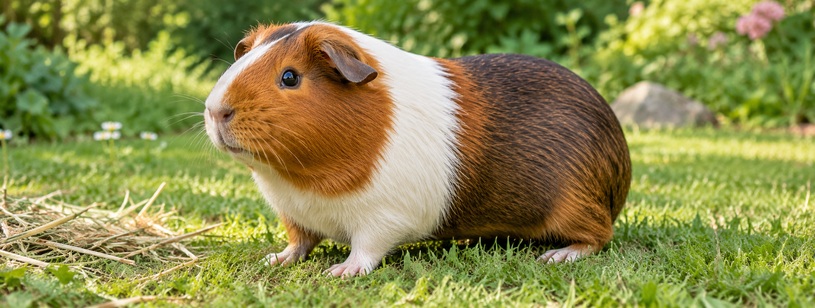
The guinea pig, or domestic cavy (Cavia porcellus), is a domesticated rodent with South American origins. It has a rounded body, short legs and no visible tail. It is a social herbivore whose diet must provide fibre and vitamin C.
Guinea pigs can live alongside people for several years, but need compatible guinea pig companions, room to move and places to hide. Despite their name, they are neither pigs nor native to Guinea.
Quick facts
| Common name | Guinea pig |
| Scientific name | Cavia porcellus |
| Typical lifespan | Frequently 5–8 years; some live longer |
| Length | Around 20–25 cm in many individuals; varies with breed and individual |
| Weight | Approximately 700–1,100 g in the range described by Animal Diversity Web; individuals vary |
| Diet type | Herbivorous: hay, grass and other suitable plant foods |
| Conservation status | Domestic form; Not Evaluated, according to the Mammal Diversity Database |
| Geographical distribution | Kept by people in many countries |
| Habitat | Domesticated animal, kept in housing provided by people. |
| Other names | Domestic cavy; cavy |
| Status | Domesticated animal |
| Origins | South America; a history of domestication in the Andean region |
| Coat | Short, rosetted, long or greatly reduced, depending on variety |
| Social life | Needs compatible guinea pig companions |
| Gestation | 59–72 days |
| Litter size | Often about 3 pups; the number varies |
| Weaning | Around 3 weeks of age |
Interesting facts
- Pups are born well developed: they have fur and open eyes and can move soon after birth.
- They cannot make their own vitamin C: an appropriate diet must supply it.
- Sounds and movements convey information: calls, body posture and reactions to companions help reveal their state.
- Short, twisting jumps are called “popcorning”: they can occur when guinea pigs are active and excited.
- Their teeth grow throughout life: fibrous food and chewing help wear them down normally.
- Breeds are not separate species: long coats, rosettes and different colours all occur within domestic Cavia porcellus.
Records and remarkable features
A documented longevity record
Guinness World Records lists Snowball, a guinea pig from the United Kingdom, as having lived for 14 years and 10½ months. Snowball died in 1979.
This was exceptional, rather than an ordinary lifespan. Veterinary references describe a much shorter life for most guinea pigs, influenced by health and care.
A long relationship with people
Guinea pigs are among the rodents with a long history of domestication in South America. Archaeological and genetic research traces their movement between communities and regions, including to Caribbean islands and later Europe.
Characteristics
What does a guinea pig look like?
The compact body has a blunt muzzle, small folded ears and eyes on the sides of the head. There is no externally visible tail like a mouse's.
Guinea pigs have four toes on each front foot and three on each hind foot. The visible incisors cut food, while teeth farther back grind it. They have 20 teeth in total.
Coats and varieties
| Variety | Typical appearance |
|---|---|
| Variety | Typical appearance |
| American | Short, smooth coat |
| Abyssinian | Coat with rosettes, or small whorls of hair |
| Peruvian | Long coat |
| Hairless or sparsely haired varieties | A different appearance and care needs suited to their coat |
Colours include white, black, cream, brown and reddish shades, with patterned combinations. Not every guinea pig has the same markings. A black-and-white individual and a reddish one can belong to the same domestic species.
Which family do they belong to?
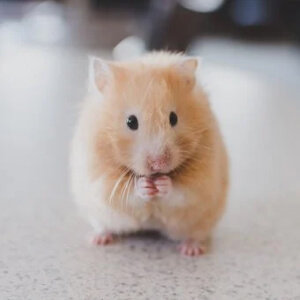
The family Caviidae also includes the capybara. Guinea pigs and hamsters are both rodents, but belong to different families and have different needs.
Habits and behaviour
A social animal
Compatible guinea pig company matters. Human contact does not fully replace relationships with the same species. Introductions should be gradual and take account of sex, temperament and available space.
A rabbit is not a suitable substitute for another guinea pig. The two animals communicate differently and have different dietary needs; keeping them together can also pose injury and infection risks.
How do guinea pigs communicate?
- Squeaks and other calls: occur in interactions with companions and surroundings.
- Jumping and exploration: may accompany activity and excitement.
- Freezing or hiding: can follow a fright.
- Teeth chattering and a tense body: may signal discomfort or conflict.
A sound alone does not tell the whole story. Look at the animal's situation and its response to companions. A frightened guinea pig benefits from an unobstructed route to shelter.
Activity and rest
Feeding and exploration alternate with short periods of rest. Guinea pigs should not be described as sleeping all day and being active exclusively at night.
Habitat and geographical distribution
South American origins
Cavia porcellus is domesticated. Its history is linked to South America and Andean communities. Wild relatives in the genus Cavia are distinct animals with their own distributions.
Domestic guinea pigs are now kept in many countries. Human-assisted distribution does not make them native wild animals on every continent.
What should their home provide?
- Floor space for movement and exploration.
- Enough hiding places for animals to retreat without blocking one another.
- A dry, comfortable surface that is cleaned regularly.
- Protection from predators and extreme temperatures, with suitable shade and ventilation.
A garden enclosure must be secure. Being able to graze does not make an unprotected open garden a safe place to roam freely.
Diet and feeding
What do guinea pigs eat?
Good-quality hay forms the basis of the diet and should be available at all times. Suitable grass and other safe plants add variety. Chewing fibrous food supports digestion and normal tooth wear.
| Component | Role in the diet |
|---|---|
| Component | Role in the diet |
| Hay and suitable grass | Fibre and opportunities to chew throughout the day |
| Safe, washed leafy greens | Variety in the menu |
| Guinea pig pellets | A fresh portion following product guidance; can provide vitamin C |
| Fresh water | Always available in a clean container |
Why is vitamin C important?
Guinea pigs cannot make their own vitamin C and must obtain it from food. A deficiency can cause serious problems. Old or improperly stored pellets can lose vitamin C.
Rabbit food is not automatically a substitute for guinea pig food. Their requirements differ. Bread, sweets and table scraps are not a sound basis for an improvised diet.
How is food processed?
Incisors cut plant material and back teeth grind it. Intestinal microorganisms also help process plant food. Do not feed clippings collected by a lawnmower, as these can cause digestive problems.
Reproduction and life cycle
Pregnancy and birth
Gestation lasts approximately 59–72 days. Litters often contain around three pups, but size varies. Breeding is not necessary for a good life, and pregnancy and birth carry risks for females.
Guinea pigs can become fertile while young. Correct sex identification and group management are therefore important for preventing unplanned breeding.
How do pups develop?
Pups are born furred, with open eyes, and can move from the start. They are described as precocial, meaning relatively well developed at birth. They may try solid food early, but still nurse from their mother.
Weaning occurs at around three weeks. Growth continues afterwards, with suitable food and a safe environment remaining important.
How long do guinea pigs live?
The MSD Veterinary Manual gives a typical span of 5–8 years. Other guides use somewhat different ranges. Genetics, health and care affect longevity; Snowball's record is not a normal expectation.
Names and history
| Classification level | Name |
|---|---|
| Class | Mammalia — mammals |
| Order | Rodentia — rodents |
| Family | Caviidae |
Guinea pig or cavy?
Both names refer to the domestic animal. The accepted scientific name is Cavia porcellus, in the family Caviidae and order Rodentia.
Despite its English name, its origins are South American. The full historical explanation for “guinea pig” is uncertain, so a single naming story should not be treated as established fact.
From the Andes to wider distribution
People raised guinea pigs in South America long before they reached Europe. Ancient DNA studies reveal a complex history of domestication and transport between regions.
They have served as food animals in some communities, companions and research animals. The expression “guinea pig” is also used figuratively for a subject in an experiment.
Cultural significance
A role in Andean culture
In the Andean region, the animal is also known as cuy. It has had a dietary and economic role in certain communities. Smithsonian educational material discusses guinea pigs among food resources in the Inka world.
Archaeological research also describes ritual contexts. These practices belong to particular periods and communities, rather than all South Americans.
Conservation and threats
A domestic animal with a distinct status
The Mammal Diversity Database identifies it as domesticated and lists its IUCN status as Not Evaluated. The absence of a natural population of this domestic form does not mean it is a wild species that has become extinct in the wild.
Health and welfare risks
- An unsuitable diet can contribute to dental and digestive problems or vitamin C deficiency.
- Isolation and a lack of hiding places can affect behaviour and comfort.
- Excessive heat, dampness and insecure housing can put animals at risk.
- Unplanned breeding can result in risky pregnancies and animals without adequate care.
A guinea pig that stops eating, loses weight or behaves unusually needs veterinary assessment. Loss of appetite should not be dismissed as fussiness.
In popular culture
Guinea pigs on screen
Disney's G-Force (2009) features guinea pigs in a spy adventure. It is fiction, with talking animals using high-tech equipment.
Real guinea pig behaviour is interesting without these fantasy abilities: the animals respond to environmental cues, interact with companions and express their state through behaviour.
Frequently asked questions
What is a guinea pig?
A domestic rodent of the species Cavia porcellus, also called a cavy, with South American origins.
What do guinea pigs eat?
Good-quality hay forms the basis of the diet, complemented by suitable grass, safe greens, appropriate pellets and fresh water.
How long does a guinea pig live?
Frequently about 5–8 years, with individual variation and occasional exceptional longevity.
Can a guinea pig live alone?
It is a social animal and needs compatible guinea pig company. Human contact does not fully replace this need.
Why do guinea pigs need vitamin C?
They cannot make their own vitamin C and must receive it through an appropriate diet.
Is a guinea pig a hamster?
No. Both are rodents, but they belong to different families and have different needs.
What are newborn guinea pigs like?
They are furred, have open eyes and can move and try solid food early, while still nursing.
Do guinea pigs have tails?
They have no externally visible tail. Their bodies are compact and their legs are short.
Did you know? About guinea pigs
- Guinea pigs are rodents, not pigs.
- Pups are born furred and with open eyes.
- They have four toes on each front foot and three on each hind foot.
- They are social and communicate through sounds and movement.