KoiCyprinus rubrofuscus — habitat, diet and reproduction
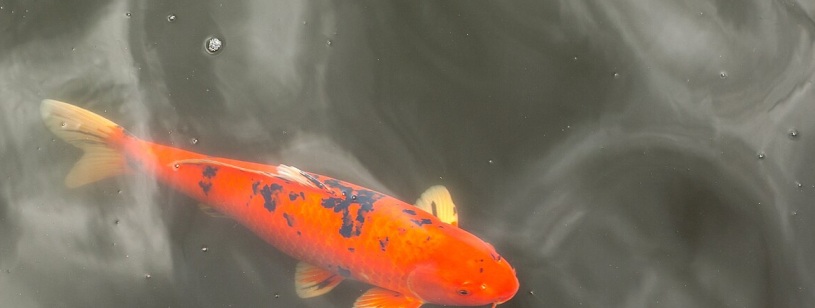
Orange koi with black spots swimming. · Richard Stovall / CC BY 4.0 (https://creativecommons.org/licenses/by/4.0). Cropped and resized.
The koi is an ornamental form of carp bred for its colours: red, orange, white, black, yellow or blue. Selective breeding began in Japan in the nineteenth century from carp raised for food. Today koi live in decorative ponds worldwide, including gardens in Romania.
Quick facts
| Common name | Koi |
| Scientific name | Cyprinus rubrofuscus (koi form) |
| Lifespan | About 25–35 years with good care |
| Length | Usually 40–70 cm; some exceed 90 cm |
| Diet | Omnivore: plants, algae, insects, larvae, prepared food |
| Predators | Herons, cormorants, otters, cats, raccoons |
| Conservation status | Domestic form, not assessed |
| Distribution | Originally East Asia; kept in ponds worldwide |
| Habitat | Ornamental ponds, artificial lakes |
| Family | Cyprinidae |
| Reproduction | Eggs stuck to plants in spring |
- Primary category:Fish
- Explore this animal's categories:
Interesting facts
- The Japanese word “koi” simply means “carp”.
- A Japanese koi named Hanako reportedly lived 226 years, but her age was never scientifically confirmed.
- The most prized koi have sold at auction for over a million dollars.
- Koi can learn to come to a person’s hand for food.
Characteristics
Koi have an elongated body with two pairs of short barbels at the mouth, like the common carp. The main difference is colour, obtained by selection over many generations.
Japanese breeders recognise dozens of varieties. Kohaku is white with red patches, Sanke has white, red and black, and Showa is black with red and white. Some varieties have metallic scales or only a few large scales.
Behaviour
Koi are calm, social fish that do well in groups. They are active by day and easily get used to people who feed them.
As water cools in autumn they slow down and eat little. In winter they rest on the pond bottom, where water stays slightly warmer, hardly feeding.
Habitat and distribution
The wild ancestors of koi live in the fresh waters of East Asia. The first coloured koi were produced in Niigata Prefecture, Japan, by farmers raising carp in ponds between rice fields.
After a 1914 exhibition in Tokyo, koi became famous throughout Japan and then the world.
Diet and feeding
Koi are omnivores, eating algae, plants, insect larvae, worms and snails. Owners feed them floating pellets.
Food amounts depend on water temperature. In cold weather digestion slows, so they get little or no food.
Reproduction and life cycle
Koi breed in spring as water warms. The female lays thousands of sticky eggs on plants and roots, and males fertilise them.
Most hatchlings lack their parents’ colours. Breeders keep only a few young with good patterns, because an outstanding koi is rare.
Name and history
“Koi” means “carp” in Japanese, and the same sound can also mean “love”, so koi are linked with luck and friendship.
An Asian legend tells of a carp that climbs a waterfall and turns into a dragon, so koi symbolise perseverance.
Conservation and threats
The koi is a domestic form and has no conservation status. Its wild Asian ancestor is affected by pollution and mixing with farmed fish.
Released into natural waters, koi can muddy the water, destroy plants and spread disease, so they should be kept only in enclosed ponds.
Frequently asked questions
How long do koi live?
Usually 25–35 years with a suitable pond and food; some live longer.
How big do koi get?
Usually 40–70 cm, and some exceed 90 cm.
What do koi eat?
Floating pellets, plants, algae, larvae and worms.
Can koi stay outdoors in winter?
Yes, if the pond is deep enough not to freeze to the bottom.