Irish Water SpanielCharacteristics, history, training and care
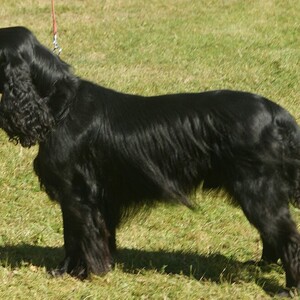
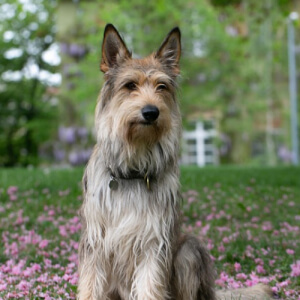
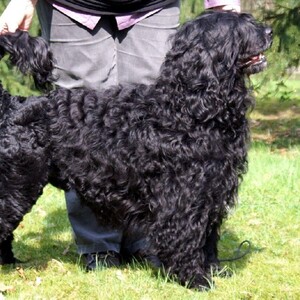
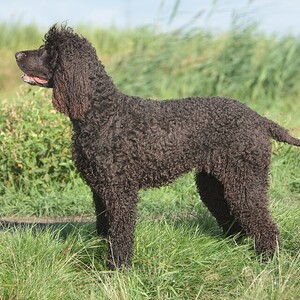
Irish Water Spaniel. · Roete002 / Wikimedia Commons, CC BY 4.0. Cropped and resized.
The Irish Water Spaniel is the tallest of the spaniels, easy to recognise by its coat of small, tight curls and its thin tail, known as the “rat tail”. It is an excellent swimmer, a hard-working and brave hunter and a playful, affectionate dog at home. Wikipedia says it is also called the “clown” of the spaniel family.
Quick facts
| Common name | Irish Water Spaniel |
| Scientific name | Canis lupus familiaris |
| Country of origin | Ireland |
| Official recognition | FCI, definitively since 28 December 1954 (group 8, water dogs, with working trial; standard no. 124); also recognised by the AKC |
| Lifespan | 12–13 years, according to the AKC |
| Size (males) | 53–59 cm at the withers; about 25–31 kg (AKC) |
| Size (females) | 51–56 cm at the withers; about 20–26 kg (AKC) |
| Coat type | Dense, tight, crisp curls with natural oils; no woolly undercoat |
| Common colours | Dark liver with a purplish tint (“puce”) |
| Energy level | High |
| Suited to an apartment? | Can adapt, with plenty of exercise |
| Temperament | Playful, clever, eager to please, brave |
| Tendency to aggression | Low |
| Good with children | Average |
| Good with other animals | Average |
| Genetic predispositions | Hip and elbow dysplasia, seizures, allergies, thyroid disease; sensitivity to sulfonamides and ivermectin |
History and origin
The FCI standard says the exact origin of the breed is unclear. Water spaniels are thought to descend from dogs from Persia that reached Ireland via Spain. The first Irish mention of “water dogs that follow waterfowl” dates from 1600, so dogs with a waterproof coat were used in Ireland even before the gun appeared.
The only clue to its ancestors is its strangest feature: the rat tail, which no similar dog has and which suggests a native Irish ancestor. The breed was very successful at shows in the second half of the 19th century, and its club was founded in 1890.
How the breed developed
- 1600 – The first Irish mention of water dogs.
- Second half of the 19th century – The breed is very successful at shows.
- 1890 – The Irish Water Spaniel Club is founded.
- 28 December 1954 – The FCI recognises the breed.
- 13 March 2001 – The current FCI standard is published.
Breed rating
| Feature | Stars |
|---|---|
| Training and intelligence | ★★★★★ |
| Easy to train | ★★★★★ |
| Intelligence | ★★★★★ |
| Independence | ★★★☆☆ |
| Stubbornness | ★★★☆☆ |
| Behaviour and temperament | ★★★★☆ |
| Affectionate with family | ★★★★★ |
| Friendly with children | ★★★☆☆ |
| Good with other dogs | ★★★☆☆ |
| Good with cats and other animals | ★★★☆☆ |
| Loyalty | ★★★★★ |
| Tendency to be aggressive | ★☆☆☆☆ |
| Tendency to bark | ★☆☆☆☆ |
| Needs and care | ★★★★☆ |
| Shedding | ★☆☆☆☆ |
| Needs frequent grooming | ★★★☆☆ |
| Activity and lifestyle | ★★★★☆ |
| Energy level | ★★★☆☆ |
| Daily exercise needs | ★★★★☆ |
| Suited to apartment life | ★★★☆☆ |
| Health and longevity | ★★★★☆ |
| Life expectancy | ★★★★☆ |
| Predisposition to genetic diseases | ★★★☆☆ |
| Working abilities and uses | ★★★★☆ |
| Good water hunting dog | ★★★★★ |
| Good companion dog | ★★★★☆ |
Indicative rating: 5 stars means the highest level. It is based on the ratings the American Kennel Club gives the breed and on the FCI standard.
Physical characteristics
The standard describes it as elegant, tall, strong and compact. The AKC says it is the tallest spaniel and one of the best swimmers among dogs. Wikipedia says it has webbed feet.
General appearance
The coat is made of dense, tight curls with a natural oiliness, without being woolly. The neck is curled, but the throat is smooth, with a V-shaped patch of short hair. The tail, thick at the root, is covered with short curls only at the start, then becomes smooth and thin, like a “rat tail”.
| Feature | Irish Water Spaniel |
|---|---|
| Size | Large |
| Height at the withers | males: 53–59 cm; females: 51–56 cm |
| Weight | about 20–31 kg |
| Coat | Dense, tight curls |
| Tail | Thin, “rat tail” |
| Feet | Webbed |
The colour is a rich, dark liver with a purplish tint specific to the breed, sometimes called “puce-liver”.
Training and socialisation
The AKC says it is playful, clever and eager to please, has plenty of energy and likes having a job to do. It is a reliable worker that tries to do what is asked of it, as long as it understands.
Sessions must be fun and interesting so that it does not get bored. It responds best to positive, reward-based training. Wikipedia says that, being curious, it often finds surprising ways to solve a task.
Tips for effective training
- Make training fun. It gets bored quickly.
- Let it swim. It is an excellent swimmer.
- Tell your vet. The AKC says it can react to sulfonamides and ivermectin.
- Start coat care in puppyhood. So that it accepts it easily for life.
Activity needs and lifestyle
The AKC says it is an active, high-energy companion that needs plenty of exercise every day: long walks or hikes, running beside a bicycle, fetching a ball or playing with other dogs.
| Activity | How often | Why it matters |
|---|---|---|
| Long walks or hikes | daily | High energy |
| Swimming and retrieving from water | weekly | It loves water |
| Play with other dogs | several times a week | It is playful |
Tips for a balanced life
- It suits an active family.
- Check the ears after swimming.
- The AKC says the coat is suitable for people with allergies.
Care and health
Coat and skin care
The AKC says the coat, which also suits people with allergies, should be brushed at least weekly and trimmed every few months. Grooming should start in puppyhood so that it becomes a pleasant experience.
Common health problems
The AKC says most dogs are healthy, but the following can occur:
| Condition | Description | Common symptoms |
|---|---|---|
| Hip dysplasia | The hip joint forms incorrectly and, over time, arthritis develops | Limping, difficulty getting up or jumping, hip pain |
| Elbow dysplasia | The elbow joint develops incorrectly and arthritis appears | Limping on the front legs, especially after exercise |
| Seizures | Repeated neurological seizures | Trembling, convulsions |
| Thyroid disease and allergies | Hormonal and skin problems | Itching, weight gain, dull coat |
Other care
- Tell your vet about its sensitivity to sulfonamides and ivermectin.
- Check the ears after swimming.
- Trim the nails regularly.
Diet and nutrition
The AKC says some dogs gain weight easily, so calories and weight should be watched.
Tips for a healthy diet
The table gives a starting estimate, calculated with the formula from the Merck Veterinary Manual. The first two calorie columns show the calories per day for a healthy adult dog. The last column shows what this means in dry food with 3,500–4,000 kcal per kilogram.
| Dog's weight | Calories per day (neutered) | Calories per day (not neutered) | Dry food per day (approximate) |
|---|---|---|---|
| 20 kg | 1,060 kcal | 1,190 kcal | 260–340 g |
| 26 kg | 1,290 kcal | 1,450 kcal | 320–410 g |
| 31 kg | 1,470 kcal | 1,660 kcal | 370–470 g |
- Split the food into two meals a day.
- Training treats count towards the daily portion.
- A dog is at the right weight when you can feel its ribs under the coat without pressing hard.
Foods to avoid
Some human foods are dangerous for dogs: chocolate, coffee, grapes and raisins, onions, garlic, xylitol (a sweetener used in chewing gum), macadamia nuts and alcohol.
Reproduction and development
Physical and emotional maturity
In dogs, sexual maturity usually comes between 6 and 12 months, but in large breeds it can be delayed until about two years. The body also reaches its adult form later than in small breeds.
Mating and pregnancy
Pregnancy lasts about 63 days, counted from ovulation. Mating a female on her first heat is not recommended. The FCI standard requires that only healthy dogs of typical breed appearance are used for breeding.
Caring for the puppies
In large breeds, a litter has around 7 puppies on average. Socialisation starts in the first weeks: gentle handling, everyday noises and new people.
Interesting facts
- Rat tail. The thin, smooth tail earns it the nicknames “Rat Tail” and “Whip Tail”.
- The tallest spaniel. The AKC and Wikipedia call it the tallest of the spaniels.
- The “clown” of the spaniels. Wikipedia says it is called this because of its curious nature.
- Webbed feet. They help it swim.
- A bog dog. It is also called the “bog-dog”.
Frequently asked questions
Why does it have a “rat tail”?
The tail is thick at the root, with short curls, then becomes smooth and thin.
How big does it get?
Males measure 53–59 cm and females 51–56 cm at the withers.
Does it shed?
Very little; the AKC gives it the lowest score for shedding.
How long does it live?
The AKC gives 12–13 years.