Ibizan HoundCharacteristics, history, training and care
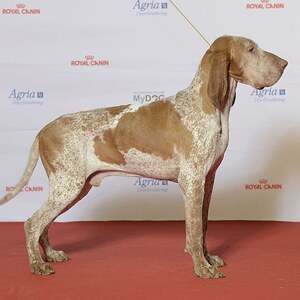
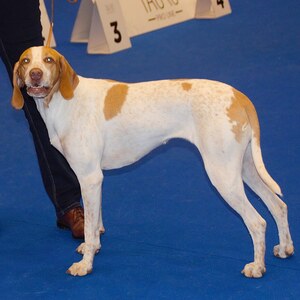
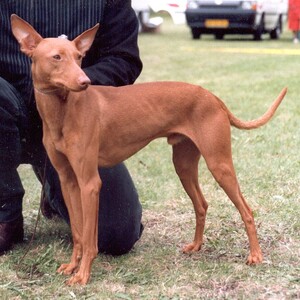
Ibizan Hound. · Jan Eduard, Pleple2000 / Wikimedia Commons, CC BY-SA 3.0. Cropped and resized.
The Ibizan Hound (Podenco Ibicenco) is a primitive, slender and elegant dog from the Balearic Islands, with large, erect ears and amber eyes. The FCI standard says depictions of these dogs appear in the tombs of the pharaohs, proving that the type existed as early as around 3400 BC. It is even-tempered, affectionate, loyal and very athletic.
Quick facts
| Common name | Ibizan Hound (Podenco Ibicenco, Ca Eivissenc) |
| Scientific name | Canis lupus familiaris |
| Country of origin | Spain (Balearic Islands) |
| Official recognition | FCI, definitively since 10 November 1954 (group 5, primitive hunting types; standard no. 89); also recognised by the AKC |
| Lifespan | 11–14 years, according to the AKC |
| Size (males) | 66–72 cm at the withers; about 23 kg (AKC) |
| Size (females) | 60–67 cm at the withers; about 20 kg (AKC) |
| Coat type | Smooth, rough or long |
| Common colours | White and red, white or red |
| Energy level | Very high |
| Suited to an apartment? | Can adapt, with a great deal of exercise |
| Temperament | Even-tempered, affectionate, loyal, a little reserved |
| Tendency to aggression | Low |
| Good with children | Average |
| Good with other animals | Very good with dogs; strong hunting instinct |
| Genetic predispositions | Hip dysplasia, eye diseases, autoimmune thyroiditis, congenital deafness |
- Primary category:Dog breeds
- Explore this animal's categories:
History and origin
The FCI standard says the breed comes from the Balearic Islands (Mallorca, Ibiza, Menorca and Formentera), where it is called the “Ca Eivissenc”. It is also widespread in Catalonia, the Valencia area, Roussillon and Provence. It was probably brought to the islands by the Phoenicians, the Carthaginians and, finally, the Romans.
It is a typical, primitive and robust representative of one of the oldest breeds still in existence. Depictions of these dogs appear in the tombs of the pharaohs and on objects in museums, so the type's existence can be traced back to 3400 BC.
How the breed developed
- Around 3400 BC – Dogs of this type appear in the tombs of the pharaohs.
- Antiquity – The Phoenicians, Carthaginians and Romans bring them to the Balearic Islands.
- 10 November 1954 – The FCI recognises the breed.
- 26 May 1982 – The current FCI standard is published.
Breed rating
| Feature | Stars |
|---|---|
| Training and intelligence | ★★★☆☆ |
| Easy to train | ★★★☆☆ |
| Intelligence | ★★★★☆ |
| Independence | ★★★★☆ |
| Stubbornness | ★★★☆☆ |
| Behaviour and temperament | ★★★★☆ |
| Affectionate with family | ★★★★★ |
| Friendly with children | ★★★☆☆ |
| Good with other dogs | ★★★★★ |
| Good with cats and other animals | ★☆☆☆☆ |
| Loyalty | ★★★★★ |
| Tendency to be aggressive | ★☆☆☆☆ |
| Tendency to bark | ★★★☆☆ |
| Needs and care | ★★★★☆ |
| Shedding | ★★☆☆☆ |
| Needs frequent grooming | ★☆☆☆☆ |
| Activity and lifestyle | ★★★★☆ |
| Energy level | ★★★★★ |
| Daily exercise needs | ★★★★★ |
| Suited to apartment life | ★★★☆☆ |
| Health and longevity | ★★★★☆ |
| Life expectancy | ★★★★☆ |
| Predisposition to genetic diseases | ★★★☆☆ |
| Working abilities and uses | ★★★★☆ |
| Good hunting dog | ★★★★★ |
| Good companion dog | ★★★★☆ |
Indicative rating: 5 stars means the highest level. It is based on the ratings the American Kennel Club gives the breed and on the FCI standard.
Physical characteristics
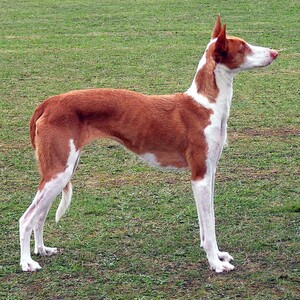
Wikipedia describes it as elegant and agile, with an athletic outline and an elastic trot, but with good bone and great stamina. Seen as a whole, the long, fine head resembles a cone cut off close to its base.
General appearance
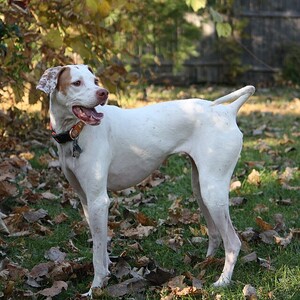
The large, erect ears, broad at the base, are the breed's hallmark. The AKC says the nose, ears, eye rims and pads are a pinkish brown colour, and the amber eyes have an alert, intelligent expression.
| Feature | Ibizan Hound |
|---|---|
| Size | Large |
| Height at the withers | males: 66–72 cm; females: 60–67 cm |
| Weight | about 20–23 kg |
| Coat | Smooth, rough or long |
| Ears | Large, erect |
| Eyes | Amber |
The standard prefers white and red, solid white or solid red. Fawn is allowed only in exceptional dogs and not in smooth-coated ones.
Training and socialisation
The AKC says it is versatile and easy to train, an excellent family dog: even-tempered, affectionate and loyal, a little reserved, but gentle and attached to its family. It is wary of strangers, but friendly and outgoing.
Early socialisation and puppy classes are recommended. Like all primitive hunters, it has a strong chasing instinct.
Tips for effective training
- The fence must be high. The AKC says it can jump 1.5–1.8 m from a standstill.
- Socialise it as a puppy. It is wary of strangers.
- Be careful around small animals. It has a strong hunting instinct.
- Keep training varied. It needs mental activity.
Activity needs and lifestyle
The AKC says it is very athletic and needs plenty of exercise: energetic play sessions every day, with its owner or with other dogs, or long walks several times a day.
| Activity | How often | Why it matters |
|---|---|---|
| Long walks | several times a day | Very high energy |
| Energetic play with other dogs | daily | It loves the company of dogs |
| Lure coursing | occasionally | Chasing instinct |
Tips for a balanced life
- The fence must be very high.
- In winter it may need a coat.
- Keep it on the lead near roads.
Care and health
Coat and skin care
The AKC says there is a smooth-coated and a wire-coated variety, both easy to groom. The large, erect ears should be checked weekly, and the teeth brushed often, ideally every day.
Common health problems
The AKC says the breed is generally healthy, but the following may occur:
| Condition | Description | Common symptoms |
|---|---|---|
| Hip dysplasia | The hip joint forms incorrectly and, over time, arthritis develops | Limping, difficulty getting up or jumping, hip pain |
| Eye diseases | Inherited eye conditions | Poor vision, cloudy eyes |
| Autoimmune thyroiditis | The body attacks the thyroid gland | Weight gain, tiredness, dull coat |
| Congenital deafness | Hereditary deafness | Does not react to sounds |
Other care
- Check the ears weekly.
- Brush its teeth often.
- Trim the nails regularly.
Diet and nutrition
The AKC recommends good-quality food suited to the dog's age. The Ibizan Hound should stay lean.
Tips for a healthy diet
The table gives a starting estimate, calculated with the formula from the Merck Veterinary Manual. The first two calorie columns show the calories per day for a healthy adult dog. The last column shows what this means in dry food with 3,500–4,000 kcal per kilogram.
| Dog's weight | Calories per day (neutered) | Calories per day (not neutered) | Dry food per day (approximate) |
|---|---|---|---|
| 20 kg | 1,060 kcal | 1,190 kcal | 260–340 g |
| 22 kg | 1,140 kcal | 1,280 kcal | 280–370 g |
| 23 kg | 1,180 kcal | 1,320 kcal | 300–380 g |
- Split the food into two meals a day to reduce the risk of bloat.
- Do not let it run right after a meal.
- In lean dogs, the ribs are easy to feel at the right weight.
Foods to avoid
Some human foods are dangerous for dogs: chocolate, coffee, grapes and raisins, onions, garlic, xylitol (a sweetener used in chewing gum), macadamia nuts and alcohol.
Reproduction and development
Physical and emotional maturity
In dogs, sexual maturity usually comes between 6 and 12 months, but in large breeds it can be delayed until about two years. The body also reaches its adult form later than in small breeds.
Mating and pregnancy
Pregnancy lasts about 63 days, counted from ovulation. Mating a female on her first heat is not recommended. The FCI standard requires that only healthy dogs of typical breed appearance are used for breeding.
Caring for the puppies
In large breeds, a litter has around 7 puppies on average. Socialisation starts in the first weeks: gentle handling, everyday noises and new people.
Interesting facts
- A champion jumper. The AKC says it jumps 1.5–1.8 m from a standstill.
- The pharaohs' dog. Similar depictions appear in Egyptian tombs.
- A pink nose. The nose, ears and pads are a pinkish brown colour.
- “Beezer”. American owners affectionately call it a “Beezer”.
- Three coat types. The FCI accepts smooth, rough and long hair.
In popular culture
The dog in the pharaohs' tombs
The FCI standard says depictions of these dogs are found in the tombs of the pharaohs and on objects in museums, which proves the type existed as early as 3400 BC. The AKC says art history students will recognise the elongated head with large, erect ears as a familiar motif from ancient Egypt.
Frequently asked questions
Where does the Ibizan Hound come from?
From the Balearic Islands, especially Ibiza.
How big does it get?
Males measure 66–72 cm and females 60–67 cm at the withers.
How high can it jump?
The AKC says it can jump 1.5–1.8 m from a standstill.
How long does it live?
The AKC gives 11–14 years.