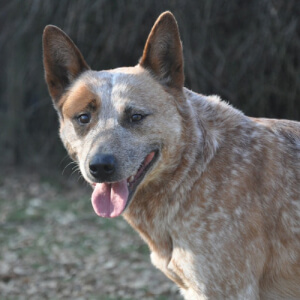
Australian Cattle DogCharacteristics, history, training and care
The Australian Cattle Dog, also called the Blue Heeler or Queensland Heeler, is an Australian herding dog. It is known for intelligence, stamina and a strong drive to work, and needs appropriate exercise and mental activity.
Quick facts
| Common name | Australian Cattle Dog |
| Scientific name | Canis lupus familiaris |
| Country of origin | Australia |
| Official Recognition | Recognized by FCI, AKC, UKC |
| Typical lifespan | About 12-16 years |
| Dimensions (Male) | About 46-51 cm / 15-22 kg |
| Dimensions (Female) | About 43-48 cm / 14-20 kg |
| Coat type | Short, dense, weather-resistant double coat |
| Common colours | Blue or blue speckled (with or without tan markings), red speckled |
| Energy Level | Very high |
| Suitable for apartment? | Depends on exercise, training, health and the individual dog |
| Temperament | Intelligent, protective, energetic |
| Behaviour towards unfamiliar people and dogs | Often reserved with strangers; socialisation, training and management matter |
| Compatibility with children | Depends on the individual; adult supervision and suitable handling are essential |
| Compatibility with other animals | Depends on socialisation, herding drive and the animals involved |
| Genetic predispositions | Congenital deafness, hip dysplasia, progressive retinal atrophy, primary lens luxation |
- Primary category:Dog breeds
- Explore this animal's categories:
History and Origin
The Australian Cattle Dog was developed in the 19th century in Australia to help drovers move cattle over long distances in a hot, harsh climate.
The evolution of the breed
- Collies and dingoes – In the 1840s, the New South Wales cattleman Thomas Hall crossed blue merle drovers' dogs from Britain with dingoes, creating hardy, quiet working dogs known as "Hall's Heelers".
- Later influences – According to tradition, breeders later added some Dalmatian and black-and-tan Kelpie blood, although the details are debated.
- A breed standard – The first breed standard was written by Robert Kaleski in 1903. Today the breed is recognised by the FCI, the AKC and other kennel clubs and is valued as a working dog around the world.
Breed Evaluation
The Australian Cattle Dog is a highly intelligent and active dog, suitable for energetic owners and farmers. These editorial ratings offer a general guide. Individual dogs vary with training, environment and health.
| Characteristic | Stars |
|---|---|
| Training and Intelligence | ★★★★★ |
| Easy to train | ★★★★☆ |
| Intelligence | ★★★★★ |
| Level of independence | ★★★★☆ |
| Level of stubbornness | ★★★☆☆ |
| Behavior and Temperament | ★★★★☆ |
| Affectionate with family | ★★★★★ |
| Friendly with children | ★★★☆☆ |
| Compatible with other dogs | ★★★☆☆ |
| Compatible with cats and other animals | ★★★☆☆ |
| Degree of loyalty | ★★★★★ |
| Tendency to be aggressive | ★★☆☆☆ |
| Tendency to bark | ★★★☆☆ |
| Needs and Care | ★★☆☆☆ |
| Shedding level | ★★★☆☆ |
| Requires frequent care | ★★☆☆☆ |
| Activity and Lifestyle | ★★★★★ |
| Energy level | ★★★★★ |
| Daily exercise requirement | ★★★★★ |
| Suitable for apartment living | ★☆☆☆☆ |
| Health and Longevity | ★★★★☆ |
| Life expectancy | ★★★★★ |
| Predisposition to genetic diseases | ★★★☆☆ |
| Work and Utility Features | ★★★★★ |
| Good guard dog | ★★★★☆ |
| Good companion dog | ★★★★☆ |
Physical Characteristics
The Australian Cattle Dog is a medium-sized, compact, muscular and very agile dog, built for stamina and quick movement.
General appearance
- A sturdy, compact body, slightly longer than tall, with strong bones and muscles.
- A short, dense double coat that protects it from rain, heat and cold.
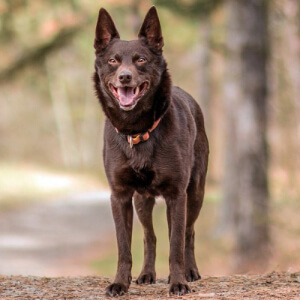
- A broad head with medium-sized, pricked ears, always alert.
- A long tail with a slight curve, usually carried low when relaxed.
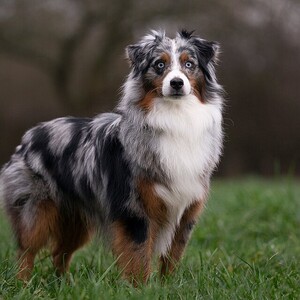
- Speckled or mottled coat – Dogs are either blue (blue, blue mottled or blue speckled) or red speckled; puppies are born white and develop their colour later.
| Characteristic | Australian Cattle Dog |
|---|---|
| Size | Medium (about 43-51 cm at the shoulder) |
| Weight | About 15-22 kg |
| Coat | Short, dense, weather-resistant |
| Muzzle | Medium length, strong |
| Shedding tendency | Moderate, heavier once or twice a year |
| Build | Athletic, compact |
The Australian Cattle Dog is an excellent companion for those looking for an active, intelligent and hardy dog.
Training and Socialization
The Australian Cattle Dog is one of the most intelligent breeds, but needs consistent training because it is independent and very energetic. It learns quickly but gets bored easily without enough stimulation.
Tips for effective training
- Start training early – Socialisation and training should start from about 8 weeks.
- Use positive methods – This breed responds best to rewards and praise, combined with clear, consistent rules.
- Give it challenges – Simple commands are not enough; it enjoys tricks, problem-solving and jobs to do.
- Avoid repetitive training – The Australian Cattle Dog gets bored quickly, so training should be short, varied and engaging.
- Wide socialisation – Without good socialisation, it may become suspicious of strangers or nip at people's heels as part of its herding instinct.
With proper training, this dog becomes an obedient and very useful companion, both as a pet and as a farm helper.
Activity and Lifestyle Needs
The Australian Cattle Dog is an extremely active breed that needs lots of exercise and mental stimulation. A bored dog may become destructive or try to "herd" children, other animals or even cyclists.
| Activity | Recommended duration |
|---|---|
| Daily walks and runs | At least 60-90 min |
| Interactive games | About 30-45 min |
| Obedience and agility training | About 15-30 min |
| Work activities (herding, scent work, retrieving) | Regularly |
Recommendations for a balanced lifestyle
- Not ideal for apartments – It needs space and a lot of activity.
- Ideal for active owners – Suitable for those who run, hike or do dog sports.
- Can become destructive – Without enough activity, it may chew furniture, dig holes or bark excessively.
- Great at dog sports – It does well in agility, frisbee, obedience, flyball and herding trials.
This breed is not for people with a quiet lifestyle, but for those who want an active, involved partner.
Care and Health
The Australian Cattle Dog is a hardy breed, but owners should know about some inherited conditions.
Fur and skin care
- Weekly brushing – The double coat needs brushing about once a week, and more often during shedding, to remove dead hair.
- Baths only when necessary – The coat sheds dirt and water well, so it does not need frequent baths.
- Checking ears and claws – Ears should be checked regularly and claws trimmed if they don't wear down naturally.
Common health problems
| Condition | Description | Common Symptoms |
|---|---|---|
| Congenital deafness | Occurs in one or both ears; puppies can be tested (BAER test) | No reaction to sounds |
| Hip and elbow dysplasia | Abnormal development of the joints | Lameness, joint pain |
| Progressive retinal atrophy | An inherited disease that slowly destroys the retina; a DNA test is available | Night blindness, vision loss |
| Primary lens luxation | An inherited condition in which the lens of the eye moves out of place | Red, painful or cloudy eye |
Other aspects of care
- Weight control – Portions should match its activity to avoid weight gain.
- Joint care – Because it is very active, it should be watched for signs of stiffness or injury.
- Regular checks at the vet – Yearly check-ups help find health problems early.
This is generally a healthy breed but prone to a few inherited problems, so puppies should come from responsible breeders who health-test their dogs.
Diet and Nutrition
The Australian Cattle Dog needs a balanced diet with enough protein and energy to support its high daily activity.
Recommendations for a healthy diet
✔ Quality protein – For example, chicken, beef or fish in a complete dog food, to maintain muscle. / ✔ Essential fatty acids – For example, fish oil for a healthy coat, if your vet recommends it. / ✔ Carbohydrates – For example, rice or sweet potatoes, as part of a balanced diet. / ✔ Fibre – For example, carrots or pumpkin for good digestion.
| Food type | Daily Amount (Adults) | Frequency |
|---|---|---|
| Premium dry food | Individual amount; follow a complete diet’s guidance and veterinary advice | 2 meals/day |
| Home cooked food | Individual amount; follow a complete diet’s guidance and veterinary advice | 2 meals/day |
| Raw food: bacterial contamination is a concern | Individual amount; follow a complete diet’s guidance and veterinary advice | 2 meals/day |
Forbidden foods
⛔ Chocolate, grapes and raisins, onions and xylitol - toxic to dogs. / ⛔ Cooked bones - can splinter and cause injuries or intestinal blockages. / ⛔ Very fatty food - can cause digestive problems and pancreatitis. / ⛔ Overfeeding – This breed burns a lot of energy, but can gain weight quickly if it is less active.
The Australian Cattle Dog must be fed properly to support its high energy.
Reproduction and Development
Breeding Australian Cattle Dogs must be planned carefully, with health tests, including hearing tests, to avoid passing on inherited conditions such as congenital deafness.
Physical and emotional maturity
- Physical maturity: The Australian Cattle Dog reaches adult size at about 12-18 months, but continues to fill out until about 2 years.
- Emotional maturity: It usually becomes calmer and more settled between 2 and 3 years, but remains active and alert throughout life.
Mating and Gestation
- Breeding decisions – A veterinarian should assess health, maturity and relevant screening. A fixed age alone does not establish that a dog should be bred.
- Duration of gestation: Approximately 58-68 days, usually about 63 days.
- Average number of puppies: Usually about 4-7 puppies per litter.
Puppy care
- First 3 weeks: Puppies depend completely on their mother for milk and warmth.
- Between 4-8 weeks: They begin to explore their surroundings and develop social skills; this is the time to introduce them gently to people and other animals.
- Moving to a new home – Timing depends on health, development and local requirements. Continue careful socialisation and veterinary care.
The Australian Cattle Dog develops quickly, and early socialisation is essential for a balanced temperament.
Curiosities and Interesting Facts
- Dingo ancestors – The breed is partly descended from the Australian dingo, which helped give it stamina and toughness.
- "Blue Heeler" and "Red Heeler" – These nicknames come from the coat colour and from the way it moves cattle by nipping at their heels.
- Born white – Puppies are born white or almost white and develop their blue or red speckled coat over the first weeks.
- One of the most intelligent breeds – In Stanley Coren's book The Intelligence of Dogs, it is ranked 10th for working and obedience intelligence.
- Working drive – Many Australian Cattle Dogs remain keen to work and play as they age, but activity must be adapted to health and fitness.
- Great stamina – Working dogs can cover long distances every day while moving cattle.
- Protective of its family – It is usually reserved with strangers and very loyal and protective towards its family.
The Dog in Popular Culture
The Australian Cattle Dog has become a symbol of rural Australia and hard work, appearing in films, cartoons and the Guinness World Records.
The Australian Cattle Dog in modern media and culture
- A long-lived Australian Cattle Dog – Guinness World Records documented Bluey as living for 29 years and 5 months (1910–1939).
- Films and TV – In the film Mad Max 2 (1981), Max's loyal dog is an Australian Cattle Dog; the popular Australian cartoon Bluey (2018) follows a family of Blue Heelers.
- A symbol of Australian farmers – In Australia, this breed is seen as an essential companion for cattle farmers.
Importance in modern culture
- A respected working dog – Although it was created for Australian conditions, today it is used for herding in many countries.
- A companion for active people – Thanks to its energy and intelligence, this breed is popular with dog sports and outdoor enthusiasts.