Finnish SpitzCharacteristics, history, training and care
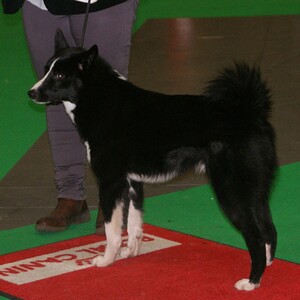
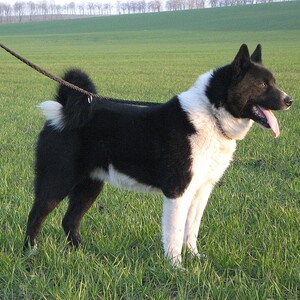
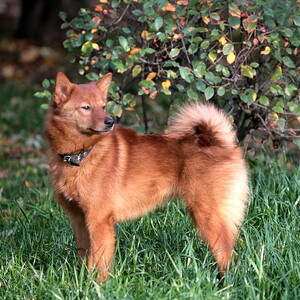
Finnish Spitz. · Karelgerda / Wikimedia Commons, CC BY-SA 3.0. Cropped and resized.
The Finnish Spitz is a golden-red hunting dog with a fox-like face, erect ears and a bushy tail curled over its back. It points game that has gone up a tree by barking, so that the hunter can get close. It is lively, energetic, brave and determined, and since 1979 it has been the national dog of Finland.
Quick facts
| Common name | Finnish Spitz (Suomenpystykorva) |
| Scientific name | Canis lupus familiaris |
| Country of origin | Finland |
| Official recognition | FCI, definitively since 3 August 1954 (group 5, Nordic hunting dogs, with a working trial; standard no. 49); also recognised by the AKC |
| Lifespan | 13–15 years, according to the AKC |
| Size (males) | 44–50 cm at the withers, ideally 47 cm; about 11–15 kg (AKC) |
| Size (females) | 39–45 cm at the withers, ideally 42 cm; about 9–13 kg (AKC) |
| Coat type | Medium-length, standing off the body, harsher on the neck and shoulders; short on the head and legs |
| Common colours | Golden-red, in varying shades |
| Energy level | Very high |
| Suited to an apartment? | It can adapt, but it barks a lot |
| Temperament | Lively, energetic, brave, determined |
| Tendency to aggression | Low; slightly reserved with strangers |
| Good with children | Very good |
| Good with other animals | Good with dogs; strong hunting instinct |
| Genetic predispositions | Few; breeders test the kneecaps, elbows, hips and eyes |
- Primary category:Dog breeds
- Explore this animal's categories:
History and origin
The FCI standard says that for hundreds of years dogs of this type were used throughout Finland to hunt all kinds of game. The aim was a dog that barks well at game that has gone up a tree and is also handsome. When the breed register began, in the 1890s, suitable dogs were found mainly in the east and north of the country.
The first standard and the first breed show took place in 1892, and the first bird-hunting trial in 1897. The breed was formed from pure natural stock and is an essential part of Finnish culture. In 1979 the Finnish Spitz was named the national dog of Finland.
How the breed developed
- Hundreds of years – The dogs hunt throughout Finland.
- 1890s – The breed register begins.
- 1892 – The first standard and the first breed show.
- 1897 – The first bird-hunting trial.
- 3 August 1954 – The FCI recognises the breed.
- 1979 – It becomes the national dog of Finland.
- 11 February 2026 – The current FCI standard is published.
Breed rating
| Feature | Stars |
|---|---|
| Training and intelligence | ★★★☆☆ |
| Easy to train | ★★★☆☆ |
| Intelligence | ★★★★★ |
| Independence | ★★★★☆ |
| Stubbornness | ★★★★☆ |
| Behaviour and temperament | ★★★★☆ |
| Affectionate with family | ★★★★★ |
| Friendly with children | ★★★★★ |
| Good with other dogs | ★★★★☆ |
| Good with cats and other animals | ★★☆☆☆ |
| Loyalty | ★★★★★ |
| Tendency to be aggressive | ★☆☆☆☆ |
| Tendency to bark | ★★★★★ |
| Needs and care | ★★★★☆ |
| Shedding | ★★★☆☆ |
| Needs frequent grooming | ★★☆☆☆ |
| Activity and lifestyle | ★★★★☆ |
| Energy level | ★★★★★ |
| Daily exercise needs | ★★★★☆ |
| Suited to apartment life | ★★★★☆ |
| Health and longevity | ★★★★☆ |
| Life expectancy | ★★★★★ |
| Predisposition to genetic diseases | ★★☆☆☆ |
| Working abilities and uses | ★★★★☆ |
| Good hunting dog | ★★★★★ |
| Good companion dog | ★★★★☆ |
Indicative rating: 5 stars means the highest level. It is based on the ratings the American Kennel Club gives the breed and on the FCI standard.
Physical characteristics
The AKC describes it as a balanced, symmetrical and square dog, easily recognised by its fox-like face, erect ears and bushy curled tail. The dense, golden-red coat, never a single shade, gives it its distinctive “glow”.
General appearance
Seen from above, the skull is egg-shaped and widest between the ears. On the shoulders, especially in males, the hair is longer and harsher. The coat on the head and legs is short and close-lying.
| Feature | Finnish Spitz |
|---|---|
| Size | Medium |
| Height at the withers | males: 44–50 cm; females: 39–45 cm |
| Weight | males: about 11–15 kg; females: 9–13 kg |
| Coat | Medium-length, stand-off, with undercoat |
| Ears | Erect, pointed |
| Tail | Bushy, curled over the back |
The coat is golden-red, in shades that vary over the body, never completely uniform. The AKC calls this colour the Finnish Spitz's “glow”.
Training and socialisation
The standard describes it as lively, energetic, brave and determined, perhaps slightly reserved with strangers, but never vicious.
The AKC says it is a very intelligent breed, and that is exactly why it can be a challenge to train. Sessions should be short and fun, with plenty of praise and rewards. Food is the universal motivator, and the dog will let you know when it has had enough.
Tips for effective training
- Keep sessions short. The AKC says it will show you when it has had enough.
- Use food as a reward. It is the best motivation for it.
- Work on the barking. It is a “bark pointer” and barks a great deal.
- Do not isolate it. The AKC says it becomes deeply attached to its family.
Activity needs and lifestyle
The AKC says it was bred to hunt all day in the forest, so it has a lot of stamina and a tendency to roam. It needs a fair amount of exercise, and a securely fenced yard is a must.
| Activity | How often | Why it matters |
|---|---|---|
| Walks on the lead | daily | Exercise and scents |
| Forest hikes | weekly | Great stamina |
| Search games | several times a week | Hunting instinct |
Tips for a balanced life
- The yard must be securely fenced.
- Think of the neighbours: it barks a lot.
- It copes very well with cold.
Care and health
Coat and skin care
The AKC says it is enough to mist the coat lightly with water and brush it with a pin brush every two to three days. It sheds twice a year; at that time daily brushing, or a bath followed by drying with cool air, speeds up the process.
Common health problems
The AKC says that, thanks to careful breeding, the Finnish Spitz is generally healthy, with very few cases of disease. Breeders test for:
| Condition | Description | Common symptoms |
|---|---|---|
| Patellar luxation | The kneecap slips out of place | Suddenly holds a hind leg up for a few steps, then uses it again |
| Elbow dysplasia | The elbow joint develops incorrectly and arthritis appears | Limping on the front legs, especially after exercise |
| Hip dysplasia | The hip joint forms incorrectly and, over time, arthritis develops | Limping, difficulty getting up or jumping, hip pain |
Other care
- Check the ears and teeth weekly.
- Trim the nails when they start to touch the floor.
- Check for ticks after outings in the woods.
Diet and nutrition
The AKC says its metabolism is very efficient for a primitive breed, so it quickly gains weight if it gets too much food. Good-quality dry food keeps it in shape.
Tips for a healthy diet
The table gives a starting estimate, calculated with the formula from the Merck Veterinary Manual. The first two calorie columns show the calories per day for a healthy adult dog. The last column shows what this means in dry food with 3,500–4,000 kcal per kilogram.
| Dog's weight | Calories per day (neutered) | Calories per day (not neutered) | Dry food per day (approximate) |
|---|---|---|---|
| 9 kg | 580 kcal | 650 kcal | 140–190 g |
| 12 kg | 720 kcal | 810 kcal | 180–230 g |
| 15 kg | 850 kcal | 960 kcal | 210–270 g |
- Give treats in moderation.
- Give table scraps rarely or not at all.
- A dog is at the right weight when you can feel its ribs under the coat without pressing hard.
Foods to avoid
Some human foods are dangerous for dogs: chocolate, coffee, grapes and raisins, onions, garlic, xylitol (a sweetener used in chewing gum), macadamia nuts and alcohol.
Reproduction and development
Physical and emotional maturity
In dogs, sexual maturity usually comes between 6 and 12 months. Most breeds become adults at around 13–15 months.
Mating and pregnancy
Pregnancy lasts about 63 days, counted from ovulation. Mating a female on her first heat is not recommended. The FCI standard requires that only healthy dogs of typical breed appearance are used for breeding.
Caring for the puppies
In dogs, a litter has 5–6 puppies on average, and the number rises with the size of the breed. Socialisation starts in the first weeks: gentle handling, everyday noises and new people.
Interesting facts
- It points game by barking. It barks at game in trees so that the hunter can get close.
- National dog. Since 1979 it has been the national dog of Finland.
- It hunts bears, too. Wikipedia says some dogs have even hunted bears.
- “Finkie”. In the United States it is nicknamed “Finkie” or “Finn”.
- A distant relative of the Taymyr wolf. Wikipedia says northern breeds have inherited some of the genes of an extinct wolf from northern Asia.
In popular culture
The national dog of Finland
The FCI standard says the Finnish Spitz was formed from pure natural stock and is an essential part of Finnish culture. In 1979 it was named the national dog of Finland.
Frequently asked questions
Why does the Finnish Spitz bark so much?
Because it was bred to point game in trees by barking.
How big does it get?
Males measure 44–50 cm, females 39–45 cm; they weigh about 9–15 kg.
Is it good with children?
Yes, the AKC gives it the top score for being good with children.
How long does it live?
The AKC gives 13–15 years.