Chesapeake Bay RetrieverCharacteristics, history, training and care
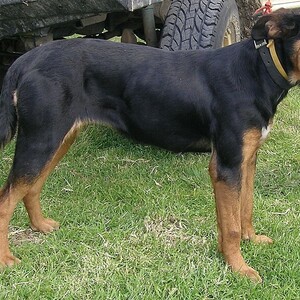
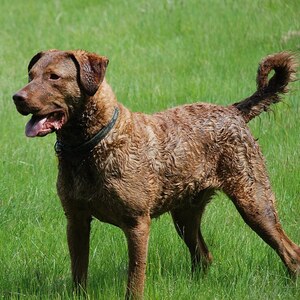
Chesapeake Bay Retriever. · Keith Rousseau / Wikimedia Commons, CC BY-SA 3.0. Cropped and resized.
The Chesapeake Bay Retriever, nicknamed the “Chessie”, is a strong, hardy American retriever with a wavy, oily, waterproof coat. It was created in the 19th century around Chesapeake Bay to retrieve ducks from icy water. It is intelligent, affectionate and protective.
Quick facts
| Common name | Chesapeake Bay Retriever (Chessie) |
| Scientific name | Canis lupus familiaris |
| Country of origin | United States (Chesapeake Bay) |
| Official recognition | FCI, definitively since 15 September 1964 (group 8, retrievers, with working trial; standard no. 263); also recognised by the AKC |
| Lifespan | 10–13 years |
| Size (males) | about 58–66 cm at the withers; 29–36 kg |
| Size (females) | about 53–61 cm at the withers; 25–32 kg |
| Coat type | Thick, short (no more than 4 cm), slightly wavy, oily, with a woolly undercoat |
| Common colours | Brown, “sedge” (red-gold) or “deadgrass”, preferably solid |
| Energy level | High |
| Suited to an apartment? | Not really; it needs plenty of exercise |
| Temperament | Intelligent, affectionate, brave, protective, independent |
| Tendency to aggression | Low; protective of the family |
| Good with children | Average to good |
| Good with other animals | Average |
| Genetic predispositions | Hip dysplasia, progressive retinal atrophy (PRCD) |
- Primary category:Dog breeds
- Explore this animal's categories:
History and origin
The breed was developed in the 19th century, around Chesapeake Bay in the United States. Hunters used it to retrieve waterfowl in all weathers, often breaking through ice on every trip.
Wikipedia says these dogs were also used to haul fishing nets and to rescue fishermen. Today they are mainly family dogs and hunting companions.
How the breed developed
- 19th century – The breed takes shape around Chesapeake Bay.
- 15 September 1964 – The FCI recognises the breed.
- 14 February 1995 – The current FCI standard is published.
Breed rating
| Feature | Stars |
|---|---|
| Training and intelligence | ★★★★★ |
| Easy to train | ★★★★★ |
| Intelligence | ★★★★☆ |
| Independence | ★★★☆☆ |
| Stubbornness | ★★★☆☆ |
| Behaviour and temperament | ★★★★☆ |
| Affectionate with family | ★★★★☆ |
| Friendly with children | ★★★☆☆ |
| Good with other dogs | ★★★☆☆ |
| Good with cats and other animals | ★★☆☆☆ |
| Loyalty | ★★★★★ |
| Tendency to be aggressive | ★★☆☆☆ |
| Tendency to bark | ★★★☆☆ |
| Needs and care | ★★★☆☆ |
| Shedding | ★★★☆☆ |
| Needs frequent grooming | ★★★☆☆ |
| Activity and lifestyle | ★★★★☆ |
| Energy level | ★★★★☆ |
| Daily exercise needs | ★★★★☆ |
| Suited to apartment life | ★★☆☆☆ |
| Health and longevity | ★★★★☆ |
| Life expectancy | ★★★★☆ |
| Predisposition to genetic diseases | ★★★☆☆ |
| Working abilities and uses | ★★★★★ |
| Good water retriever | ★★★★★ |
| Good companion dog | ★★★★☆ |
Indicative rating: 5 stars means the highest level. It is based on the ratings the American Kennel Club gives the breed and on the FCI standard.
Physical characteristics
It is a strong, well-built retriever, equally good on land and in water. The hindquarters are as high as or slightly higher than the shoulders.
General appearance
The very clear, yellowish or amber eyes have an intelligent expression. The small ears hang down. The coat is wavy on the shoulders, neck, back and loins, and short on the face and legs.
| Feature | Chesapeake Bay Retriever |
|---|---|
| Size | Large |
| Height at the withers | males: about 58–66 cm; females: about 53–61 cm |
| Weight | males: 29–36 kg; females: 25–32 kg |
| Coat | Short, wavy, oily, waterproof |
| Eyes | Yellowish or amber, very clear |
| Ears | Small, hanging |
The standard calls for a colour as close as possible to its working surroundings: any shade of brown, “sedge” or “deadgrass”. Self-coloured dogs are preferred.
Training and socialisation
The AKC gives it the top score for trainability, but says it is more emotionally complex than other gun dogs and has a mind of its own. It may stubbornly go its own way.
It is protective of its family and polite, but not very friendly with strangers. Early socialisation helps it a great deal.
Tips for effective training
- Give it a job. Retrieving, especially from water, is its favourite activity.
- Be consistent. It is independent and tests the rules.
- Socialise it early. It is reserved with strangers.
- Try dog sports. It does very well at obedience, tracking and agility.
Activity needs and lifestyle
The AKC says it is an intelligent, high-energy breed that needs a job and plenty of exercise. It enjoys hiking, running, hunting and, above all, swimming.
| Activity | How often | Why it matters |
|---|---|---|
| Swimming | several times a week | It is made for water |
| Running or hiking | daily | High energy |
| Retrieving | daily | Its main instinct |
Tips for a balanced life
- Ideally, it should have access to water.
- With enough exercise, it is calm indoors.
- It is a good watchdog.
Care and health
Coat and skin care
The short coat needs little care: brushing once a week. The oil in the coat makes it waterproof, like a duck's feathers, so it should not be bathed often. When it comes out of the water and shakes, it is left only damp.
Common health problems
As with most large dogs, hip dysplasia is a problem. The AKC also recommends genetic tests for a form of progressive retinal atrophy (PRCD) and eye examinations for breeding dogs.
| Condition | Description | Common symptoms |
|---|---|---|
| Hip dysplasia | The hip joint forms incorrectly and, over time, arthritis develops | Limping, difficulty getting up or jumping, hip pain |
| Progressive retinal atrophy (PRCD) | The retina gradually degenerates over time | Sees less and less well, especially at night |
Other care
- Check the ears regularly, especially after swimming.
- Brush its teeth often.
- Trim the nails regularly.
Diet and nutrition
A very active retriever needs plenty of energy. Adjust the portion to its activity and weight.
Tips for a healthy diet
The table gives a starting estimate, calculated with the formula from the Merck Veterinary Manual. The first two calorie columns show the calories per day for a healthy adult dog. The last column shows what this means in dry food with 3,500–4,000 kcal per kilogram.
| Dog's weight | Calories per day (neutered) | Calories per day (not neutered) | Dry food per day (approximate) |
|---|---|---|---|
| 25 kg | 1,250 kcal | 1,410 kcal | 310–400 g |
| 30 kg | 1,440 kcal | 1,620 kcal | 360–460 g |
| 36 kg | 1,650 kcal | 1,850 kcal | 410–530 g |
- Give it its food in two meals a day to reduce the risk of bloat.
- Training treats count towards the daily portion.
- A dog is at the right weight when you can feel its ribs without pressing hard.
Foods to avoid
Some human foods are dangerous for dogs: chocolate, coffee, grapes and raisins, onions, garlic, xylitol (a sweetener used in chewing gum), macadamia nuts and alcohol.
Reproduction and development
Physical and emotional maturity
In dogs, sexual maturity usually comes between 6 and 12 months, but in large breeds it can be delayed until about two years. The body also reaches its adult form later than in small breeds.
Mating and pregnancy
Pregnancy lasts about 63 days, counted from ovulation. Mating a female on her first heat is not recommended. The FCI standard requires that only healthy dogs of typical breed appearance are used for breeding.
Caring for the puppies
In large breeds, a litter has around 7 puppies on average. Socialisation starts in the first weeks: gentle handling, everyday noises and new people.
Interesting facts
- A coat like duck feathers. The oil in the coat keeps cold water from reaching the skin.
- It broke through ice. The standard says it often had to break through ice to retrieve birds.
- The state dog of Maryland. Wikipedia notes that it is the official dog of the US state of Maryland.
- Yellow eyes. The yellowish or amber eyes match the brown coat.
- The colour of its surroundings. The standard calls for a colour as close as possible to the reed beds where it works.
In popular culture
The official state dog of Maryland
The Chesapeake Bay Retriever is the official dog of the US state of Maryland, home to a large part of Chesapeake Bay, where the breed took shape.
Frequently asked questions
What is a Chessie?
It is the nickname of the Chesapeake Bay Retriever.
How big does it get?
Males measure about 58–66 cm and weigh 29–36 kg; females measure 53–61 cm and weigh 25–32 kg.
Does it like water?
Very much. It was created to retrieve ducks from icy water.
Is it good for a family?
Yes, if it gets plenty of exercise. It is affectionate and protective.
How long does it live?
Its life expectancy is 10–13 years.