LovebirdAgapornis — habitat, diet and reproduction
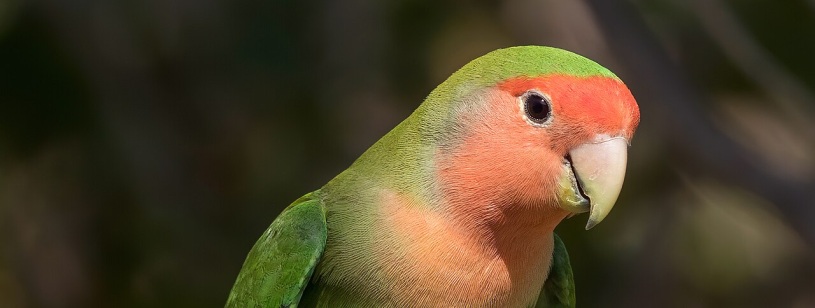
A rosy-faced lovebird (Agapornis roseicollis). · Charles J. Sharp / CC BY-SA 4.0 (https://creativecommons.org/licenses/by-sa/4.0). Cropped and resized.
Lovebirds are small parrots in the genus Agapornis, known for close bonds between partners. They have compact bodies, short tails and strong bills for their size. The name covers several African species with different colours, ranges and behaviours. The photograph shows a rosy-faced lovebird.
Quick facts
| Common name | Lovebird |
| Scientific name | Agapornis, a genus containing several species |
| Lifespan | Variable; Fischer’s lovebirds may live 15–20 years in human care |
| Length | Around 15 cm in the rosy-faced lovebird |
| Weight | Around 46–63 g in the rosy-faced lovebird |
| Diet | Seeds, fruit, buds and other plant material |
| Predators | Birds of prey and nest predators |
| Conservation status | Varies: rosy-faced LC; Fischer’s NT |
| Distribution | Africa, with different species ranges |
| Habitat | Savanna, scrub and open woodland, depending on species |
| Family | Psittaculidae |
| Social organisation | Pairs and flocks |
- Primary category:Birds
- Explore this animal's categories:
Interesting facts
- Partners often sit close together and preen each other’s head feathers.
- Female rosy-faced lovebirds may carry nesting material tucked into their rump feathers.
- Rosy-faced lovebirds have established introduced populations in Arizona.
- Their small size is accompanied by energetic and sometimes territorial behaviour.
Characteristics
A compact body and short tail distinguish lovebirds from longer-tailed parrots such as budgerigars. Many species are mainly green, with contrasting colours on the head and breast.
Rosy-faced lovebirds have pale bills, pink faces and blue rumps. Fischer’s lovebirds have orange faces and red bills. Males and females look very similar in these species.
Captive colour varieties can look different. Identification should consider the bill, facial pattern and origin as well as overall colour.
Behaviour
Pairs maintain their bond through proximity, calls and preening. Feeding a partner can also be part of their interactions. Flocks provide opportunities to communicate and locate resources.
Around a nest, these same birds can defend space vigorously. Compatibility matters when birds share an enclosure. The name describes pair bonding without guaranteeing that any two individuals will get along.
Lovebirds climb actively. Safe branches, flight space and appropriate chewable items allow them to use these skills.
Habitat and distribution
Rosy-faced lovebirds originate in southwestern Africa. They occupy relatively dry landscapes with scattered vegetation and access to water. Some live near cultivated land.
Fischer’s lovebirds naturally occur in Tanzania, south and east of Lake Victoria. Wooded savanna and riverine vegetation provide food and shelter. Each species therefore needs its own range description.
Diet and feeding
Grass seeds are important to many species. Fruit, buds and other plant parts are also eaten. Birds forage on the ground, among tall grasses and in trees.
Abundant seed crops attract larger gatherings. Visits to cereal fields can create conflicts with farmers. Captive diets should be varied and suited to the species.
Reproduction and life cycle
Nest sites vary. Rosy-faced lovebirds use rocky crevices and structures built by other birds; other species use tree hollows. Plant material lines the nesting space.
Fischer’s lovebirds may lay around four to six eggs, with variation. Incubation lasts roughly 21–23 days. Chicks leave the nest at about six weeks and continue receiving parental care afterwards.
Name and history
The name lovebird refers to the close relationship between partners. Agapornis names the whole genus.
Birds kept in aviculture include distinct species as well as selectively bred colour forms. A scientific name helps separate species identity from plumage colour.
Conservation and threats
Conservation status differs by species. Rosy-faced lovebirds are Least Concern, while Fischer’s lovebirds are Near Threatened.
Capture for trade and habitat loss affect wild populations. Hybridisation with introduced species creates additional concerns in some areas. Protecting habitats and ensuring documented captive origins help reduce pressure on wild birds.
Frequently asked questions
Is lovebird the name of one species?
It covers several species in the genus Agapornis. The photographed bird is Agapornis roseicollis.
Can colour reveal a bird’s sex?
The sexes look very similar in several familiar species. Colour alone may be inconclusive.
Why does a lovebird shred material?
Chewing and preparing nesting material are natural behaviours. Female rosy-faced lovebirds may carry strips between their feathers.
Can a lovebird share a cage with any other parrot?
Species, available space and individual compatibility matter. Territorial behaviour can cause injuries, especially in small enclosures.