Brazilian TerrierCharacteristics, history, training and care
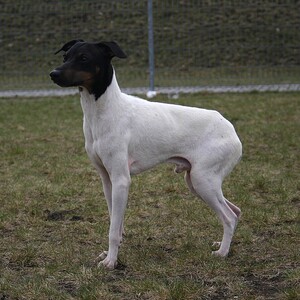
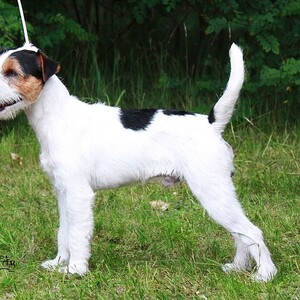
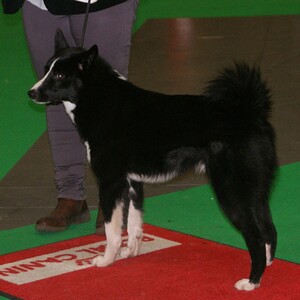
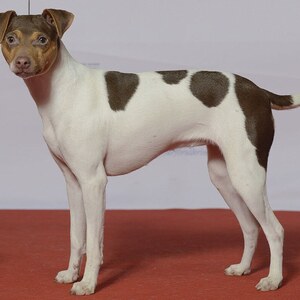
Brazilian Terrier. · Svenska Mässan from Sweden / Wikimedia Commons, CC BY-SA 4.0. Cropped and resized.
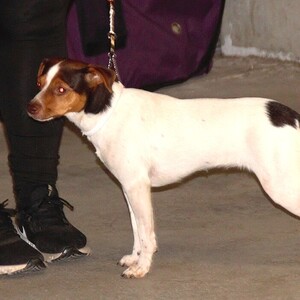
The Brazilian Terrier is a small, lithe and very energetic dog, white with black, blue or brown markings and tan points. It developed on Brazil's farms, where it hunted rats and announced strangers. It is intelligent, learns quickly and is friendly with the family, but suspicious of strangers.
Quick facts
| Common name | Brazilian Terrier (Terrier Brasileiro) |
| Scientific name | Canis lupus familiaris |
| Country of origin | Brazil |
| Official recognition | FCI, definitively since 21 May 2007 (group 3, standard no. 341); AKC, in the Foundation Stock Service since May 2023 |
| Lifespan | 12–14 years |
| Size (males) | 35–40 cm at the withers |
| Size (females) | 33–38 cm at the withers |
| Weight | about 10 kg |
| Coat type | Short, smooth, fine, lying close to the skin |
| Common colours | White with black, blue, brown or isabella markings and tan points |
| Energy level | Very high |
| Suited to an apartment? | Yes, if it gets plenty of exercise |
| Temperament | Restless, alert, active; gentle with friends, suspicious of strangers |
| Tendency to aggression | Low with the family |
| Good with children | Very good |
| Good with other animals | Average; hunts rodents |
| Genetic predispositions | Patellar luxation, mucopolysaccharidosis type VII (rare) |
- Primary category:Dog breeds
- Explore this animal's categories:
History and origin
In the 19th and early 20th centuries, many young Brazilians studied in France and England. Many came home married, and their wives often brought a small terrier with them.
The families returned to their farms, where the dogs were crossed with local dogs. Over a few generations a new type took shape. Later, as farmers moved to the cities, the dogs became house guards and family companions.
How the breed developed
- 19th century – Young Brazilians bring small terriers back from Europe.
- On the farms – The dogs are crossed with local ones and hunt mice and rats.
- 20th century – With the move to the cities, they become guards and companions.
- 21 May 2007 – The FCI recognises the breed.
- May 2023 – The AKC accepts it into the Foundation Stock Service.
Breed rating
| Feature | Stars |
|---|---|
| Training and intelligence | ★★★★★ |
| Easy to train | ★★★★★ |
| Intelligence | ★★★★★ |
| Independence | ★★★★☆ |
| Stubbornness | ★★★☆☆ |
| Behaviour and temperament | ★★★★☆ |
| Affectionate with family | ★★★★★ |
| Friendly with children | ★★★★★ |
| Good with other dogs | ★★★☆☆ |
| Good with cats and other animals | ★★☆☆☆ |
| Loyalty | ★★★★★ |
| Tendency to be aggressive | ★★☆☆☆ |
| Tendency to bark | ★★★☆☆ |
| Needs and care | ★★★☆☆ |
| Shedding | ★★★☆☆ |
| Needs frequent grooming | ★☆☆☆☆ |
| Activity and lifestyle | ★★★★★ |
| Energy level | ★★★★★ |
| Daily exercise needs | ★★★★★ |
| Suited to apartment life | ★★★★★ |
| Health and longevity | ★★★★☆ |
| Life expectancy | ★★★★☆ |
| Predisposition to genetic diseases | ★★☆☆☆ |
| Working abilities and uses | ★★★★★ |
| Good rodent hunter | ★★★★★ |
| Good companion dog | ★★★★★ |
Indicative rating: 5 stars means the highest level. It is based on the ratings the American Kennel Club gives the breed and on the FCI standard.
Physical characteristics
It is a small to medium-sized, lithe and well-balanced dog, with a square body and curved lines. Its build is solid, but not heavy.
General appearance
The triangular ears are semi-erect, with the tip folding towards the outer corner of the eye. The eyes are large and round. The tail may be short from birth or long.
| Feature | Brazilian Terrier |
|---|---|
| Size | Small to medium |
| Height at the withers | males: 35–40 cm; females: 33–38 cm |
| Weight | about 10 kg |
| Coat | Short, smooth, fine, dense |
| Ears | Triangular, semi-erect |
| Tail | Short from birth or long |
The base colour is white, with black, blue, brown or isabella (beige) markings. Tan markings above the eyes, on the sides of the muzzle and on the ears must always be present.
Training and socialisation
The AKC says it is intelligent and learns quickly, but must be trained gently. It can be trained from a very young age.
It is an excellent alarm dog: it announces strangers straight away.
Tips for effective training
- Be gentle. Harsh methods do not work with it.
- Start early. It can be trained from its first months.
- Give it a job. It enjoys agility, canicross, barn hunt (searching for rats) and earthdog sports.
- Work on barking. As an alarm dog, it barks when something new appears.
Activity needs and lifestyle
Like most terriers, it has a great deal of energy. The AKC recommends regular walks and sport. Outdoors it should be kept on a lead or in a fenced area.
| Activity | How often | Why it matters |
|---|---|---|
| Brisk walks | daily | Burns off its high energy |
| Play and search games | daily | Keep its mind busy |
| Agility or canicross | weekly | A sport to match its energy |
Tips for a balanced life
- Keep it on a lead or in fenced areas.
- Do not leave it near pet rodents.
- Without exercise, it gets bored and gets up to mischief.
Care and health
Coat and skin care
Grooming is very simple. It usually sheds twice a year, when it should be brushed 2–3 times a week. The rest of the year it needs little brushing. Bathe it only when it is very dirty.
Common health problems
The AKC says the breed is very hardy. It has few typical diseases, and these are rare:
| Condition | Description | Common symptoms |
|---|---|---|
| Patellar luxation | The kneecap slips out of place | Suddenly holds a hind leg up for a few steps, then uses it again |
| Mucopolysaccharidosis type VII | A rare genetic metabolic disease; detected by a genetic test | Growth and walking problems in puppies |
Other care
- Check the ears and nails at every bath.
- Trim the nails regularly.
- Brush its teeth often.
Diet and nutrition
A small but very active dog needs good-quality food. Adjust the portion to how much it moves.
Tips for a healthy diet
The table gives a starting estimate, calculated with the formula from the Merck Veterinary Manual. The first two calorie columns show the calories per day for a healthy adult dog. The last column shows what this means in dry food with 3,500–4,000 kcal per kilogram.
| Dog's weight | Calories per day (neutered) | Calories per day (not neutered) | Dry food per day (approximate) |
|---|---|---|---|
| 8 kg | 530 kcal | 600 kcal | 130–170 g |
| 10 kg | 630 kcal | 710 kcal | 160–200 g |
| 12 kg | 720 kcal | 810 kcal | 180–230 g |
- Give it its food in two meals a day.
- Training treats count towards the daily portion.
- A dog is at the right weight when you can feel its ribs without pressing hard.
Foods to avoid
Some human foods are dangerous for dogs: chocolate, coffee, grapes and raisins, onions, garlic, xylitol (a sweetener used in chewing gum), macadamia nuts and alcohol.
Reproduction and development
Physical and emotional maturity
In dogs, sexual maturity usually comes between 6 and 12 months. Small breeds become adults faster than large ones, usually at around one year.
Mating and pregnancy
Pregnancy lasts about 63 days, counted from ovulation. Mating a female on her first heat is not recommended. The FCI standard requires that only healthy dogs of typical breed appearance are used for breeding.
Caring for the puppies
In small breeds, a litter has 3–4 puppies on average. The puppies are very small and fragile in the first weeks, so they must be kept warm and handled with care. Socialisation starts early: gentle handling, everyday noises and new people.
Interesting facts
- It was a circus dog. The AKC says that for a long time it was used in circuses, thanks to its intelligence.
- It appeared on a stamp. The Brazilian Post dedicated a stamp to it.
- One of two Brazilian breeds. Wikipedia says it is one of the two native breeds of Brazil recognised worldwide.
- The tail can be short from birth. Some puppies are born with a short tail.
- Spanish relatives. Its relatives include the Ratonero Bodeguero Andaluz.
In popular culture
On a Brazilian stamp
The AKC notes that the Brazilian Terrier was honoured with a stamp issued by the Brazilian Post. Thanks to its intelligence and how easily it learns, it was also used for a long time in circus shows.
Frequently asked questions
How big does it get?
It measures 33–40 cm at the withers and weighs about 10 kg.
Is it suitable for children?
Yes. The AKC gives it top marks for compatibility with children.
Does it need a lot of exercise?
Yes, it has a great deal of energy, like most terriers.
How long does it live?
Its life expectancy is 12–14 years.