Sugar gliderPetaurus breviceps — habitat, diet and reproduction
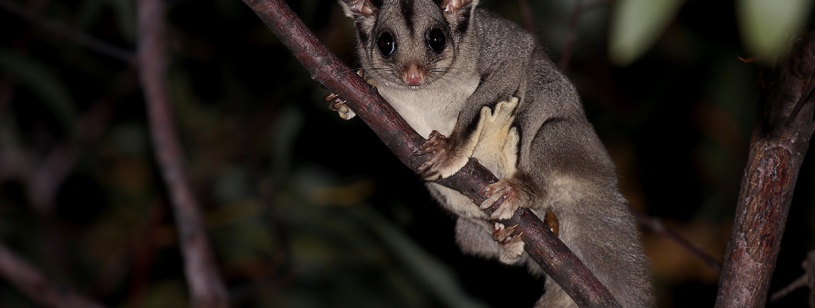
Sugar glider (Petaurus breviceps) on a branch at night. · patrickkavanagh / CC BY 2.0 (https://creativecommons.org/licenses/by/2.0). Cropped and resized.
The sugar glider is a palm-sized marsupial that lives in the forests of Australia and New Guinea. A membrane of skin between its front and hind legs lets it glide from tree to tree. It is active at night and loves sweet food: tree sap, nectar and eucalyptus gum.
Quick facts
| Common name | Sugar glider |
| Scientific name | Petaurus breviceps (in the broad sense) |
| Lifespan | About 5–9 years in the wild; over 12 in captivity |
| Length | About 24–30 cm from nose to tail tip |
| Weight | About 115–140 g |
| Diet | Omnivore: sap, gum, nectar, pollen, insects |
| Predators | Owls, pythons, goannas, cats |
| Conservation status | Least Concern (LC), in the broad sense |
| Distribution | Eastern and northern Australia, New Guinea |
| Habitat | Eucalyptus forests and rainforests |
| Family | Petauridae |
| Activity | Nocturnal |
Interesting facts
- A sugar glider can glide about 50 metres in a single leap.
- It looks like a flying squirrel, although the two are not closely related.
- The female has a pouch where the young grows for about 70 days.
- In 2020–2021, researchers showed that the “sugar glider” is actually a group of three very similar species.
Characteristics
The sugar glider has dense, soft fur, grey above and pale below. A black stripe runs from the nose between the eyes and down the back.
Large dark eyes suit night vision. The gliding membrane stretches from the fifth finger to the ankle, and a long bushy tail helps balance and steering.
Behaviour
Sugar gliders live in groups of up to 7–10 adults sharing a leaf-lined tree-hole nest. Group members recognise each other by scent, and males mark territory with special glands.
At night they glide between trees to forage. In cold weather they can lower their body temperature and enter torpor for a few hours to save energy.
Habitat and distribution
Sugar gliders live in northern and eastern Australia, in Tasmania where people introduced them, and in New Guinea.
They favour eucalyptus and acacia forests and rainforests with hollows and sap-rich trees.
Diet and feeding
Their diet changes with the seasons. In winter they eat mainly acacia gum and eucalyptus sap obtained by gnawing bark. In spring and summer they take nectar, pollen and many insects.
The name “sugar glider” reflects its taste for sweet food. In captivity it needs a balanced diet, not just fruit and sweets.
Reproduction and life cycle
The female usually gives birth to 1–2 young after a pregnancy of only about 16 days. The tiny young crawl into the pouch and attach to a teat.
They stay there for about 70 days, then remain in the nest cared for by both parents, becoming independent after a few months.
Name and history
The scientific name Petaurus breviceps comes from Greek and Latin: “petauron” means an acrobat’s trapeze and “breviceps” means “short head”.
Its resemblance to flying squirrels is an example of convergent evolution: unrelated animals developed the same solution, gliding.
Conservation and threats
The sugar glider in the broad sense is assessed as Least Concern. After the split into three species, some populations have smaller ranges and may be more vulnerable.
Threats include felling of old hollow-bearing forest, fires and cats. Sugar gliders are kept as pets in many countries, but they need lots of space, companions and a night-time routine.
Frequently asked questions
Is the sugar glider a squirrel?
No. It is an Australian marsupial that looks like a flying squirrel but is not closely related.
What does the sugar glider eat?
Tree sap and gum, nectar, pollen and insects.
How long does a sugar glider live?
About 5–9 years in the wild and over 12 years in captivity.
Is the sugar glider a good pet?
Only for owners who can provide lots of space, other gliders as company, special food and night-time care.