DachshundCharacteristics, history, training and care
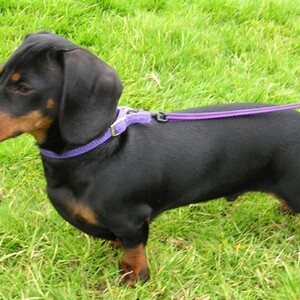
Smooth-haired miniature Dachshund · Ellen Levy Finch (Elf) / Wikimedia Commons, CC BY-SA 3.0. Cropped and resized.
The Dachshund, also called the Teckel or Dackel, is a German hunting dog with a long body, short legs and plenty of personality. It was bred for hunting in burrows, but it also works well above ground, on a trail. It comes in three sizes and with three coat types. It is friendly, brave and very affectionate, but also stubborn.
Quick facts
| Common name | Dachshund (Teckel, Dackel) |
| Scientific name | Canis lupus familiaris |
| Country of origin | Germany |
| Official recognition | FCI, definitively since 1955 (group 4, dachshunds, with working trial; standard no. 148); also recognised by the AKC |
| Lifespan | 12–16 years, according to the AKC |
| Size (males) | The FCI measures chest girth: standard 37–47 cm, miniature 32–37 cm, kaninchen 27–32 cm |
| Size (females) | chest girth: standard 35–45 cm, miniature 30–35 cm, kaninchen 25–30 cm |
| Weight | AKC: standard 7–14.5 kg; miniature up to 5 kg |
| Coat type | Smooth, wire or long |
| Common colours | Red; black or brown with tan; dapple (merle); brindle |
| Energy level | Moderate |
| Suited to an apartment? | Yes, without too many stairs |
| Temperament | Friendly, even-tempered, brave, persevering, stubborn |
| Tendency to aggression | Low |
| Good with children | Average; its back must be protected |
| Good with other animals | Good with dogs; strong hunting instinct |
| Genetic predispositions | Slipped disc (long back), obesity, ear infections |
- Primary category:Dog breeds
- Explore this animal's categories:
History and origin
The FCI standard says the Dachshund has been known since the Middle Ages. From the German hounds (Bracken), dogs suited to hunting underground were consistently selected, and from these short-legged dogs came the Dachshund, one of the most versatile hunting breeds.
The oldest breed club, the Deutscher Teckelklub, was founded in 1888. For decades the breed has been bred in three sizes (standard, miniature and rabbit, or kaninchen) and with three coat types (smooth, wire and long), making nine varieties.
How the breed developed
- Middle Ages – The first short-legged dogs suited to hunting in burrows appear.
- 1888 – The Deutscher Teckelklub, the oldest breed club, is founded.
- 1955 – The FCI recognises the breed.
- 1972 – A dachshund, Waldi, becomes the first official Olympic mascot, in Munich.
- 25 May 2021 – The current FCI standard is published.
Breed rating
| Feature | Stars |
|---|---|
| Training and intelligence | ★★★★☆ |
| Easy to train | ★★★☆☆ |
| Intelligence | ★★★★☆ |
| Independence | ★★★★☆ |
| Stubbornness | ★★★★★ |
| Behaviour and temperament | ★★★★☆ |
| Affectionate with family | ★★★★★ |
| Friendly with children | ★★★☆☆ |
| Good with other dogs | ★★★★☆ |
| Good with cats and other animals | ★★☆☆☆ |
| Loyalty | ★★★★★ |
| Tendency to be aggressive | ★★☆☆☆ |
| Tendency to bark | ★★★★★ |
| Needs and care | ★★★★☆ |
| Shedding | ★★☆☆☆ |
| Needs frequent grooming | ★★☆☆☆ |
| Activity and lifestyle | ★★★★☆ |
| Energy level | ★★★☆☆ |
| Daily exercise needs | ★★★☆☆ |
| Suited to apartment life | ★★★★☆ |
| Health and longevity | ★★★★☆ |
| Life expectancy | ★★★★☆ |
| Predisposition to genetic diseases | ★★★★☆ |
| Working abilities and uses | ★★★★☆ |
| Good hunting dog | ★★★★☆ |
| Good companion dog | ★★★★★ |
Indicative rating: 5 stars means the highest level. It is based on the ratings the American Kennel Club gives the breed and on the FCI standard.
Physical characteristics
The standard describes it as a low, short-legged dog with a long but compact, very muscular body, with a bold head carriage and an alert expression. Its build allows it to work nimbly and quickly, both above and below ground.
General appearance
The head is long. The medium-sized, almond-shaped eyes are dark reddish-brown to blackish-brown, with an energetic, friendly expression. The rounded, high-set ears reach the corner of the lips. The tail continues the line of the back.
| Feature | Dachshund |
|---|---|
| Size | Small, in three sizes |
| Chest girth | standard: 35–47 cm; miniature: 30–37 cm; kaninchen: 25–32 cm |
| Weight | standard: 7–14.5 kg; miniature: up to 5 kg (AKC) |
| Coat | Smooth, wire or long |
| Eyes | Almond-shaped, dark brown |
| Ears | Rounded, high-set |
For the smooth-haired Dachshund, the standard accepts red (with or without black hairs), black or brown with tan markings, the dapple (merle) pattern and the brindle pattern. A small white patch on the chest, up to 3 cm, is allowed. Any other colour disqualifies.
Training and socialisation
The AKC says Dachshunds are very intelligent, but independent and often stubborn, so training can be a challenge. They are sensitive and do not respond well to harsh commands or punishment.
They do best with positive, reward-based training. They have an excellent nose and a strong prey drive: bred to follow a trail without being distracted, they may ignore commands when they find something interesting.
Tips for effective training
- Be patient and consistent. The AKC says these are the key to training.
- Use rewards. It loves receiving affection and food.
- Keep it off the stairs. The AKC recommends that it should not climb up or down stairs or jump off furniture.
- Work on the barking. The AKC gives it the top score for barking.
Activity needs and lifestyle
The AKC says that, although small, it needs regular exercise to strengthen the muscles that support its back. Two moderate walks a day are enough. It is not built for long runs, jumping or tiring swims.
| Activity | How often | Why it matters |
|---|---|---|
| Moderate walks | twice a day | Strong muscles for the back |
| Scent games | several times a week | They use its excellent nose |
| Quiet play indoors | daily | No jumping off furniture |
Tips for a balanced life
- Use a ramp for the sofa or bed.
- Lift it by supporting its whole body, not just the chest.
- Always keep it at the right weight.
Care and health
Coat and skin care
The AKC says Dachshunds shed moderately and have little odour. Smooth-haired ones only need wiping with a towel or a grooming mitt. Long-haired ones need brushing more often. The wire coat is hand-stripped (trimmed) a few times a year.
Common health problems
The AKC says the breed is generally healthy, but the long back needs care:
| Condition | Description | Common symptoms |
|---|---|---|
| Intervertebral disc disease | A disc between the vertebrae ruptures and presses on the spinal cord | Back or neck pain, unsteady walking on the hind legs; in severe cases, paralysis |
| Obesity | Extra weight strains the long back | Sagging belly, tiredness, higher risk of a slipped disc |
| Ear infections | Infections of the drop ears | Scratching, unpleasant smell, tilted head |
Other care
- Clean the ears regularly.
- Brush its teeth often.
- Trim the nails when they start to touch the floor.
Diet and nutrition
The AKC says it is extremely important that a Dachshund does not put on weight, to protect its back from a slipped disc. Ignore the pleading looks and give it only the recommended portion.
Tips for a healthy diet
The table gives a starting estimate, calculated with the formula from the Merck Veterinary Manual. The first two calorie columns show the calories per day for a healthy adult dog. The last column shows what this means in dry food with 3,500–4,000 kcal per kilogram.
| Dog's weight | Calories per day (neutered) | Calories per day (not neutered) | Dry food per day (approximate) |
|---|---|---|---|
| 5 kg | 370 kcal | 420 kcal | 92–120 g |
| 9 kg | 580 kcal | 650 kcal | 140–190 g |
| 14 kg | 810 kcal | 910 kcal | 200–260 g |
- Give table scraps very rarely or not at all; never cooked bones.
- Training treats count towards the daily portion.
- A dog is at the right weight when you can feel its ribs without pressing hard.
Foods to avoid
Some human foods are dangerous for dogs: chocolate, coffee, grapes and raisins, onions, garlic, xylitol (a sweetener used in chewing gum), macadamia nuts and alcohol.
Reproduction and development
Physical and emotional maturity
In dogs, sexual maturity usually comes between 6 and 12 months. Small breeds become adults faster than large ones, usually at around one year.
Mating and pregnancy
Pregnancy lasts about 63 days, counted from ovulation. Mating a female on her first heat is not recommended. The FCI standard requires that only healthy dogs of typical breed appearance are used for breeding.
Caring for the puppies
In small breeds, a litter has 3–4 puppies on average. The puppies are very small and fragile in the first weeks, so they must be kept warm and handled with care. Socialisation starts early: gentle handling, everyday noises and new people.
Interesting facts
- The name means “badger dog”. In German, “Dachs” means badger and “Hund” means dog.
- Nine varieties. Three sizes and three coat types give nine varieties of the breed.
- Measured at the chest. The FCI divides the sizes by chest girth, not by height.
- An Olympic mascot. Waldi, a dachshund, was the first official Olympic mascot, in Munich, in 1972.
- It lives a long time. The AKC gives a life expectancy of 12–16 years.
In popular culture
Waldi, the 1972 Olympic mascot
Because of its link with Germany and its popularity in Munich, a dachshund named Waldi was chosen as the first official mascot of the Summer Olympic Games, in Munich, in 1972. In the German TV series “Hausmeister Krause”, the main character's passion for dachshunds even led to a new rise in the breed's popularity.
Frequently asked questions
What sizes of Dachshund are there?
Standard, miniature and kaninchen; the FCI tells them apart by chest girth.
What coat types are there?
Smooth, wire and long.
Does it have back problems?
It can suffer from a slipped disc. Keep it slim and keep it away from stairs and jumping.
Does it bark a lot?
Yes, the AKC gives it top marks for barking.
How long does it live?
The AKC gives 12–16 years.