European hornetVespa crabro — habitat, diet and reproduction
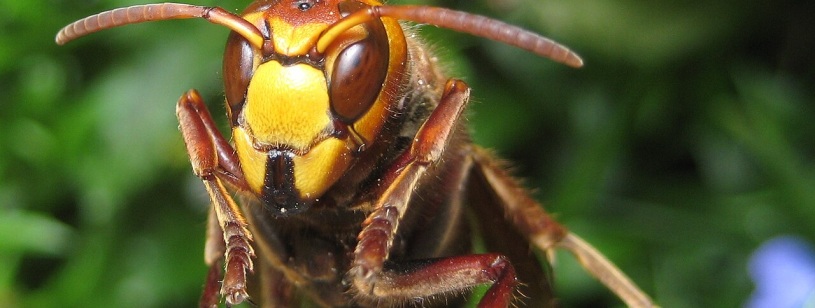
European hornet (Vespa crabro) on a piece of wood. · Aconcagua (talk) / CC BY-SA 3.0 (https://creativecommons.org/licenses/by-sa/3.0). Cropped and resized.
The European hornet is the largest social wasp in Europe: workers are about 2.5 cm long and queens up to 3.5 cm. It has a yellow-red head, a brown thorax and an abdomen striped yellow and brown. Although it looks frightening, it is less aggressive than common wasps and usually attacks only when its nest is threatened.
Quick facts
| Common name | European hornet |
| Scientific name | Vespa crabro |
| Lifespan | Workers a few weeks; queen about a year |
| Length | Workers about 25 mm; queens up to 35 mm |
| Diet | Adults: sap, fruit; larvae: insects brought by workers |
| Predators | Birds such as the honey buzzard, some mammals |
| Conservation status | Not evaluated; widespread, locally protected in some countries |
| Distribution | Europe, Asia; introduced to North America |
| Habitat | Woods, orchards, parks, tree holes and lofts |
| Family | Vespidae |
| Lifestyle | Colonies with one queen |
- Primary category:Insects
- Explore this animal's categories:Animals of AsiaAnimals of EuropeAnimals of North AmericaAnimals of RomaniaAnimals of Romania’s gardens and parksAnimals that live in groupsArthropodsCarnivoresEEgg-laying animalsFlying animalsForest animalsInsect-eating animalsInsectsInsects of RomaniaInvertebratesNocturnal animalsPredatory animals of RomaniaStriped animalsVenomous animalsWild animals
Interesting facts
- Unlike many wasps, the hornet also flies at night and is attracted to light.
- The European hornet usually does not attack healthy beehives, unlike the invasive Asian hornet.
- In Germany, the European hornet is a protected species.
- Workers chew wood and bark to make the “paper” of the nest.
Characteristics
The hornet has a robust body covered in fine hairs. Its head is yellow and red, its eyes large and brown, and its thorax reddish-brown. The abdomen is striped yellow and brown with small dark spots.
Females have a venomous sting; males have none and cannot sting. The queen is much larger than the workers.
Behaviour
Hornets live in colonies led by a queen. In spring, the overwintered queen starts the nest alone, then workers take over.
They are active by day and on warm nights, sometimes coming to lit windows. Workers defend the nest, and the sting is painful, but away from the nest hornets usually avoid people.
Habitat and distribution
The species lives across almost all of Europe and much of Asia and was introduced to eastern North America in the nineteenth century.
In Romania it is common in broadleaf woods, orchards and parks, nesting in tree holes, lofts, bird boxes or walls.
Diet and feeding
Adults feed on tree sap, ripe fruit and nectar. For the larvae, workers hunt insects: flies, beetles, butterflies and sometimes bees.
By catching many insects, hornets help control pests.
Reproduction and life cycle
The queen lays eggs in the hexagonal cells of the nest. Workers feed the larvae, which become adults after a few weeks.
In autumn new males and queens appear and mate. Males and workers die with the cold, while young queens overwinter in rotten wood or under bark. The nest is not reused.
Name and history
The scientific name Vespa crabro comes from Latin: “vespa” means wasp and “crabro” was the Roman name for the hornet.
The Romanian name “gărgăun” is old and also describes grumpy, “buzzing” people. Hornets are related to bees and bumblebees.
Conservation and threats
The European hornet is not globally threatened, but some countries, such as Germany, protect it by law. Loss of hollow old trees reduces its nest sites.
The sting can be dangerous for people allergic to venom. Nests where they cause no trouble can be left alone until autumn, when the colony dies naturally.
Frequently asked questions
Is the European hornet dangerous?
Its sting hurts and can be dangerous for allergic people. Away from the nest, it usually does not attack.
How does a hornet differ from a wasp?
The hornet is much larger, with a yellow-red head and brown thorax, and is less aggressive than the common wasp.
What does the hornet eat?
Adults drink sap and eat fruit, while larvae are fed insects caught by workers.
What should I do about a hornet nest?
If it causes no trouble, leave it until autumn. Otherwise, call a specialist; do not try to destroy it yourself.