Siberian HuskyCharacteristics, history, training and care
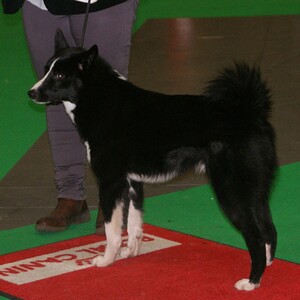
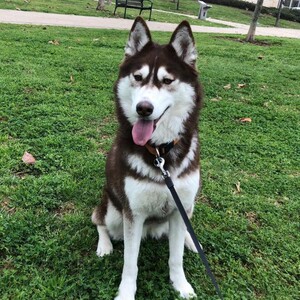
Siberian Husky. · ShonMichaeli / Wikimedia Commons, CC BY-SA 4.0. Cropped and resized.
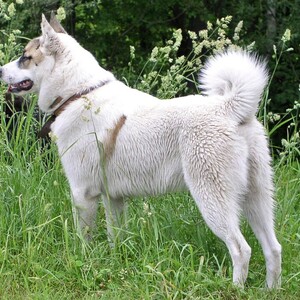
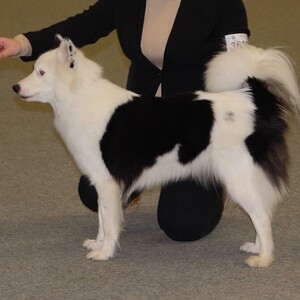
The Siberian Husky is a medium-sized sled dog of the Spitz type, with a thick double coat, erect triangular ears and blue, brown or odd eyes. Wikipedia says it was created by the Chukchi people of the Russian Far East. The FCI standard describes it as friendly and gentle, but alert and outgoing, without the possessive instincts of a guard dog.
Quick facts
| Common name | Siberian Husky |
| Scientific name | Canis lupus familiaris |
| Country of origin | United States (a breed developed from the Chukchi dogs of Siberia) |
| Official recognition | FCI, definitively since 8 September 1966 (group 5, Nordic sled dogs; standard no. 270); also recognised by the AKC |
| Lifespan | 12–14 years, according to the AKC |
| Size (males) | 53.5–60 cm at the withers; 20.5–28 kg |
| Size (females) | 50.5–56 cm at the withers; 15.5–23 kg |
| Coat type | Double, of medium length, with a soft, dense undercoat |
| Common colours | Black, grey, agouti, sable, red, white, with or without white markings |
| Energy level | Very high |
| Suited to an apartment? | Only with a great deal of exercise |
| Temperament | Friendly, gentle, alert, outgoing, mischievous |
| Tendency to aggression | Very low; it is not a guard dog |
| Good with children | Very good, according to the AKC |
| Good with other animals | Very good with dogs; may chase small animals |
| Genetic predispositions | Cancer, arthritis; hip dysplasia and eye diseases are relatively rare |
History and origin
Wikipedia says the Siberian Husky was created by the Chukchi people of the Chukotka Peninsula, in eastern Siberia, for sled pulling and companionship. The Russian fur trader William Goosak brought them to Nome, Alaska, during the Gold Rush, to work in the mining areas and on expeditions through otherwise impassable terrain.
In 1925, several sled dog teams carried diphtheria serum from Nenana to Nome, a distance of more than 600 miles. The last musher was Gunnar Kaasen, whose lead dog was called Balto, while the longest stretch was covered by Leonhard Seppala's team, led by Togo.
How the breed developed
- Centuries ago – Created by the Chukchi people in Siberia.
- Gold Rush – Brought to Nome, Alaska.
- 1925 – The “serum run” to Nome.
- 8 September 1966 – The FCI recognises the breed.
Breed rating
| Feature | Stars |
|---|---|
| Training and intelligence | ★★★★☆ |
| Easy to train | ★★★★★ |
| Intelligence | ★★★★★ |
| Independence | ★★★★★ |
| Stubbornness | ★★★★★ |
| Behaviour and temperament | ★★★★★ |
| Affectionate with family | ★★★★★ |
| Friendly with children | ★★★☆☆ |
| Good with other dogs | ★★★☆☆ |
| Good with cats and other animals | ★★★★★ |
| Loyalty | ★★★★★ |
| Tendency to be aggressive | ★★☆☆☆ |
| Tendency to bark | ★★★★☆ |
| Needs and care | ★★★☆☆ |
| Shedding | ★★★★★ |
| Needs frequent grooming | ★★★★☆ |
| Activity and lifestyle | ★★★☆☆ |
| Energy level | ★★★☆☆ |
| Daily exercise needs | ★★★★★ |
| Suited to apartment life | ★☆☆☆☆ |
| Health and longevity | ★★★★★ |
| Life expectancy | ★★★★☆ |
| Predisposition to genetic diseases | ★☆☆☆☆ |
| Working abilities and uses | ★★★★☆ |
| Good companion dog | ★★★★★ |
| Good companion dog | ★★★★☆ |
Indicative rating: 5 stars means the highest level. It is based on the ratings the American Kennel Club gives the breed and on the FCI standard.
Physical characteristics
The standard describes it as a medium-sized working dog, quick and light on its feet, with free and graceful movement. The AKC says the almond-shaped eyes may be brown or blue; odd eyes or parti-coloured eyes are also accepted.
General appearance
The coat is double and of medium length, well furred but never so long that it hides the outline of the dog. The undercoat is soft and dense, and the guard hairs are straight, smooth and lie flat.
| Feature | Siberian Husky |
|---|---|
| Size | Medium |
| Height at the withers | males: 53.5–60 cm; females: 50.5–56 cm |
| Weight | males: 20.5–28 kg; females: 15.5–23 kg |
| Coat | Double, medium |
| Eyes | Brown, blue or odd |
| Type | Sled dog |
The standard accepts black, grey, agouti, sable, red and white, solid or in several shades, with or without white markings, symmetrical or not. Merle and brindle patterns are not accepted.
Training and socialisation
The standard describes it as friendly and gentle, but alert and outgoing. It does not have the possessive instincts of a guard dog, is not overly suspicious of strangers and is not aggressive with other dogs. Its intelligence and eagerness to work make it a pleasant companion.
The AKC says it has an overwhelming desire to run, so it must be kept on a lead or in a securely fenced area. It is very sociable and needs the company of people or other dogs; it should not be left alone all day.
Tips for effective training
- Keep it on a lead. Its desire to run is overwhelming.
- Do not leave it alone all day. It needs company.
- Make training fun. That is what the AKC recommends.
- Check the fence. It may jump or dig.
Activity needs and lifestyle
Bred to pull a light sled over long distances, it needs a great deal of exercise every day: running, canicross, bikejoring or sled pulling. Without enough exercise it gets bored and becomes destructive.
| Activity | How often | Why it matters |
|---|---|---|
| Running or canicross | daily | Energy |
| Long walks | daily | Stamina |
| Sledding or harness work | in winter, occasionally | Working instinct |
Tips for a balanced life
- It needs a great deal of exercise.
- The fence must be high and secure.
- Avoid hard exercise in hot weather.
Care and health
Coat and skin care
The AKC says the husky is naturally very clean and needs only a few baths a year. Weekly brushing keeps the coat healthy, and twice a year, when it sheds its undercoat, it needs brushing much more often.
Common health problems
The AKC says the breed is generally healthy and long-lived, active even in old age. Hip dysplasia and eye diseases are relatively rare. Watch for:
| Condition | Description | Common symptoms |
|---|---|---|
| Cancer | Occurs, as in many breeds | Lumps, weight loss |
| Arthritis | Mainly in old age | Stiffness, limping |
| Eye diseases | Relatively rare, but they occur | Poor vision, cloudy eyes |
Other care
- Have its eyes checked by a vet.
- Brush it often during shedding.
- Keep it at the right weight.
Diet and nutrition
The AKC says it stays in good condition on less food than other breeds of the same size. Dogs that pull sleds in winter may need up to 32% protein, and about 20% in summer.
Tips for a healthy diet
The table gives a starting estimate, calculated with the formula from the Merck Veterinary Manual. The first two calorie columns show the calories per day for a healthy adult dog. The last column shows what this means in dry food with 3,500–4,000 kcal per kilogram.
| Dog's weight | Calories per day (neutered) | Calories per day (not neutered) | Dry food per day (approximate) |
|---|---|---|---|
| 16 kg | 900 kcal | 1,010 kcal | 220–290 g |
| 22 kg | 1,140 kcal | 1,280 kcal | 280–370 g |
| 28 kg | 1,360 kcal | 1,530 kcal | 340–440 g |
- Do not overfeed it.
- Adjust the protein to its workload.
- A dog is at the right weight when you can feel its ribs under the coat without pressing hard.
Foods to avoid
Some human foods are dangerous for dogs: chocolate, coffee, grapes and raisins, onions, garlic, xylitol (a sweetener used in chewing gum), macadamia nuts and alcohol.
Reproduction and development
Physical and emotional maturity
In dogs, sexual maturity usually comes between 6 and 12 months. Most breeds become adults at around 13–15 months.
Mating and pregnancy
Pregnancy lasts about 63 days, counted from ovulation. Mating a female on her first heat is not recommended. The FCI standard requires that only healthy dogs of typical breed appearance are used for breeding.
Caring for the puppies
In dogs, a litter has 5–6 puppies on average, and the number rises with the size of the breed. Socialisation starts in the first weeks: gentle handling, everyday noises and new people.
Interesting facts
- Odd eyes. It may have one blue eye and one brown.
- The Chukchi dog. Created by the Chukchi people of Siberia.
- No odour. The AKC says it is naturally clean and odourless.
- It eats little. It stays in condition on less food than other breeds.
- Not a guard dog. The standard says it has no guarding instinct.
In popular culture
Balto (1995)
The animated film “Balto” tells the story of the 1925 serum run to Nome; Balto was Gunnar Kaasen's lead dog.
Togo (2019)
The film “Togo” tells the story of the same run from the perspective of Togo, Leonhard Seppala's lead dog.
Frequently asked questions
Can it be let off the lead?
It is not recommended; the AKC says it has an overwhelming desire to run.
Is it a good guard dog?
No; the standard says it has no guarding instinct.
What colour are its eyes?
Brown, blue, one of each or parti-coloured.
Can it live in a flat?
Only with a great deal of daily exercise.
How long does it live?
The AKC gives 12–14 years.