Australian ShepherdCharacteristics, history, training and care
The Australian Shepherd is an active herding breed developed in the United States. It is associated with ranch work and needs physical activity as well as opportunities to learn. Coat colour and breed labels do not guarantee an individual dog’s temperament or health.
Quick facts
| Common name | Australian Shepherd |
| Scientific name | Canis lupus familiaris |
| Country of origin | USA (although the name suggests Australia) |
| Official Recognition | Recognised by AKC, FCI and UKC |
| Typical lifespan | About 12-15 years |
| Dimensions (Male) | About 51-58 cm / 23-29 kg |
| Dimensions (Female) | About 46-53 cm / 18-25 kg |
| Coat type | Double, medium length, weather-resistant |
| Common colours | Blue merle, red merle, black, red, with or without white and tan markings |
| Energy Level | Very high |
| Suitable for an apartment? | Depends on exercise, training, health and the individual dog |
| Temperament | Intelligent, hardworking, affectionate |
| Behaviour towards unfamiliar people and dogs | Individual behaviour varies; socialisation, training and management matter |
| Compatibility with children | Depends on the individual; adult supervision and suitable handling are essential |
| Compatibility with other animals | Depends on socialisation, prey drive and the animals involved |
| Health considerations | Hip and elbow dysplasia, epilepsy, eye diseases, MDR1 drug sensitivity |
- Primary category:Dog breeds
- Explore this animal's categories:
History and Origin
Despite its name, the Australian Shepherd was developed in the western United States in the 19th and 20th centuries as a working dog on ranches.
Evolution of the breed
- Basque and Australian connections - One popular theory says the breed's ancestors came with Basque shepherds, some of whom had worked in Australia before moving to the United States; the name may also come from sheep imported from Australia with their dogs.
- Development in the American West - Ranchers kept the most agile, intelligent and hard-working dogs, creating a versatile herding breed.
- Rodeos and films - The breed became better known after the Second World War through rodeo shows and films, especially the trick dogs of Jay Sisler.
- Official recognition - The American Kennel Club recognised the Australian Shepherd in 1993.
Breed Evaluation
The Australian Shepherd is a very intelligent, affectionate and energetic dog, best suited to active owners. These are general editorial ratings, not measured scores; individual dogs vary.
| Characteristic | Stars |
|---|---|
| Training and Intelligence | ★★★★★ |
| Easy to train | ★★★★★ |
| Intelligence | ★★★★★ |
| Level of independence | ★★★☆☆ |
| Level of stubbornness | ★★☆☆☆ |
| Behavior and Temperament | ★★★★☆ |
| Affectionate with family | ★★★★★ |
| Friendly with children | ★★★★☆ |
| Compatible with other dogs | ★★★★☆ |
| Compatible with cats and other animals | ★★★☆☆ |
| Degree of loyalty | ★★★★★ |
| Tendency to be aggressive | ★☆☆☆☆ |
| Tendency to bark | ★★★☆☆ |
| Needs and Care | ★★★☆☆ |
| Shedding level | ★★★★☆ |
| Requires frequent care | ★★★☆☆ |
| Activity and Lifestyle | ★★★★★ |
| Energy level | ★★★★★ |
| Daily exercise requirement | ★★★★★ |
| Suitable for apartment living | ★★☆☆☆ |
| Health and Longevity | ★★★★☆ |
| Life expectancy | ★★★★☆ |
| Predisposition to genetic diseases | ★★★☆☆ |
| Work and Utility Features | ★★★★★ |
| Good watchdog | ★★★★☆ |
| Good companion dog | ★★★★★ |
Physical Characteristics
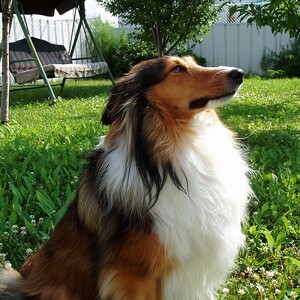
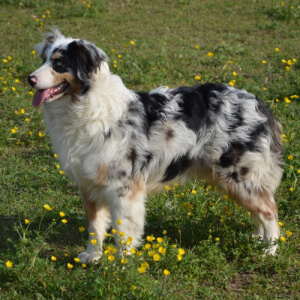
The Australian Shepherd is a medium-sized, athletic and well-balanced dog, built for agility and stamina.
General appearance
- A strong but lean body, slightly longer than it is tall.
- A medium-length, weather-resistant double coat.
- Triangular ears set high on the head, which fold forward or to the side.
- Brown, blue, amber or odd-coloured eyes; many dogs have two different eye colours.
- A long tail, or a naturally short "bobtail" in some dogs; in some countries tails are docked, where this is legal.
| Characteristic | Australian Shepherd |
|---|---|
| Size | Medium (about 46-58 cm at the shoulder) |
| Weight | About 18-32 kg |
| Coat | Double, medium length, weather-resistant |
| Colours | Blue merle, red merle, black, red, with or without white and tan markings |
| Shedding tendency | Moderate to high |
| Build | Athletic, with moderate bone |
The Australian Shepherd is an athletic, hard-working and intelligent dog with a lively, alert expression.
Training and Socialization
The Australian Shepherd learns very quickly, but needs consistent training and regular mental challenges to avoid boredom. It enjoys working with people, which makes it well suited to advanced training and dog sports.
Tips for effective training
- Start early - Puppies can begin learning simple commands as soon as they come home, from about 8 weeks old.
- Use positive rewards - This dog responds best to training with treats, praise and play.
- Give mental challenges - Aussies enjoy learning tricks and tasks; without mental stimulation they can become bored and destructive.
- Socialise widely - Introduce the puppy to many people, animals and places, as some Aussies can be reserved or suspicious with strangers.
- Manage the herding instinct - Some Aussies try to herd children, cyclists or other animals by circling or nipping at heels; training can redirect this behaviour.
Fair, varied training will help the Australian Shepherd become an obedient and well-adjusted family companion.
Activity and Lifestyle Needs
The Australian Shepherd is one of the most active breeds and needs daily physical and mental exercise. Without enough activity, it can become restless, anxious or destructive.
| Activity | Recommended duration |
|---|---|
| Daily walks and runs | At least 60-90 min |
| Interactive games | About 30 min |
| Obedience and agility training | About 15-30 min |
| Dog sports (frisbee, flyball, canicross, herding) | Recommended |
Recommendations for a balanced lifestyle
- Better with space - It is best suited to homes with a garden and owners who can give it plenty of daily activity.
- Ideal for active families - It suits people who run, hike or take part in dog sports.
- Does not like being alone - If left alone for long periods, it may become anxious and destructive.
- Great at dog sports - It is one of the most successful breeds in agility, frisbee, flyball and herding trials.
Without enough activity and mental challenges, the Australian Shepherd may develop unwanted behaviours such as chewing objects, digging or excessive barking.
Care and Health
The Australian Shepherd is not difficult to care for, but owners should know about some inherited health problems.
Fur and skin care
- Brushing 1-2 times a week - The double coat sheds moderately, and more during seasonal shedding, so regular brushing prevents tangles and loose hair.
- Occasional baths - Bathing is needed only from time to time, when the dog is dirty.
- Checking ears and claws – Ears should be cleaned regularly and claws trimmed if they don't grow naturally.
Common health problems
| Condition | Description | Common symptoms |
|---|---|---|
| Hip and elbow dysplasia | Abnormal development of the joints | Lameness, stiff gait |
| Epilepsy | A neurological disorder that occurs in the breed | Recurrent seizures |
| Eye diseases | Including cataracts, Collie eye anomaly and progressive retinal atrophy | Poor vision, especially at night |
| Deafness and blindness | Common in "double merle" puppies, born when two merle dogs are bred together | No reaction to sounds, poor vision |
| MDR1 drug sensitivity | A gene mutation that makes some dogs very sensitive to certain medicines | Severe reactions to some drugs; a DNA test is available |
Other aspects of care
- Weight control - Food should match the dog's level of activity, as extra weight puts strain on the joints.
- Regular veterinary checks - Yearly check-ups and health tests of breeding dogs help reduce inherited problems.
The Australian Shepherd is generally a healthy, hardy breed, but responsible breeders test for inherited diseases.
Diet and Nutrition
The Australian Shepherd needs a balanced diet that supports its high activity level and joint health.
Recommendations for a healthy diet
Choose a complete, balanced diet suited to age, size and health. Plan home-prepared diets and supplements with a qualified veterinarian; raw pet food can carry harmful bacteria.
| Food type | Daily Amount (Adults) | Frequency |
|---|---|---|
| Premium dry food | Individual amount; follow complete-food guidance and veterinary advice | 2 meals/day |
| Home cooked food | Individual amount; follow complete-food guidance and veterinary advice | 2 meals/day |
| Raw food: bacterial contamination is a concern | Individual amount; follow complete-food guidance and veterinary advice | 2 meals/day |
Forbidden foods
Chocolate, grapes and raisins, onions and garlic, and xylitol - toxic to dogs. ; Cooked bones - can splinter and cause injuries or intestinal blockage. ; Very fatty food - can lead to digestive problems and pancreatitis. ; Overfeeding - can cause weight gain, which strains the joints.
The Australian Shepherd must be fed properly to keep its energy and healthy joints.
Reproduction and Development
Breeding requires veterinary planning, suitable health screening and care for the mother and puppies. Pregnancy and birth can involve complications.
Physical and emotional maturity
- Physical maturity: Most Aussies reach adult size at about 12-18 months, but continue to fill out until about 2 years.
- Emotional maturity: Many become calmer and more settled at about 2-3 years.
Mating and Gestation
- Breeding decisions require veterinary assessment of maturity, health and suitable screening; a fixed age does not establish that breeding is appropriate.
- Duration of gestation: Approximately 58-68 days, usually about 63 days.
- Average number of puppies: Usually about 6-8 puppies per litter.
Puppy care
- The first 3 weeks: Puppies depend completely on their mother for warmth, milk and protection.
- Between 4-8 weeks: They begin to play, explore and learn from their littermates; this is an important time for socialisation with people.
- After 8 weeks: Puppies can go to new homes and begin basic training and house rules.
Australian Shepherd puppies develop quickly, and early socialisation is essential for a balanced temperament.
Curiosities and Interesting Facts
- It is not Australian - Despite its name, the breed was developed in the United States.
- A rodeo star - It became popular through rodeo shows, where trained Aussies performed tricks.
- Eyes of different colours - Many Australian Shepherds have two different eye colours or eyes with patches of colour.
- Dog sports champion - Aussies are among the most successful breeds in agility, frisbee and herding.
- Strong herding instinct - Some try to "herd" people and animals, which can be managed with training.
- Natural bobtail - Some Australian Shepherds are born with a naturally short tail; the same gene occurs in several other breeds, such as the Pembroke Welsh Corgi.
- The Miniature American Shepherd - A smaller dog developed from small Australian Shepherds is now recognised as a separate breed.
The Dog in Popular Culture
Australian shepherd in modern media and culture
- Hyper Hank - In the 1970s, the frisbee-catching Australian Shepherd Hyper Hank became famous and performed at the White House during Jimmy Carter's presidency.
- Jay Sisler's trick dogs - The Aussies "Shorty" and "Stub" performed at rodeos and appeared in Disney films, including "Stub: The World's Greatest Cowdog".
- Working dogs - Many Australian Shepherds work as search-and-rescue dogs, detection dogs and therapy dogs.
Importance in modern culture
- A companion for adventurers - It is popular with hikers, runners and active families because of its energy and intelligence.
- A working breed - It was bred mainly for work and ability rather than looks, which explains its intelligence and stamina.