Bracco ItalianoCharacteristics, history, training and care
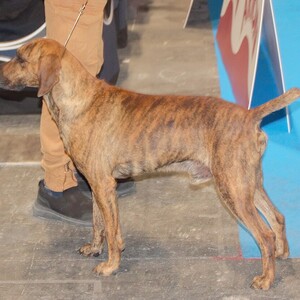
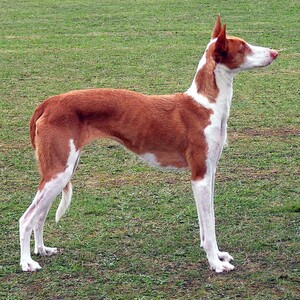
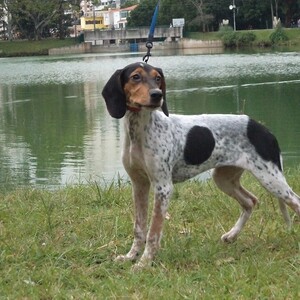
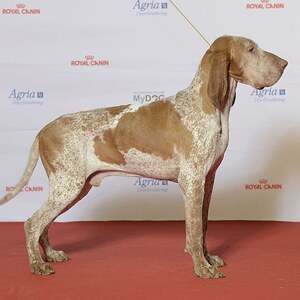
Bracco Italiano (Italian Pointer) · Svenska Mässan from Sweden / Wikimedia Commons, CC BY 2.0. Cropped and resized.
The Bracco Italiano is a large, powerful Italian hunting dog with long ears and pendulous lips. It is one of the oldest pointing dogs, used to hunt birds. At home it is gentle and patient, and in the field it never tires.
Quick facts
| Common name | Bracco Italiano (Italian Pointer) |
| Scientific name | Canis lupus familiaris |
| Country of origin | Italy |
| Official recognition | FCI, definitively since 7 June 1956 (Group 7, pointing dogs, with a working trial; standard no. 202); also recognised by the AKC |
| Lifespan | 10–14 years |
| Size (males) | 58–67 cm at the withers |
| Size (females) | 55–62 cm at the withers |
| Weight | 25–40 kg, depending on size |
| Coat type | Short, dense and glossy |
| Common colours | White; white with orange or brown patches; white flecked with orange or brown |
| Energy level | Moderate to high |
| Suited to an apartment? | Not really; it needs daily exercise |
| Temperament | Docile, sociable, patient, easy to train |
| Tendency to aggression | Very low |
| Good with children | Good |
| Good with other animals | Good |
| Genetic predispositions | Hip and elbow dysplasia, eyelid problems, cataracts, renal amyloidosis |
- Primary category:Dog breeds
- Explore this animal's categories:
History and origin
The Bracco Italiano is the traditional pointing dog of the Italian peninsula. Frescoes from the 14th century show very similar dogs, which proves how old the breed is.
The first dog entered in the stud book of the Kennel Club Italiano, founded in 1882, was a Bracco Italiano. At the time there were two types: a larger, heavier one and a smaller, lighter one.
How the breed developed
- 14th century – Italian frescoes show dogs similar to the Bracco.
- 1882 – The first dog in the Kennel Club Italiano stud book is a Bracco Italiano.
- 1890s – Ferdinando Delor writes a standard for the large type.
- 1949 – A national standard is approved and the breed society is founded.
- 7 June 1956 – The FCI recognises the breed.
- 1990s – The breed reaches the United States.
Breed rating
| Feature | Stars |
|---|---|
| Training and intelligence | ★★★★★ |
| Easy to train | ★★★★★ |
| Intelligence | ★★★★☆ |
| Independence | ★★☆☆☆ |
| Stubbornness | ★★☆☆☆ |
| Behaviour and temperament | ★★★★☆ |
| Affectionate with family | ★★★☆☆ |
| Friendly with children | ★★★★☆ |
| Good with other dogs | ★★★★☆ |
| Good with cats and other animals | ★★★☆☆ |
| Loyalty | ★★★★☆ |
| Tendency to be aggressive | ★☆☆☆☆ |
| Tendency to bark | ★★☆☆☆ |
| Needs and care | ★★☆☆☆ |
| Shedding | ★☆☆☆☆ |
| Needs frequent grooming | ★★☆☆☆ |
| Activity and lifestyle | ★★★★☆ |
| Energy level | ★★★★☆ |
| Daily exercise needs | ★★★★☆ |
| Suited to apartment life | ★★☆☆☆ |
| Health and longevity | ★★★★☆ |
| Life expectancy | ★★★★☆ |
| Predisposition to genetic diseases | ★★★☆☆ |
| Working abilities and uses | ★★★★★ |
| Good hunting dog (pointing) | ★★★★★ |
| Good companion dog | ★★★★☆ |
Indicative rating: 5 stars means the highest level. It is based on the ratings the American Kennel Club gives the breed and on the FCI standard.
Physical characteristics
It is a strong, harmonious dog, almost square: the body is as long as, or slightly longer than, it is tall. It has lean legs, well-developed muscles and a “chiselled” head.
General appearance
The long ears reach the tip of the nose. The upper lips are long and hang below the lower jaw. The fairly large eyes have a gentle, submissive expression.
| Feature | Bracco Italiano |
|---|---|
| Size | Large |
| Height at the withers | males: 58–67 cm; females: 55–62 cm |
| Weight | 25–40 kg |
| Coat | Short, dense and glossy |
| Ears | Long, reaching the tip of the nose |
| Eyes | Fairly large, dark ochre or brown |
The accepted colours are white, white with orange or amber patches, white with brown patches, and white finely flecked with orange or brown. For white and brown, the standard prefers a warm brown, like a monk's habit.
Training and socialisation
The standard describes it as docile, easy to train, reliable and with a great capacity for understanding. The AKC says it can be a little independent, but wants to please its owner.
It needs a calm, patient trainer, gentle but firm.
Tips for effective training
- Be calm and patient. It helps it understand quickly.
- Give it a job. Hunting or dog sports keep it content.
- Use praise. It is happy when it sees it has pleased you.
- Try agility, obedience or rally. They give it exercise and mental activity.
Activity needs and lifestyle
The AKC recommends at least 30 minutes of exercise a day, preferably more: free running in a safe, fenced place or a daily jog. It also needs time with the family, playing or training.
| Activity | How often | Why it matters |
|---|---|---|
| Running or jogging | daily, at least 30 minutes | Its energy is moderate to high |
| Play or training with the family | daily | It makes it happy |
| Hunting or dog sport | weekly | Uses its pointing instinct |
Tips for a balanced life
- Puppies should not run on hard surfaces such as concrete until they are a year old.
- Avoid repeated jumping in puppies, to protect their joints.
- It is gentle indoors and tireless in the field.
Care and health
Coat and skin care
The short coat needs very little grooming. The long ears should be cleaned with a solution recommended by the vet once or twice a week, so that they stay clean and dry.
Common health problems
The AKC says the Bracco Italiano is generally healthy. Responsible breeders test their dogs for:
| Condition | Description | Common symptoms |
|---|---|---|
| Hip dysplasia | The hip joint forms incorrectly and, over time, arthritis develops | Limping, difficulty getting up or jumping, hip pain |
| Elbow dysplasia | The elbow joint develops incorrectly and arthritis appears | Limping on the front legs, especially after exercise |
| Entropion and ectropion | The eyelid turns inwards or outwards | Watering, irritation, red eyes |
| Renal amyloidosis | An abnormal protein builds up in the kidneys | Great thirst, lots of urine, weight loss |
Other care
- Trim the nails regularly so they do not split.
- Brush its teeth regularly.
- Wipe its pendulous lips after meals.
Diet and nutrition
Puppies grow fast, so they need a balanced diet that does not overload their joints. The AKC warns that some dogs put on weight easily.
Tips for a healthy diet
The table gives a starting estimate, calculated with the formula from the Merck Veterinary Manual. The first two calorie columns show the calories per day for a healthy adult dog. The last column shows what this means in dry food with 3,500–4,000 kcal per kilogram.
| Dog's weight | Calories per day (neutered) | Calories per day (not neutered) | Dry food per day (approximate) |
|---|---|---|---|
| 25 kg | 1,250 kcal | 1,410 kcal | 310–400 g |
| 32 kg | 1,510 kcal | 1,700 kcal | 380–490 g |
| 40 kg | 1,780 kcal | 2,000 kcal | 440–570 g |
- Give it its food in two meals a day to reduce the risk of bloat.
- Training treats count towards the daily portion.
- A dog is at the right weight when you can feel its ribs without pressing hard.
Foods to avoid
Some human foods are dangerous for dogs: chocolate, coffee, grapes and raisins, onions, garlic, xylitol (a sweetener used in chewing gum), macadamia nuts and alcohol.
Reproduction and development
Physical and emotional maturity
In dogs, sexual maturity usually comes between 6 and 12 months, but in large breeds it can be delayed until about two years. The body also reaches its adult form later than in small breeds.
Mating and pregnancy
Pregnancy lasts about 63 days, counted from ovulation. Mating a female on her first heat is not recommended. The FCI standard requires that only healthy dogs of typical breed appearance are used for breeding.
Caring for the puppies
In large breeds, a litter has around 7 puppies on average. Socialisation starts in the first weeks: gentle handling, everyday noises and new people.
Interesting facts
- The first dog in the Italian stud book. The first dog entered in the Kennel Club Italiano stud book was a Bracco.
- Painted 700 years ago. Frescoes from the 14th century show dogs like it.
- The colour of a “monk's habit”. For the brown variety, the standard prefers a warm brown, like a monk's habit.
- A fast, ground-covering trot. It was selected for a fast trot that covers a lot of ground.
- A retriever too. The standard says it is by nature an excellent retriever.
In popular culture
In the frescoes of Italy
According to the FCI standard, the Bracco Italiano appears in Italian frescoes from the 14th century. That makes it one of the oldest pointing dogs depicted in art.
Frequently asked questions
What is a Bracco Italiano?
An Italian pointing dog with long ears and pendulous lips, used to hunt birds.
How big does it get?
Males measure 58–67 cm and females 55–62 cm; they weigh 25–40 kg.
How much exercise does it need?
At least 30 minutes a day, but more is better.
Is it easy to train?
Yes. It is docile and wants to please its owner, if it is handled calmly.
How long does it live?
Its life expectancy is 10–14 years.