MuskoxOvibos moschatus — habitat, diet and reproduction
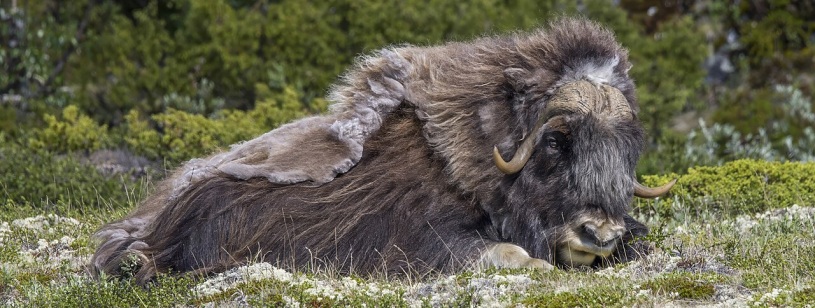
Male muskox with long shaggy hair and heavy horns in Dovrefjell, Norway. · Charles J. Sharp / Sharp Photography / Wikimedia Commons / CC BY-SA 4.0 (https://creativecommons.org/licenses/by-sa/4.0/). Cropped and resized. Source: https://commons.wikimedia.org/wiki/File:Muskox_(Ovibos_moschatus)_male_Dovrefjell_1.jpg
The muskox (Ovibos moschatus) is an Arctic herbivore with long hair and powerful horns. Fine underfur called qiviut insulates the body. When predators approach, adults may form a barrier around calves. Its compact build and behaviour suit year-round life on tundra.
Quick facts
| Common name | Muskox |
| Scientific name | Ovibos moschatus |
| Lifespan | Approximately 12–20 years, depending on conditions |
| Height | Males around 1.5 m at the shoulder; females about 1.2 m |
| Weight | Males around 270–360 kg; females 180–230 kg in described Alaskan populations |
| Diet | Grasses, sedges and low woody plants; ruminant herbivore |
| Predators | Wolves and grizzly bears |
| Conservation status | Least Concern globally; local populations may face difficulties |
| Distribution | Canada and Greenland; reintroduced to Alaska and parts of Eurasia |
| Habitat | Arctic tundra and cold open landscapes |
| Family | Bovidae; related to the sheep and goat group |
| Reproduction | Usually one calf after around 8–9 months of gestation |
Interesting facts
- Both sexes have horns, with particularly heavy bases on mature males.
- Adults can face predators while sheltering calves behind them.
- Qiviut sheds in spring and may catch on shrubs.
- Despite its name, the muskox is closer to sheep and goats than to cattle.
Records and extremes
Muskoxen remain on Arctic tundra throughout the year. A compact body and dense coat conserve heat when food is difficult to reach.
Fine qiviut lies beneath the long outer hairs. Spring shedding releases much of the undercoat, helped by rubbing against rocks or shrubs.
Males engage in spectacular head-on contests. Thick horn bases bear part of the impact as rivals compete for breeding access.
Characteristics
A stocky body, short legs and a very small tail sit beneath hanging hair. The shoulders form a slight hump.
Dark brown fur contrasts with paler areas on the back and legs. Horns curve down beside the head before turning outward and upward. Female horns are thinner.
Cloven hooves support movement on rock and frozen ground. The shaggy appearance may recall a yak, although the two belong to different bovid branches.
Behaviour
Herd size varies seasonally. Females, calves and younger animals maintain close associations, while some males travel alone or in small groups.
Adults may form a defensive line or outward-facing circle against wolves. Calves occupy the sheltered area. Close spacing and horns complicate attacks.
Slow movement and resting conserve energy. Short bursts of speed remain possible. Familiar sites with shallow snow are often used through winter.
Habitat and distribution
Natural populations survived in Arctic Canada and Greenland. Relocations restored populations in Alaska and parts of Eurasia.
Norway’s present Dovrefjell population descends from releases between 1947 and 1953. It is monitored and managed by the authorities.
Tundra provides low vegetation in a cold, largely treeless landscape. Wind-swept areas offer easier winter access to plants than deep snow.
Diet and feeding
Grasses, sedges, herbs and shrub shoots, including Arctic willows, form the diet. Summer vegetation helps rebuild body reserves.
Ruminant digestion involves bringing food back for further chewing. Stomach microorganisms help process plant fibres.
Muskoxen can uncover plants beneath shallow snow. Deep snow or hard ice crust restricts feeding, making stored fat especially important.
Reproduction and life cycle
Breeding begins in late summer and continues into autumn. Dominant males compete for access to groups of females.
After roughly 8–9 months, a female usually gives birth to one calf. Alaskan births mainly occur between April and June.
The calf stands quickly and follows its mother, initially relying on milk. Grazing develops gradually, while maternal condition and food availability influence survival.
Name and history
Zimmermann described the species in 1780 as Bos moschatus. It is now known as Ovibos moschatus.
Arctic communities clean and spin qiviut into warm clothing. Fibres can be gathered after natural shedding. The Inuit name Umiŋmak refers to the animal’s shaggy appearance.
Conservation and threats
Globally Least Concern, muskoxen can still face local declines from severe winters, disease and other pressures. Regional monitoring reveals these differences.
Rain followed by freezing can seal plants beneath hard ice. Such events restrict food and affect calf survival. Climate change alters these conditions.
Conservation includes protecting habitat and tracking populations. Restored and introduced herds require management suited to their particular setting.
Frequently asked questions
Is it closely related to cattle?
Within Bovidae, it is closer to the sheep and goat group.
What is qiviut?
Fine insulating underfur beneath the long outer hairs.
How are calves protected?
Adults may form a line or circle with horns facing the threat.
Do females have horns?
Yes, generally thinner than those of males.
Does it hibernate?
It stays active and seeks food where snow is shallower.
Where did Norway’s population come from?
The present Dovrefjell population descends from releases made between 1947 and 1953.