Ocean sunfishMola mola — habitat, diet and reproduction
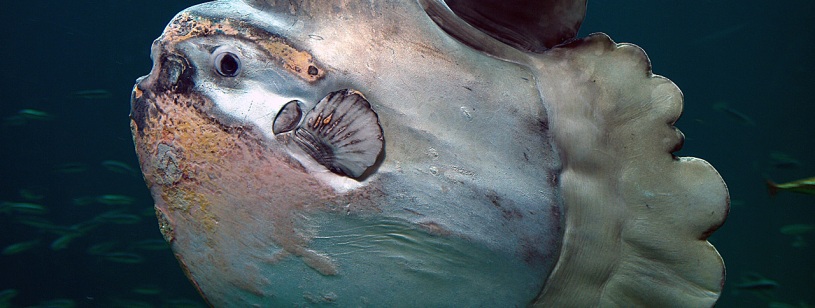
Ocean sunfish (Mola mola) in a public aquarium. · Per-Ola Norman / Public domain ().
The ocean sunfish is the heaviest bony fish in the world: large individuals can weigh more than a tonne. Its body is tall and flattened and ends abruptly without a normal tail, as if the fish were just a huge head. It lives in warm and temperate oceans and feeds mainly on jellyfish.
Quick facts
| Common name | Ocean sunfish, mola |
| Scientific name | Mola mola |
| Lifespan | Not known precisely; probably over 10 years |
| Length | Often 1.8 m; can exceed 3 m fin to fin |
| Weight | Often 250–1,000 kg; up to about 2,300 kg |
| Diet | Carnivore: jellyfish, salps, small fish, crustaceans |
| Predators | Sea lions, orcas, large sharks |
| Conservation status | Vulnerable (VU) |
| Distribution | Tropical and temperate oceans worldwide |
| Habitat | Open ocean, from the surface to hundreds of metres deep |
| Family | Molidae |
| Reproduction | Huge numbers of eggs released in open water |
- Primary category:Fish
- Explore this animal's categories:
Interesting facts
- A female can carry about 300 million eggs, more than any other known vertebrate.
- A newly hatched fry is a few millimetres long, while the adult can be millions of times heavier.
- It lies on its side at the surface, probably to warm up after dives into cold water.
- Seabirds and cleaner fish remove parasites from its skin.
Characteristics
The ocean sunfish has a tall, laterally flattened body with thick, rough, silver-grey skin. Its very long dorsal and anal fins move together like oars.
Instead of a tail it has a broad flap called the clavus, used as a rudder. The mouth is small, with teeth fused into a beak.
Behaviour
The sunfish swims by beating its top and bottom fins alternately. It looks slow but often dives hundreds of metres for food.
After dives it surfaces and lies on its side in the sun, giving it its English name. Its skin carries many parasites, cleaned by birds and small fish.
Habitat and distribution
The species lives in tropical and temperate waters of all oceans, including the Atlantic and Mediterranean. It does not live in the Black Sea.
It spends most of its time in the open ocean, far from shore.
Diet and feeding
Its main food is jellyfish and other jelly animals such as salps. It also eats small fish, larvae, crustaceans and squid.
Jellyfish provide few nutrients, so the sunfish must eat enormous amounts. Floating plastic bags can be mistaken for jellyfish and swallowed.
Reproduction and life cycle
The sunfish releases huge numbers of tiny eggs directly into the water, and very few reach adulthood.
Young look at first like tiny spiky stars, losing the spines as they grow. Growth is very fast: one captive sunfish gained over 300 kg in about a year.
Name and history
The scientific name Mola comes from Latin and means “millstone”, after the fish’s round shape and grey colour.
The weight record of 2,744 kg belongs to a related species, Mola alexandrini, the heaviest bony fish ever measured.
Conservation and threats
The ocean sunfish is assessed as Vulnerable. Its main threat is accidental capture in fishing nets and on hooks, where it is caught in large numbers.
Plastic litter mistaken for jellyfish and ship strikes also harm it, and in some Asian countries it is fished for meat.
Frequently asked questions
How much does an ocean sunfish weigh?
Usually 250–1,000 kg; the largest can reach about 2,300 kg.
Is the ocean sunfish dangerous?
No. It is a peaceful fish that eats jellyfish and small animals.
Why does the sunfish have no tail?
Its tail became a broad flap called the clavus, which helps it steer.
Does the sunfish live in the Black Sea?
No. It lives in the oceans and the Mediterranean, but not the Black Sea.