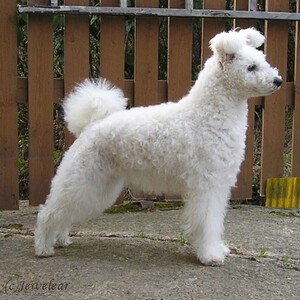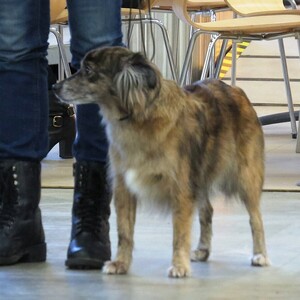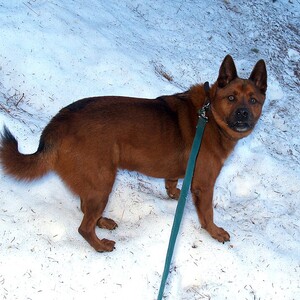
Bouvier des ArdennesCharacteristics, history, training and care
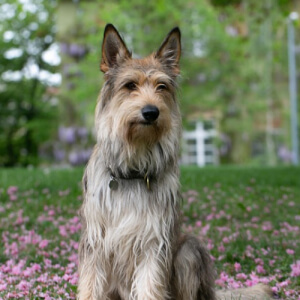
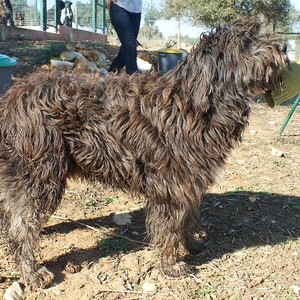
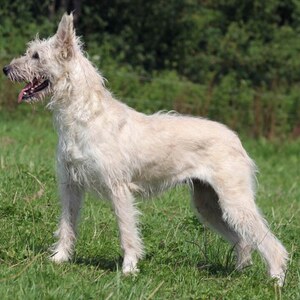
Bouvier des Ardennes. · Andreagenial / Wikimedia Commons, CC BY-SA 3.0. Cropped and resized.
The Bouvier des Ardennes is a medium to large Belgian farm dog with a harsh, shaggy coat and a moustache. It was bred in the Belgian Ardennes to gather, drive and guard cattle. It is hard-working, intelligent and full of energy, but it needs a job.
Quick facts
| Common name | Bouvier des Ardennes |
| Scientific name | Canis lupus familiaris |
| Country of origin | Belgium (Ardennes) |
| Official recognition | FCI, definitively since 13 June 1955 (Group 1, cattle dogs, with a working trial; standard no. 171); also recognised by the AKC |
| Lifespan | 12–16 years |
| Size (males) | 56–62 cm at the withers; 28–35 kg |
| Size (females) | 52–56 cm at the withers; 22–28 kg |
| Coat type | Harsh, shaggy, about 6 cm long, with a very dense undercoat; moustache and beard |
| Common colours | Any colour except white: grey, fawn, reddish, straw, often mixed with black |
| Energy level | Very high |
| Suited to an apartment? | No; it needs work and space |
| Temperament | Hard-working, stubborn, brave, affectionate |
| Tendency to aggression | Low, but it is protective |
| Good with children | Average |
| Good with other animals | Average; it needs socialisation |
| Genetic predispositions | No breed-specific diseases are known |
- Primary category:Dog breeds
- Explore this animal's categories:
History and origin
In the Belgian Ardennes this dog has always been called “the cow dog”. It takes its name from its job, not its looks: “bouvier” means cowherd. The harsh climate, hard work, difficult terrain and poverty of the region shaped its type.
In the 19th century it drove dairy cows, sheep, pigs and horses. It was also used to track roe deer and wild boar, and in the two world wars it became the poachers' dog. As the farms disappeared, its numbers fell so low that it was thought to be extinct, until a few dogs were found in 1985.
How the breed developed
- 19th century – The dogs drive cattle, sheep, pigs and horses in the Ardennes.
- 27 April 1903 – At the Liège show, Professor Reul discovers Tom, the first dog of the ideal type.
- 1913 – A society for improving the breed is founded in Liège and proposes a standard.
- 13 June 1955 – The FCI recognises the breed.
- 1985 – A few breeders find surviving dogs and rebuild the breed.
- 25 October 2000 – The current FCI standard is published.
Breed rating
| Feature | Stars |
|---|---|
| Training and intelligence | ★★★★☆ |
| Easy to train | ★★★★★ |
| Intelligence | ★★★★★ |
| Independence | ★★★★☆ |
| Stubbornness | ★★★★☆ |
| Behaviour and temperament | ★★★★☆ |
| Affectionate with family | ★★★★★ |
| Friendly with children | ★★★☆☆ |
| Good with other dogs | ★★★☆☆ |
| Good with cats and other animals | ★★★☆☆ |
| Loyalty | ★★★★★ |
| Tendency to be aggressive | ★★☆☆☆ |
| Tendency to bark | ★★★★★ |
| Needs and care | ★★★☆☆ |
| Shedding | ★☆☆☆☆ |
| Needs frequent grooming | ★★★☆☆ |
| Activity and lifestyle | ★★★★★ |
| Energy level | ★★★★★ |
| Daily exercise needs | ★★★★★ |
| Suited to apartment life | ★☆☆☆☆ |
| Health and longevity | ★★★★☆ |
| Life expectancy | ★★★★★ |
| Predisposition to genetic diseases | ★★☆☆☆ |
| Working abilities and uses | ★★★★★ |
| Good cattle dog | ★★★★★ |
| Good companion dog | ★★★★☆ |
Indicative rating: 5 stars means the highest level. It is based on the ratings the American Kennel Club gives the breed and on the FCI standard.
Physical characteristics
It is a medium to large, hardy, muscular and fast dog. The AKC describes it as a dog made to be useful, not beautiful. It looks a little like the Bouvier des Flandres and the Laekenois Belgian Shepherd.
General appearance
The harsh coat forms a moustache and a short beard. The small, triangular ears are preferably erect. Many dogs are born with a short tail, and quite a few are born without one.
| Feature | Bouvier des Ardennes |
|---|---|
| Size | Medium to large |
| Height at the withers | males: 56–62 cm; females: 52–56 cm |
| Weight | males: 28–35 kg; females: 22–28 kg |
| Coat | Harsh, shaggy, about 6 cm; very dense undercoat, thicker in winter |
| Ears | Small, triangular, preferably erect |
| Tail | Often naturally short or absent |
All colours except white are accepted. The coat is often a mix of grey, black and fawn hairs, ranging from light to dark grey, brownish, reddish or straw-coloured. A white patch on the chest or on the tips of the toes is accepted.
Training and socialisation
The AKC gives it top marks for trainability, but says it is a dog that thinks for itself. It may question a task if it finds it boring, repetitive or unrewarding.
It needs firm but fair training, started at an early age. For a beginner it can be hard to handle.
Tips for effective training
- Be firm and fair. Discipline is learnt early, without harshness.
- Vary the exercises. Repetition bores it.
- Reward it. Good motivation makes it a precise, attentive competitor.
- Socialise it. Positive contact with people and animals shows it what is normal.
Activity needs and lifestyle
The AKC says a walk round the neighbourhood or a game of fetch is not enough. It is a farm dog that works all day without tiring. If it has no job, it will find its own “occupations”.
| Activity | How often | Why it matters |
|---|---|---|
| Farm work or dog sport | daily | It needs a job |
| Free running in nature | several times a week | Burns off its very high energy |
| Training | daily | Keeps its mind busy |
Tips for a balanced life
- It suits a farm or a country house with plenty of space.
- It is not a dog for sedentary owners.
- It barks often to announce its territory.
Care and health
Coat and skin care
The coat is hard-wearing and needs little grooming: brushing once a week and an occasional bath. The AKC says the coat should not be hand-stripped, so that it stays natural.
Common health problems
There are no known hereditary diseases specific to the breed. As the population is small, breeders must take care of genetic diversity.
Other care
- Trim the nails when they start to touch the floor.
- Check the ears and teeth regularly.
- Clean its moustache and beard after meals.
Diet and nutrition
A very active farm dog needs a lot of energy. Adjust the portion to its work and weight.
Tips for a healthy diet
The table gives a starting estimate, calculated with the formula from the Merck Veterinary Manual. The first two calorie columns show the calories per day for a healthy adult dog. The last column shows what this means in dry food with 3,500–4,000 kcal per kilogram.
| Dog's weight | Calories per day (neutered) | Calories per day (not neutered) | Dry food per day (approximate) |
|---|---|---|---|
| 22 kg | 1,140 kcal | 1,280 kcal | 280–370 g |
| 28 kg | 1,360 kcal | 1,530 kcal | 340–440 g |
| 35 kg | 1,610 kcal | 1,810 kcal | 400–520 g |
- Give it its food in two meals a day.
- Fresh water should always be available.
- A dog is at the right weight when you can feel its ribs without pressing hard.
Foods to avoid
Some human foods are dangerous for dogs: chocolate, coffee, grapes and raisins, onions, garlic, xylitol (a sweetener used in chewing gum), macadamia nuts and alcohol.
Reproduction and development
Physical and emotional maturity
In dogs, sexual maturity usually comes between 6 and 12 months, but in large breeds it can be delayed until about two years. The body also reaches its adult form later than in small breeds.
Mating and pregnancy
Pregnancy lasts about 63 days, counted from ovulation. Mating a female on her first heat is not recommended. The FCI standard requires that only healthy dogs of typical breed appearance are used for breeding.
Caring for the puppies
In large breeds, a litter has around 7 puppies on average. Socialisation starts in the first weeks: gentle handling, everyday noises and new people.
Interesting facts
- Thought to be extinct. Until 1985 the breed was believed to have died out.
- The poachers' dog. In the two world wars it was used by poachers.
- It is born without a tail. Many dogs have a short or missing tail from birth.
- The first ideal dog was called Tom. He was discovered on 27 April 1903 at the Liège show.
- It herds horses too. In the 19th century it drove not only cows and sheep, but also pigs and horses.
Frequently asked questions
What does “bouvier” mean?
It means cowherd, someone who guards and drives cattle.
How big does it get?
Males measure 56–62 cm and weigh 28–35 kg; females measure 52–56 cm and weigh 22–28 kg.
Is it suitable for a beginner?
Not really. It is intelligent and independent and needs an experienced owner.
How long does it live?
Its life expectancy is 12–16 years.