Peruvian Hairless DogCharacteristics, history, training and care
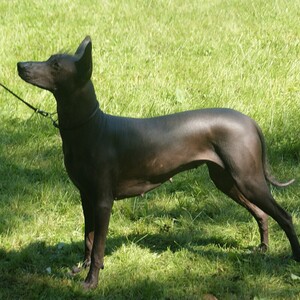
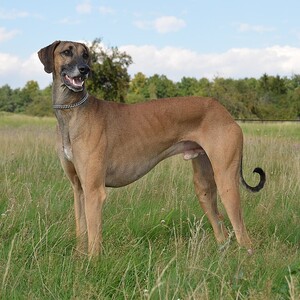
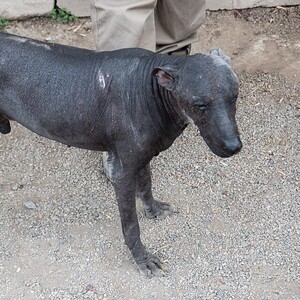
Peruvian Hairless Dog. · PsamatheM / Wikimedia Commons, CC BY-SA 4.0. Cropped and resized.
The Peruvian Hairless Dog (Viringo) is an elegant, slender sighthound-type dog from Peru, hairless or, less often, with a short coat. It comes in three sizes: small, medium and large. It appears on the pottery of pre-Inca cultures. The standard describes it as noble and affectionate at home, lively and alert, but wary of strangers.
Quick facts
| Common name | Peruvian Hairless Dog (Perro sin pelo del Perú, Viringo) |
| Scientific name | Canis lupus familiaris |
| Country of origin | Peru |
| Official recognition | FCI, definitively since 30 June 1981 (group 5, primitive type; standard no. 310); the AKC calls it the Peruvian Inca Orchid |
| Lifespan | 12–14 years, according to the AKC |
| Size (males) | Small: 25–40 cm; medium: 41–50 cm; large: 51–65 cm |
| Size (females) | The same three sizes |
| Weight | Small: 4–8 kg; medium: 8–12 kg; large: 12–30 kg |
| Coat type | Hairless (a few hairs on the head, feet and tail) or short-coated |
| Common colours | Black, grey, bronze, copper, brown or blonde skin |
| Energy level | High |
| Suited to an apartment? | Yes, with daily exercise |
| Temperament | Noble, affectionate, lively, alert, wary of strangers |
| Tendency to aggression | Low; a good watchdog |
| Good with children | Average |
| Good with other animals | Average |
| Genetic predispositions | Skin sensitive to sun and cold; missing teeth |
- Primary category:Dog breeds
- Explore this animal's categories:
History and origin
The FCI standard says this dog, known as the “viringo”, has aroused the curiosity of Peruvians throughout the ages. It appears on the pottery of pre-Inca cultures such as Vicus, Mochica, Chancay and Chimú, where it often takes the place of the puma, the snake or the falcon. The hairless dog appears in the pre-Inca archaeological periods, between 300 BC and AD 1460.
Wikipedia says it is the only surviving dog breed native to Peru and that it is recognised as part of the national cultural heritage. Over time it has had many names, including “Allqu” in Inca times and “perro calato”.
How the breed developed
- 300 BC – AD 1460 – It appears in the art of pre-Inca cultures.
- Inca era – It is called “Allqu”.
- 30 June 1981 – The FCI recognises the breed.
- Today – It is part of Peru's cultural heritage.
Breed rating
| Feature | Stars |
|---|---|
| Training and intelligence | ★★★☆☆ |
| Easy to train | ★★★☆☆ |
| Intelligence | ★★★★☆ |
| Independence | ★★★★☆ |
| Stubbornness | ★★★☆☆ |
| Behaviour and temperament | ★★★★☆ |
| Affectionate with family | ★★★★★ |
| Friendly with children | ★★★☆☆ |
| Good with other dogs | ★★★☆☆ |
| Good with cats and other animals | ★★★☆☆ |
| Loyalty | ★★★★★ |
| Tendency to be aggressive | ★★☆☆☆ |
| Tendency to bark | ★★★☆☆ |
| Needs and care | ★☆☆☆☆ |
| Shedding | ★★★☆☆ |
| Needs frequent grooming | ★★★☆☆ |
| Activity and lifestyle | ★★★★☆ |
| Energy level | ★★★★☆ |
| Daily exercise needs | ★★★☆☆ |
| Suited to apartment life | ★★★☆☆ |
| Health and longevity | ★★★★☆ |
| Life expectancy | ★★★☆☆ |
| Predisposition to genetic diseases | ★★★☆☆ |
| Working abilities and uses | ★★★☆☆ |
| Good guard dog | ★★★☆☆ |
| Good companion dog | ★★★★★ |
Indicative rating: 5 stars means the highest level. It is based on the ratings the American Kennel Club gives the breed and on the FCI standard.
Physical characteristics
The standard describes it as an elegant, slender dog whose appearance expresses speed, strength and harmony. The AKC says it is essentially a sighthound, with the same elegant outline as the Greyhound or the Whippet.
General appearance
The hairless variety has only a few hairs on the head, the tips of the feet and the tail. The coated variety has a smooth, short, close-lying coat. Wikipedia says the gene that causes hairlessness often means these dogs have fewer teeth, especially molars and premolars.
| Feature | Peruvian Hairless Dog |
|---|---|
| Sizes | Small, medium and large |
| Height at the withers | 25–40 cm, 41–50 cm or 51–65 cm |
| Weight | 4–8 kg, 8–12 kg or 12–30 kg |
| Coat | Hairless or short |
| Type | Elegant, sighthound-like |
| Teeth | Some are often missing |
In the hairless variety, the skin may be black, slate black, elephant black, all shades of grey, bronze, copper, dark brown or light blonde, solid or with unpigmented areas. In the coated variety, the coat may be any colour except merle.
Training and socialisation
The standard describes it as noble and affectionate at home with those close to it, but also lively and alert; it can be wary of strangers and is a good watchdog.
The AKC says it needs a lot of socialisation and that, being intelligent and a primitive breed, it can be a challenge to train. New owners must set aside plenty of time for training and socialising the puppy.
Tips for effective training
- Socialise it a lot. The AKC says it needs a lot of socialisation.
- Be patient. It is a primitive breed.
- Keep it indoors. It is not an outdoor dog.
- Try coursing or agility. The AKC says it does well at them.
Activity needs and lifestyle
The AKC says it needs a fair amount of activity: play in a fenced yard, walks several times a day or games indoors. It does well at coursing, rally and agility.
| Activity | How often | Why it matters |
|---|---|---|
| Walks | several times a day | Energy |
| Indoor games | daily | Mental activity |
| Coursing | occasionally | Sighthound instinct |
Tips for a balanced life
- Put sunscreen on it on sunny days.
- In winter, dress it warmly.
- Keep it indoors, with the family.
Care and health
Coat and skin care
The AKC says it is not an outdoor dog and that it needs sunscreen on sunny days. Otherwise, an occasional bath keeps it clean. The nails are trimmed as needed, and the ears are checked from time to time.
Common health problems
The AKC says most of these dogs are healthy. The hairless variety needs special care for its skin and teeth:
| Condition | Description | Common symptoms |
|---|---|---|
| Sunburn and skin irritation | Skin unprotected by hair burns and gets irritated easily | Red skin, scabs |
| Missing teeth | The hairlessness gene often leads to fewer teeth | Difficulty chewing |
Other care
- Put sunscreen on it.
- Moisturise its skin if it gets dry.
- Check its teeth regularly.
Diet and nutrition
The AKC says some dogs put on weight easily, so calories and weight must be watched. If it is missing teeth, its food must be easy to chew.
Tips for a healthy diet
The table gives a starting estimate, calculated with the formula from the Merck Veterinary Manual. The first two calorie columns show the calories per day for a healthy adult dog. The last column shows what this means in dry food with 3,500–4,000 kcal per kilogram.
| Dog's weight | Calories per day (neutered) | Calories per day (not neutered) | Dry food per day (approximate) |
|---|---|---|---|
| 6 kg | 430 kcal | 480 kcal | 110–140 g |
| 10 kg | 630 kcal | 710 kcal | 160–200 g |
| 20 kg | 1,060 kcal | 1,190 kcal | 260–340 g |
- Give it its food in two meals a day.
- Choose the kibble size to suit its teeth.
- A dog is at the right weight when you can feel its ribs without pressing hard.
Foods to avoid
Some human foods are dangerous for dogs: chocolate, coffee, grapes and raisins, onions, garlic, xylitol (a sweetener used in chewing gum), macadamia nuts and alcohol.
Reproduction and development
Physical and emotional maturity
In dogs, sexual maturity usually comes between 6 and 12 months. Most breeds become adults at around 13–15 months.
Mating and pregnancy
Pregnancy lasts about 63 days, counted from ovulation. Mating a female on her first heat is not recommended. The FCI standard requires that only healthy dogs of typical breed appearance are used for breeding.
Caring for the puppies
In dogs, a litter has 5–6 puppies on average, and the number rises with the size of the breed. Socialisation starts in the first weeks: gentle handling, everyday noises and new people.
Interesting facts
- On pre-Columbian pottery. It appears on vessels of pre-Inca cultures.
- Three sizes. It comes in small, medium and large varieties.
- National heritage. It is part of Peru's cultural heritage.
- “Orchid of the Incas”. The AKC calls it the Peruvian Inca Orchid.
- Coated too. Coated puppies are sometimes born as well.
In popular culture
On the pottery of pre-Inca cultures
The FCI standard says it appears on the pottery of the Vicus, Mochica, Chancay and Chimú cultures, often in place of the puma, the snake or the falcon, especially in the Chancay culture.
Frequently asked questions
Is its skin really bare?
Yes, the hairless variety has only a few hairs on the head, feet and tail.
How big does it get?
It depends on the size: 25–40 cm, 41–50 cm or 51–65 cm.
Does it need sun protection?
Yes. The AKC says it needs sunscreen on sunny days.
How long does it live?
The AKC gives 12–14 years.