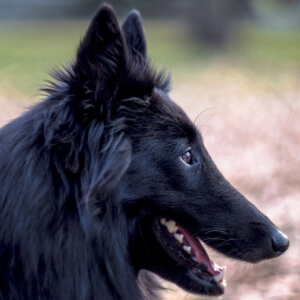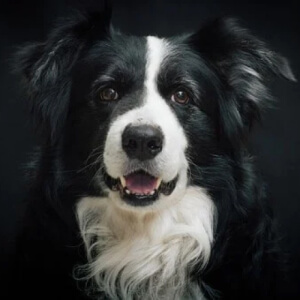
Border CollieCharacteristics, history, training and care
The Border Collie is a herding dog with a strong working background. Many individuals are highly active and responsive to training. They need appropriate physical activity, mental stimulation and opportunities to rest.
Quick facts
| Common name | Border Collie |
| Scientific name | Canis lupus familiaris |
| Country of origin | United Kingdom (Anglo-Scottish border region) |
| Official Recognition | Recognized by FCI; recognized by AKC in 1995 |
| Typical lifespan | About 12-15 years |
| Dimensions (Male) | About 48-56 cm / 14-20 kg |
| Dimensions (Female) | About 46-53 cm / 12-19 kg |
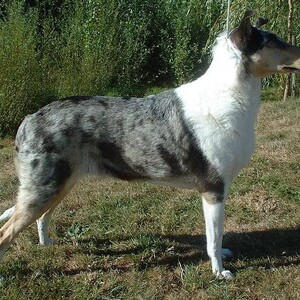
| Coat type | Double, medium-long (rough) or short (smooth) |
| Common colours | Black and white, red and white, tricolour, blue merle and others |
| Energy Level | Very high |
| Suitable for an apartment? | Depends on exercise, training, health and the individual dog |
| Temperament | Smart, alert, hard-working |
| Behaviour towards unfamiliar people and dogs | Individual behaviour varies; socialisation, training and management matter |
| Compatibility with children | Depends on the individual; adult supervision and suitable handling are essential |
| Compatibility with other animals | Depends on socialisation, prey drive and the animals involved |
| Health considerations | Hip dysplasia, collie eye anomaly, epilepsy |
- Primary category:Dog breeds
- Explore this animal's categories:
History and Origin
The Border Collie is a herding dog from the borderlands of Scotland and England, bred for intelligence, agility and stamina.
Evolution of the breed
- Working sheepdogs - Shepherds in Scotland, northern England and Wales used collie-type dogs for centuries to gather and drive sheep in the hills.
- The name "Border Collie" - It refers to the Anglo-Scottish border region; the name became common after the International Sheep Dog Society (founded in 1906) began to use it in the early 20th century.
- Bred for work - It was selected for herding ability rather than looks; many of today's Border Collies trace back to a dog called Old Hemp, born in Northumberland in 1893.
- The Border Collie is recognised by the American Kennel Club and is strongly associated with herding work. It can also participate in conformation and other organised activities.
Breed Evaluation
The Border Collie is a very intelligent, hard-working and extremely active dog, suited to people who can give it daily mental and physical stimulation. These are general editorial ratings, not measured scores; individual dogs vary.
| Characteristic | Stars |
|---|---|
| Training and Intelligence | ★★★★★ |
| Easy to train | ★★★★★ |
| Intelligence | ★★★★★ |
| Level of independence | ★★★☆☆ |
| Level of stubbornness | ★★★★☆ |
| Behavior and Temperament | ★★★★★ |
| Affectionate with family | ★★★★★ |
| Friendly with children | ★★★★★ |
| Compatible with other dogs | ★★★★☆ |
| Compatible with cats and other animals | ★★★☆☆ |
| Degree of loyalty | ★★★★★ |
| Tendency to be aggressive | ★☆☆☆☆ |
| Tendency to bark | ★★★★☆ |
| Needs and Care | ★★★☆☆ |
| Shedding level | ★★★☆☆ |
| Requires frequent care | ★★★☆☆ |
| Activity and Lifestyle | ★★★★★ |
| Energy level | ★★★★★ |
| Daily exercise requirement | ★★★★★ |
| Suitable for apartment living | ★☆☆☆☆ |
| Health and Longevity | ★★★★☆ |
| Life expectancy | ★★★★★ |
| Predisposition to genetic diseases | ★★★☆☆ |
| Work and Utility Features | ★★★★★ |
| He's a good herding dog. | ★★★★★ |
| Good companion dog | ★★★★☆ |
Physical Characteristics
The Border Collie is an athletic, agile, well-proportioned dog, built for quick movement and stamina.
General appearance
- A muscular body, slightly longer than tall, built for quick, precise movements.
- A double coat, either medium-long ("rough") or short ("smooth"), that protects it from the weather.
- A moderately broad head with an alert, intelligent expression.
- Ears that can be erect or semi-erect, giving it a lively expression.
- A long tail, carried low, which helps with balance during quick turns.
| Characteristic | Border Collie |
|---|---|
| Size | Medium (about 46-56 cm at the shoulder) |
| Weight | About 12-20 kg |
| Coat | Double, rough or smooth, weather-resistant |
| Muzzle | Medium length, tapering |
| Shedding tendency | Moderate |
| Build | Athletic and hardy |
The Border Collie is a very agile, intelligent breed with all the qualities needed to excel in herding and dog sports.
Training and Socialization
The Border Collie is often described as the most intelligent dog breed and can learn complex commands and tasks with great precision. Because of its high energy and need for mental stimulation, training must be consistent and varied.
Tips for effective training
- Start early - The Border Collie learns very quickly and should be socialised and trained from an early age.
- Use positive methods - It responds best to rewards, praise and play; harsh methods should be avoided.
- Varied, challenging training - It gets bored with repetitive exercises, so new commands, agility courses and interactive games are important.
- Managing the herding instinct - It may try to "herd" people, cars or other animals by circling, staring or nipping; recall and redirection help control this.
- A daily job - It should not be left bored, or it may become destructive, anxious or hyperactive.
The Border Collie is not ideal for beginners, but with good training it becomes one of the most obedient and hard-working dogs.
Activity and Lifestyle Needs
The Border Collie is one of the most active breeds and needs daily physical exercise and mental stimulation.
| Activity | Recommended duration |
|---|---|
| Brisk walks and runs | At least 60-90 min |
| Obedience training | About 15-30 min |
| Dog sports (agility, flyball, frisbee, herding) | Several times a week |
| Interactive games | About 30 min |
Recommendations for a balanced lifestyle
- Best for active people - It is not suited to a quiet lifestyle or a small apartment without plenty of exercise.
- Needs a job - It is happiest when it has a task, such as herding, agility training or search and rescue.
- Do not leave it alone for long - The Border Collie can develop separation anxiety and destructive behaviour.
- Can live with other animals if well socialised - Because of its herding instinct, it must learn not to chase or "herd" cats and smaller dogs.
- Rest is important too - Young dogs and very driven dogs also need to learn to relax.
The Border Collie is best suited to active people who can give it daily physical and mental stimulation.
Care and Health
The Border Collie is generally a strong, healthy breed, but it needs regular veterinary checks and care for its coat and joints.
Fur and skin care
- Regular brushing - The Border Collie sheds moderately, and brushing 2-3 times a week removes dead hair.
- Baths only when needed - The coat tends to shed dirt, so frequent washing is not necessary.
- Ear and eye checks - Ears and eyes should be checked regularly for signs of infection.
Common health problems
| Condition | Description | Common symptoms |
|---|---|---|
| Hip dysplasia | Abnormal development of the hip joint | Limping, pain when moving |
| Collie eye anomaly | An inherited eye disease that can affect vision; a DNA test is available | Vision problems, in severe cases blindness |
| Epilepsy | Seizures of varying strength | Trembling, loss of consciousness |
| Rare inherited diseases | Such as trapped neutrophil syndrome and neuronal ceroid lipofuscinosis; DNA tests are available | Poor growth, infections, nervous system problems |
Other aspects of care
- Regular veterinary checks - Checks of the joints, eyes and nervous system are recommended.
- Balanced food - Even active Border Collies can gain weight if their food does not match their activity.
- Protecting young joints - Very hard, repetitive exercise should be avoided in the first year to protect growing bones and joints.
The Border Collie is generally healthy, but some inherited problems should be monitored, and breeding dogs should be health-tested.
Diet and Nutrition
The Border Collie needs a balanced diet with good-quality protein to support its high energy level.
Recommendations for a healthy diet
Choose a complete, balanced diet suited to age, size and health. Plan home-prepared diets and supplements with a qualified veterinarian; raw pet food can carry harmful bacteria.
| Food type | Daily Amount (Adults) | Frequency |
|---|---|---|
| Premium dry food | Individual amount; follow a complete diet’s guidance and veterinary advice | 2 meals/day |
| Home cooked food | Individual amount; follow complete-food guidance and veterinary advice | 2 meals/day |
| Raw food: bacterial contamination is a concern | Individual amount; follow complete-food guidance and veterinary advice | 2 meals/day |
Forbidden foods
Chocolate, grapes and raisins, onions and xylitol - toxic to dogs. ; Cooked bones - can splinter and cause intestinal blockage. ; Very fatty foods - can upset digestion and cause pancreatitis. ; Overfeeding - can lead to extra weight, which affects the joints and performance.
The Border Collie should be fed according to its activity level, avoiding overfeeding.
Reproduction and Development
Breeding requires veterinary planning, suitable health screening and care for the mother and puppies. Pregnancy and birth can involve complications.
Physical and emotional maturity
- Physical maturity: The Border Collie reaches adult size at about 12 months, but continues to fill out until about 2 years.
- Emotional maturity: It can stay very playful and excitable until about 2-3 years and needs regular mental stimulation.
Mating and Gestation
- Breeding decisions require veterinary assessment of maturity, health and suitable screening; reaching a fixed age does not establish that breeding is appropriate.
- Duration of gestation: Approximately 58-68 days, usually about 63 days.
- Average number of puppies: Usually about 4-8 puppies.
Puppy care
- The first 3 weeks: Puppies depend completely on their mother for warmth and milk, which supports their immune system.
- Between 4-8 weeks: They begin to explore and play with littermates and people; early socialisation is very important for a balanced temperament.
- Moving to a new home: When puppies go to their new homes, gentle basic training can start right away, as Border Collies learn very quickly.
Border Collie puppies develop quickly, and good food and a stimulating environment are essential for healthy growth.
Curiosities and Interesting Facts
- A very clever dog - In Stanley Coren's book The Intelligence of Dogs, the Border Collie is ranked first for working and obedience intelligence.
- Chaser - A Border Collie called Chaser, studied by psychologist John Pilley, learned the names of more than 1,000 toys.
- Fast learners - According to Coren, the top breeds, including the Border Collie, can learn a new command in fewer than five repetitions.
- The "eye" - When herding, Border Collies use an intense stare, called "the eye", to move sheep.
- Herding anything - Some Border Collies try to herd children, bicycles or other pets.
- Dog sports champion - It excels in agility, flyball, frisbee, obedience and sheepdog trials.
- Active into old age - Many Border Collies stay active and playful until they are 12-14 years old.
The Dog in Popular Culture
The Border Collie is a familiar sight in films, television and dog sports around the world.
Border Collie in Modern Media and Culture
- "Babe" (1995) - In this film about a pig who learns to herd sheep, the sheepdogs Fly and Rex are Border Collies.
- "One Man and His Dog" - This long-running BBC television programme made sheepdog trials with Border Collies popular in Britain.
- Therapy and assistance dogs - Thanks to their intelligence, some Border Collies work as therapy and assistance dogs.
Importance in modern culture
- Search and rescue - Thanks to its speed and intelligence, the Border Collie is trained to find missing people.
- A favourite in dog sports - It is a top choice for agility, flyball, frisbee and advanced obedience.