Bedlington TerrierCharacteristics, history, training and care
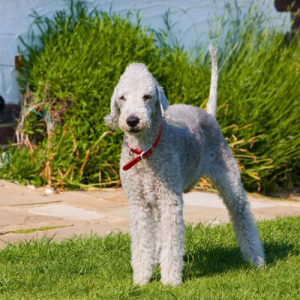
The Bedlington Terrier is an English dog that looks like a lamb, with a thick, curly coat and a rounded head, with no stop between the forehead and the muzzle. It was bred by miners around the town of Bedlington, in northern England. The FCI standard describes it as mild and gentle at rest, but full of courage when roused.
Quick facts
| Common name | Bedlington Terrier |
| Scientific name | Canis lupus familiaris |
| Country of origin | United Kingdom (England) |
| Official recognition | FCI, definitively since 20 June 1963 (group 3, terriers; standard no. 9) |
| Lifespan | 13.7 years on average, according to a 2024 UK study |
| Size (males) | About 41 cm at the withers, slightly more; 8–10 kg |
| Size (females) | About 41 cm at the withers, slightly less; 8–10 kg |
| Coat type | Thick, “linty”, a mixture of hard and soft hair; does not shed |
| Common colours | Blue, liver or sandy, with or without tan |
| Energy level | High |
| Suited to an apartment? | Yes, with daily walks and running |
| Temperament | Brave, confident, affectionate, dignified |
| Tendency to aggression | Can be jealous or quarrelsome with other dogs |
| Good with children | Good; the AKC and the ASPCA describe it as gentle |
| Good with other animals | Accepts them in the house; outdoors it may chase them |
| Genetic predispositions | Copper toxicosis (a liver disease), eye and kidney problems |
- Primary category:Dog breeds
- Explore this animal's categories:
History and origin
Before they had a name, the dogs were used by Romani people and poachers for hunting. They were then called Rothbury Terriers, after Lord Rothbury, who was very fond of them. According to Wikipedia, some dogs have pedigrees going back to 1782.
The name Bedlington Terrier appears from 1825 and was first given to a dog called Young Piper, owned by Joseph Ainsley. Piper hunted badgers from the age of eight months and saved a child from a pig. The dog was called “the favourite companion of the northern miners”.
The first show with a class for the breed took place in 1870, in Bedlington itself, and the breed club was founded in 1875. The breed is related to the Dandie Dinmont Terrier, and its arched back also suggests Whippet blood.
How the breed developed
- 1782 – The oldest known pedigrees.
- 1825 – The name Bedlington Terrier appears.
- 1870 – The first show with a class for the breed.
- 1875 – The breed club is founded.
- 20 June 1963 – Definitive FCI recognition.
Breed rating
| Feature | Stars |
|---|---|
| Training and intelligence | ★★★☆☆ |
| Easy to train | ★★★☆☆ |
| Intelligence | ★★★★☆ |
| Independence | ★★★☆☆ |
| Stubbornness | ★★★☆☆ |
| Behaviour and temperament | ★★★☆☆ |
| Affectionate with family | ★★★★☆ |
| Friendly with children | ★★★☆☆ |
| Good with other dogs | ★★☆☆☆ |
| Good with cats and other animals | ★★★☆☆ |
| Loyalty | ★★★★☆ |
| Tendency to be aggressive | ★★☆☆☆ |
| Tendency to bark | ★★★☆☆ |
| Needs and care | ★★★☆☆ |
| Shedding | ★☆☆☆☆ |
| Needs frequent grooming | ★★★★☆ |
| Activity and lifestyle | ★★★★☆ |
| Energy level | ★★★★☆ |
| Daily exercise needs | ★★★★☆ |
| Suited to apartment life | ★★★★☆ |
| Health and longevity | ★★★★☆ |
| Life expectancy | ★★★★☆ |
| Predisposition to genetic diseases | ★★★☆☆ |
| Working abilities and uses | ★★★★☆ |
| Good hunting dog | ★★★☆☆ |
| Good companion dog | ★★★★☆ |
Indicative rating: 5 stars means the highest level. The rating is based on the breed's AKC profile (energy 4 out of 5, shedding 1 out of 5, watchdog 4 out of 5), on the FCI standard and on Wikipedia.
Physical characteristics
The FCI standard describes it as a graceful, lithe, muscular dog, with no sign of weakness or coarseness. The head is pear- or wedge-shaped, and the expression is mild at rest. The back is arched, and the body is somewhat longer than it is tall.
General appearance
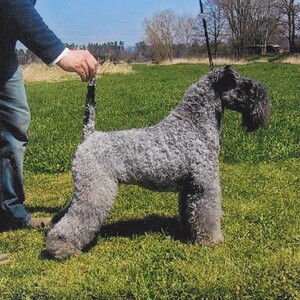
The coat is very thick and “linty”, standing well out from the skin. It is a mixture of hard and soft hair and tends to curl, especially on the head and face. On the head it forms a topknot lighter than the body.
| Feature | Bedlington Terrier |
|---|---|
| Size | Small to medium |
| Height at the withers | about 41 cm |
| Weight | 8–10 kg (FCI) |
| Coat | Thick, curly, non-shedding |
| Colour | Blue, liver or sandy |
| Back | Arched |
The standard accepts blue, liver or sandy, with or without tan. According to Wikipedia, puppies are born black or dark brown and lighten with age, because of a greying gene.
Training and socialisation
The standard describes it as intelligent, confident and affectionate, with strong hunting instincts. According to Wikipedia, it can be stubborn and easily roused. It responds well to gentle, consistent training.
Socialisation with other dogs matters a great deal, because it can be jealous and does not back down if provoked. The New Zealand Kennel Club recommends not keeping it with dominant dogs.
Tips for effective training
- Use rewards. It learns quickly.
- Socialise it early with other dogs. It can be jealous.
- Work on the recall. It has sighthound blood and may run off.
- Get it used to clipping from an early age. The coat is clipped regularly.
Activity needs and lifestyle
It is a fast, hardy dog and a very good swimmer. According to Wikipedia, it could keep pace with a trotting horse. It needs daily walks and running in a fenced area. At home it is usually calm.
| Activity | How often | Why it matters |
|---|---|---|
| Walks | daily | Fitness |
| Running in a fenced area | several times a week | Speed and energy |
| Swimming | occasionally | It likes water |
Tips for a balanced life
- Suited to active families.
- Good for people who want a dog that does not shed.
- A secure fence, as it may run after animals.
Care and health
Coat and skin care
The coat does not shed and has little smell, but dead hair stays trapped in it. That is why it must be brushed weekly and clipped every few weeks. According to Wikipedia, the lamb-like show clip is hard to do, even for professionals.
Common health problems
A 2024 study in the United Kingdom found a life expectancy of 13.7 years, compared with 12.7 years on average for purebred dogs. The breed is known above all for copper toxicosis, an inherited liver disease that affected about 5% of the dogs in a British survey.
| Condition | Description | Common symptoms |
|---|---|---|
| Copper toxicosis | Copper builds up in the liver and destroys it; a DNA test exists | Tiredness, vomiting, weight loss, yellow skin and eyes |
| Retinal dysplasia and cataracts | Inherited eye problems | Poor sight, cloudy or watery eyes |
| Kidney disease | The kidneys work less and less well | Drinks and urinates a lot, loses its appetite |
Other care
- Ask for the parents' DNA test for copper toxicosis.
- Check its eyes.
- Have yearly blood tests done.
Diet and nutrition
A small, active terrier needs good-quality food. Dogs with copper toxicosis are given a low-copper diet, set by the vet.
Tips for a healthy diet
The table gives a starting estimate, calculated with the formula from the Merck Veterinary Manual. The first two calorie columns show the calories per day for a healthy adult dog. The last column shows what this means in dry food with 3,500–4,000 kcal per kilogram.
| Dog's weight | Calories per day (neutered) | Calories per day (not neutered) | Dry food per day (approximate) |
|---|---|---|---|
| 8 kg | 530 kcal | 600 kcal | 130–170 g |
| 9 kg | 580 kcal | 650 kcal | 140–190 g |
| 10 kg | 630 kcal | 710 kcal | 160–200 g |
- Split the food into two meals a day.
- Avoid liver and other copper-rich foods, if the vet advises it.
- A dog is at the right weight when you can feel its ribs under the coat without pressing hard.
Foods to avoid
Some human foods are dangerous for dogs: chocolate, coffee, grapes and raisins, onions, garlic, xylitol (a sweetener used in chewing gum), macadamia nuts and alcohol.
Reproduction and development
Physical and emotional maturity
In dogs, sexual maturity usually comes between 6 and 12 months. Small breeds become adults faster than large ones, usually at around one year.
Mating and pregnancy
Pregnancy lasts about 63 days, counted from ovulation. Mating a female on her first heat is not recommended. The FCI standard requires that only healthy dogs of typical breed appearance are used for breeding.
Caring for the puppies
In small breeds, a litter has 3–4 puppies on average. The puppies are very small and fragile in the first weeks, so they must be kept warm and handled with care. Socialisation starts early: gentle handling, everyday noises and new people.
Interesting facts
- It looks like a lamb. Because of its coat and rounded head.
- A bark like a machine gun. According to Wikipedia, its bark has been compared to a machine gun.
- It swims like a Newfoundland. It is as fast in the water as on land.
- A Westminster winner. In 1948, Rock Ridge Night Rocket took the top prize.
- Dyed dogs. At early shows, some were dyed to look better.
In popular culture
In painting and film
According to Wikipedia, the painter Craigie Aitchison often painted Bedlington Terriers, especially in his Crucifixion paintings. In the Finnish film “Sisu” (2022), a Bedlington is the companion of a gold prospector.
Frequently asked questions
Does it shed?
Hardly at all, but it must be brushed weekly and clipped regularly.
Why does it look like a lamb?
Because of its thick, curly coat and its rounded head, with no stop between the forehead and the muzzle.
Does it get along with other dogs?
Usually yes, if it is socialised; it can be jealous and does not back down.
Which disease should be tested for?
Copper toxicosis, an inherited liver disease; a DNA test exists.