QuailInteresting facts and information
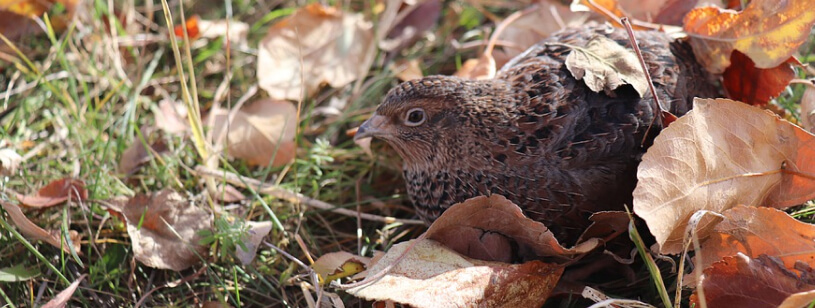
Quail are small, ground-dwelling birds. The common quail (Coturnix coturnix) lives mainly in open grassy habitats and eats seeds and small invertebrates. Unlike many other quail, it makes long seasonal migrations.
Wild quail and domestic quail need separate descriptions. Japanese quail (Coturnix japonica) are widely raised for eggs and meat.
Their patterned brown plumage makes many wild quail difficult to spot among grasses and crops.
Quick facts
| Common name | Quail |
| Scientific name | Coturnix coturnix (common quail); quail also includes other species |
| Typical lifespan | Usually 1-3 years in the wild, up to about 5 years in captivity |
| Maximum speed | Not well measured; fast, low flight over short distances |
| Wingspan | About 32–35 cm for the common quail; other quail species differ |
| Length | About 16-18 cm (common quail) |
| Weight | About 70-140 g (common quail) |
| Diet type | Omnivore (seeds, insects, green plants) |
| Main predators | Birds of prey, foxes, martens and wild cats; hunting is a separate human pressure. |
| Conservation status | Common quail: Least Concern (IUCN); other species differ |
| Geographical distribution | The common quail occurs in Europe, Asia and Africa. Other quail species have different ranges. |
| Social behaviour | Lives alone or in pairs; gathers in larger numbers during migration |
| Special adaptations | Patterned plumage for camouflage and seasonal migration in the common quail |
Interesting facts
- The common quail (Coturnix coturnix) is a migratory bird, unlike many other ground-dwelling gamebirds.
- Small, speckled eggs - Quail eggs weigh only about 10 g, have beautiful brown-spotted shells and are eaten in many countries.
- Long-distance travellers - Although they spend most of their time on the ground, common quails fly across the Mediterranean Sea and the Sahara on their migration between Europe and Africa.
- A distinctive call - The male's three-note call is often written as "wet-my-lips", and it is heard far more often than the bird is seen.
- Egg-laying champions - Domestic Japanese quail can lay around 250-300 eggs a year.
- Masters of hiding - Quails stay hidden in tall grass and crops and prefer to run rather than fly, so they are very hard to spot.
- Quails in the Bible - In the Book of Exodus, flocks of quails provide food for the Israelites in the desert.
Records and remarkable features
- Quail are small, ground-dwelling birds. The common quail (Coturnix coturnix) lives mainly in open grassy habitats and eats seeds and small invertebrates. Unlike many other quail, it makes long seasonal migrations.
- The common quail is the only gamebird in Europe that migrates to Africa for the winter.
- In 1990, Japanese quail chicks hatched aboard the Mir space station, among the first animals to hatch in space.
Characteristics
The quail is a small, plump bird, built for life on the ground and for short, fast flights.
Physical aspect
- Small and rounded - The common quail is only about 16-18 cm long and weighs about 70-140 g, with short wings and a very short tail.
- Camouflage colours - Its brown plumage with pale streaks and dark bars lets it hide perfectly in grass and cereal fields.
- Short, strong legs - Let it run quickly through vegetation, its first defence against predators.
- A short beak - Good for picking up seeds and insects.
- Alert eyes - Quails keep a constant lookout for predators.
Special adaptations
- Explosive take-off - When frightened at close range, quails burst into the air with fast wingbeats and fly low over the ground.
- Strong flyers when migrating - Despite their small wings, common quails fly hundreds of kilometres at night during migration.
- Freezing and running - If pursued, quails crouch motionless or run through the vegetation.
- Coping with dry weather - They get some of their water from insects and green plants, but they also drink when water is available.
Habits and behaviour
Quails are secretive birds. They usually live alone or in pairs, but gather in larger numbers during migration.
Social behaviour
- Alone or in small groups - Outside migration, common quails rarely form large flocks.
- Calls - Males call loudly, often at dusk and at night, to attract females and mark their territory.
- Courtship - Males chase females and fluff up their feathers to impress them during the breeding season.
Defence and Survival Techniques
- Camouflage - They often freeze rather than flee, and are almost invisible in the grass.
- Running - When threatened, they usually run away through the vegetation.
- Short flights - They take off only when danger is very close, and soon land again.
- Hidden nests - They nest on the ground, in tall grass or crops, where the nest is well hidden.
Habitat and geographic distribution
The common quail breeds across Europe, Asia and North Africa and spends the winter mainly in Africa and southern Asia. Other quail species live on other continents.
| Region | Species present | Habitat Preferred |
|---|---|---|
| Europe | Common quail (Coturnix coturnix) | Cereal fields, meadows, steppes |
| Asia | Japanese quail (Coturnix japonica); rain quail (Coturnix coromandelica) | Grasslands, farmland, river valleys |
| Africa | Common quail (wintering and resident); harlequin quail (Coturnix delegorguei) | Grasslands, savannas, farmland |
| North America | New World quails, such as the northern bobwhite and California quail (a separate family) | Farmland, open grassland, scrub |
| Australia | Stubble quail (Coturnix pectoralis), brown quail | Grasslands, crops, coastal meadows |
Types of Habitat
- Grasslands and steppes - Ideal for hiding and finding food.
- Farmland - Common quails like fields of wheat, barley, alfalfa and other crops.
- Dry areas - In Africa and Asia, some quails live in savannas and dry grasslands.
Human Impact and Threats
- Habitat loss - Intensive farming, early harvests and pesticides reduce nesting places and food.
- Hunting - Large numbers of migrating quails are shot or caught in nets, especially around the Mediterranean.
- Weather - Droughts and storms during migration can kill many quails.
Diet and feeding
Quails are omnivores that eat seeds, green plants and insects, depending on the season and habitat.
What does quail eat?
| Type of food | Examples |
|---|---|
| Seeds and cereals | Wheat, millet, maize, oats, weed seeds |
| Green plants | Clover, dandelion, grass shoots |
| Insects and other small animals | Ants, grasshoppers, beetles, caterpillars, worms, spiders |
| Fruit and berries | Small berries and fallen fruit |
| Grit | Small stones that help grind food in the gizzard |
Feeding methods
- Constant pecking - Quails spend much of the day searching for food on the ground.
- Seasonal changes - In spring and summer they eat more insects, especially when raising chicks; in autumn they eat more seeds.
- Scratching - They scratch the ground to uncover seeds and insects.
- Feeding in groups - Captive quails feed together, but can become aggressive when food is short.
Adaptation to Food Availability
- In dry steppes, they feed mainly on seeds and green plants.
- In dry periods, they get part of the water they need from green plants and insects.
- On farms, they are given special feed rich in grain and protein to increase egg production.
Reproduction and life cycle
Quail reproduction differs between species and conditions. High egg production in domestic Japanese quail does not establish that wild populations are stable.
| Characteristic | Details |
|---|---|
| Age of sexual maturity | About 6-8 weeks (Japanese quail); in their first year (common quail) |
| Breeding season | About May - August in Europe; all year in captivity |
| Number of eggs per nest | Usually about 7-12 eggs |
| Incubation period | About 16-20 days |
| Time until chicks can fly | About 19 days |
| Life expectancy | Usually 1-3 years in the wild, up to about 5 years in captivity |
Breeding process
- Males attract females with their loud calls and by chasing them.
- The female makes a simple nest on the ground, a shallow scrape lined with grass, hidden in tall vegetation or crops.
- The eggs are cream-coloured with brown spots, which gives them good camouflage.
- Only the female incubates the eggs and looks after the chicks; in the common quail, the male usually leaves.
- The chicks are precocial: they can run and find food within hours of hatching.
Survival Strategies
- When danger approaches, the female may sit tight on the nest or slip away quietly, relying on camouflage.
- Chicks grow quickly; they can fly at about 19 days old and become independent after about a month or more.
- If a female loses her eggs, she can lay another clutch in the same season.
Name and history
People have hunted and kept quails for thousands of years, for their meat, eggs and song, and even for fights.
Origin and etymology of the name
- The English word "quail" comes from Old French quaille, from Medieval Latin quaccula, probably imitating the bird's call.
- Coturnix is the old Latin name for the quail.
Quail in the History of Humanity
- Ancient Egypt - A quail chick was a hieroglyph for the sound "w", and Egyptian tomb paintings show migrating quails being caught in nets.
- Ancient Greece and Rome - Quails were kept for fighting and eaten as a delicacy; according to Plutarch, the emperor Augustus punished an official for eating a champion fighting quail.
- Japan - The Japanese quail was domesticated in Japan, first as a songbird and later, in the early 20th century, for egg production.
- The 20th century - Japanese quail became important laboratory animals and were even taken into space.
Quail in Folklore and Superstition
- The island of quails - In Greek mythology, Asteria turned into a quail to escape Zeus; the island of Delos was once called Ortygia, "quail island".
- Food from the sky - The Bible describes quails arriving in huge numbers to feed the Israelites in the desert.
Cultural significance and mythology
Quails have been important to people for thousands of years, as food, as songbirds and as symbols in religion and art.
- Quail poisoning - Eating wild quails can sometimes make people ill, a condition called coturnism, probably because the birds have eaten certain poisonous plants; it may explain a passage in the Book of Numbers.
- Songbirds - In Japan and parts of Europe, quails were once kept in cages for their call.
- A state bird - The California quail, a New World quail, is the state bird of California.
Conservation status and threats
Most quail species are widespread, but some wild populations are declining because of habitat loss and hunting, and one species is already extinct.
| IUCN Status | Species Affected | Affected Regions |
|---|---|---|
| Least Concern (LC) | Common quail (Coturnix coturnix) | Europe, Asia, Africa |
| Least Concern (LC) | Rain quail (Coturnix coromandelica) | India, Sri Lanka, Southeast Asia |
| Near Threatened (NT) | Japanese quail (Coturnix japonica), wild populations | East Asia |
| Extinct (EX) | New Zealand quail (Coturnix novaezelandiae), extinct since about 1875 | New Zealand |
Main threats
- Habitat loss - Intensive farming and the loss of grasslands reduce nesting areas.
- Hunting - Quails are hunted in large numbers, and illegal nets and traps catch many migrating birds.
- Pesticides - Farm chemicals reduce the insects and weed seeds that quails eat.
- Weather - Migrating quails are vulnerable to storms and droughts.
Conservation efforts
- Monitoring - In Europe, quail numbers are counted to set sustainable hunting rules.
- Hunting rules - Many countries have hunting seasons and bag limits, and some ban the use of nets.
- Wildlife-friendly farming - Leaving field margins and stubble helps quails and other farmland birds.
In popular culture
- Beethoven's "Pastoral" Symphony (1808) - At the end of the second movement, the woodwinds imitate a nightingale, a cuckoo and a quail.
- "The Call of the Quail" - Both Beethoven and Schubert wrote songs called "Der Wachtelschlag", inspired by the quail's call.
- Food - Quail eggs and quail meat appear in cuisines around the world, from Japanese bento boxes to Mediterranean dishes.