Chinese Crested DogCharacteristics, history, training and care
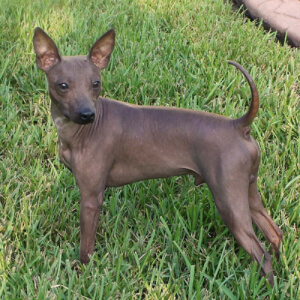
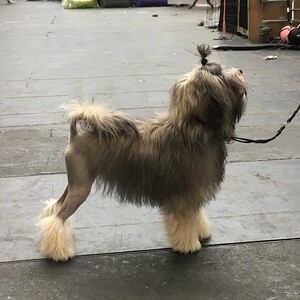
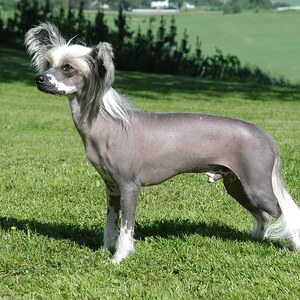
Chinese Crested Dog, hairless variety · Tommy Gildseth / Wikimedia Commons, CC BY 3.0. Cropped and resized.
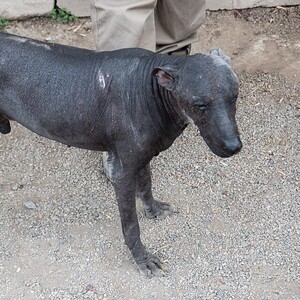
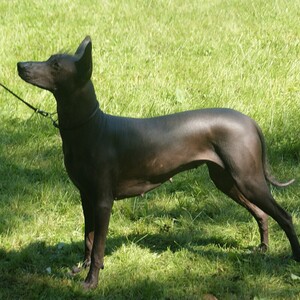
The Chinese Crested Dog is a small, elegant dog with two varieties: the “Hairless”, with no hair on the body, and the “Powder Puff”, covered in long, soft hair. The hairless one has only a crest on its head, “socks” on its feet and a plume on its tail. It is playful, affectionate and devoted to its family.
Quick facts
| Common name | Chinese Crested Dog |
| Scientific name | Canis lupus familiaris |
| Country of origin | China; patronage: Great Britain |
| Official recognition | FCI, definitively since 17 July 1972 (group 9, hairless dogs; standard no. 288); also recognised by the AKC |
| Lifespan | 13–18 years |
| Size (males) | ideally 28–33 cm at the withers |
| Size (females) | ideally 23–30 cm at the withers |
| Weight | about 3.5–5.5 kg |
| Coat type | Hairless: no hair, with crest, “socks” and plume; Powder Puff: long, soft hair |
| Common colours | Any colour or combination, except merle |
| Energy level | Moderate |
| Suited to an apartment? | Yes |
| Temperament | Alert, loyal, calm, playful, sensitive |
| Tendency to aggression | Very low |
| Good with children | Average; it is fragile |
| Good with other animals | Good |
| Genetic predispositions | Skin problems (sunburn, acne), eye diseases, patellar luxation, Legg-Calvé-Perthes disease |
- Primary category:Dog breeds
- Explore this animal's categories:
History and origin
The FCI standard says the exact origin of the breed is hard to establish. The AKC notes that it is an old breed, first used on ships to catch rats.
The breed has two varieties, which can even be born in the same litter. Wikipedia explains that hairlessness is caused by an incompletely dominant gene; puppies that inherit two copies of this gene do not survive before birth.
How the breed developed
- Ancient times – The dogs are used on ships to catch rats.
- 17 July 1972 – The FCI recognises the breed, under the patronage of Great Britain.
- 8 September 2026 – The newest FCI standard is published.
Breed rating
| Feature | Stars |
|---|---|
| Training and intelligence | ★★★★☆ |
| Easy to train | ★★★★☆ |
| Intelligence | ★★★★☆ |
| Independence | ★★☆☆☆ |
| Stubbornness | ★★☆☆☆ |
| Behaviour and temperament | ★★★★☆ |
| Affectionate with family | ★★★★☆ |
| Friendly with children | ★★★☆☆ |
| Good with other dogs | ★★★☆☆ |
| Good with cats and other animals | ★★★☆☆ |
| Loyalty | ★★★★★ |
| Tendency to be aggressive | ★☆☆☆☆ |
| Tendency to bark | ★★★☆☆ |
| Needs and care | ★☆☆☆☆ |
| Shedding | ★☆☆☆☆ |
| Needs frequent grooming | ★★☆☆☆ |
| Activity and lifestyle | ★★★☆☆ |
| Energy level | ★★★☆☆ |
| Daily exercise needs | ★★★☆☆ |
| Suited to apartment life | ★★★★☆ |
| Health and longevity | ★★★★☆ |
| Life expectancy | ★★★★★ |
| Predisposition to genetic diseases | ★★★☆☆ |
| Working abilities and uses | ★★☆☆☆ |
| Good rodent hunter | ★★☆☆☆ |
| Good companion dog | ★★★★★ |
Indicative rating: 5 stars means the highest level. It is based on the ratings the American Kennel Club gives the breed and on the FCI standard.
Physical characteristics
It is a small, fine-boned, elegant and graceful dog. Apart from the coat, the two varieties are almost identical.
General appearance
The eyes, so dark that they look black, are almond-shaped. The large ears stand erect; in the Powder Puff they may also hang down. The long tail tapers towards the tip and has a plume on the underside.
| Feature | Chinese Crested Dog |
|---|---|
| Size | Small |
| Height at the withers | males: 28–33 cm; females: 23–30 cm |
| Weight | about 3.5–5.5 kg |
| Coat | Hairless (with crest) or long-haired (Powder Puff) |
| Eyes | Almond-shaped, almost black |
| Ears | Large, erect |
The standard accepts any colour or combination of colours, except merle. In the hairless variety the skin is smooth and soft, often pink with spots.
Training and socialisation
The AKC says it loves spending time with its owner, which makes it well suited to agility, flyball and obedience. It is also a very good therapy dog.
It has a very sensitive nature and must be trained with patience and gentleness. Harsh words can damage its relationship with you.
Tips for effective training
- Be gentle and patient. Harshness makes it unwilling to learn.
- Use rewards. It learns easily with praise and food.
- Try dog sports. It enjoys agility, flyball and lure coursing.
- Socialise it early. This helps it stay calm with new people.
Activity needs and lifestyle
The AKC says short daily walks and play in the garden are enough for it. Outdoors, the hairless variety needs sunscreen or a coat.
| Activity | How often | Why it matters |
|---|---|---|
| Short walks | daily | Moderate exercise |
| Play in the garden or indoors | daily | It loves to play |
| Dog sports | weekly | It is competitive, though small |
Tips for a balanced life
- Protect its skin from the sun, especially in puppies.
- In winter, the hairless variety needs a coat.
- It has no doggy smell and leaves no hair around the house.
Care and health
Coat and skin care
Although it has no hair, the Hairless variety needs a lot of care: its exposed skin easily develops irritation, allergies, sunburn and acne. It needs skin-care products, sunscreen and anti-acne lotions. The Powder Puff variety must be brushed daily.
Common health problems
The AKC says the breed is generally healthy. Responsible breeders test their dogs for a few problems:
| Condition | Description | Common symptoms |
|---|---|---|
| Eye problems | Progressive retinal atrophy, glaucoma, primary lens luxation | Red or cloudy eyes, poorer vision |
| Patellar luxation | The kneecap slips out of place | Suddenly holds a hind leg up for a few steps, then uses it again |
| Legg-Calvé-Perthes disease | The head of the femur deteriorates because of poor blood supply | Lameness in one hind leg, in puppies |
Other care
- Use a dog sunscreen on sunny days.
- Brush its teeth often.
- Trim the nails regularly.
Diet and nutrition
A small dog needs small portions. Choose a good-quality food for small breeds.
Tips for a healthy diet
The table gives a starting estimate, calculated with the formula from the Merck Veterinary Manual. The first two calorie columns show the calories per day for a healthy adult dog. The last column shows what this means in dry food with 3,500–4,000 kcal per kilogram.
| Dog's weight | Calories per day (neutered) | Calories per day (not neutered) | Dry food per day (approximate) |
|---|---|---|---|
| 3.5 kg | 290 kcal | 320 kcal | 72–91 g |
| 4.5 kg | 350 kcal | 390 kcal | 88–111 g |
| 5.5 kg | 400 kcal | 450 kcal | 100–130 g |
- Give it its food in two meals a day.
- Training treats count towards the daily portion.
- A dog is at the right weight when you can feel its ribs without pressing hard.
Foods to avoid
Some human foods are dangerous for dogs: chocolate, coffee, grapes and raisins, onions, garlic, xylitol (a sweetener used in chewing gum), macadamia nuts and alcohol.
Reproduction and development
Physical and emotional maturity
In dogs, sexual maturity usually comes between 6 and 12 months. Small breeds become adults faster than large ones, usually at around one year.
Mating and pregnancy
Pregnancy lasts about 63 days, counted from ovulation. Mating a female on her first heat is not recommended. The FCI standard requires that only healthy dogs of typical breed appearance are used for breeding.
Caring for the puppies
In small breeds, a litter has 3–4 puppies on average. The puppies are very small and fragile in the first weeks, so they must be kept warm and handled with care. Socialisation starts early: gentle handling, everyday noises and new people.
Interesting facts
- Two varieties in the same litter. A hairless puppy and a Powder Puff can be born in the same litter.
- It can get sunburnt. The skin of the hairless variety burns easily, especially in puppies.
- It can get acne. The AKC says it can have blackheads and acne, just like people.
- No doggy smell. The hairless variety has no doggy smell and, of course, does not shed.
- A reversed undercoat. In the Powder Puff, the undercoat is shorter than the topcoat, the opposite of most dogs.
Frequently asked questions
Why does it have no hair?
Because of a gene. The breed also has a variety with hair, called the Powder Puff.
How big does it get?
Males measure 28–33 cm, females 23–30 cm; they weigh about 3.5–5.5 kg.
What care does its skin need?
Sunscreen, a coat in the cold and products against irritation and acne.
How long does it live?
Its life expectancy is 13–18 years.