SloughiCharacteristics, history, training and care
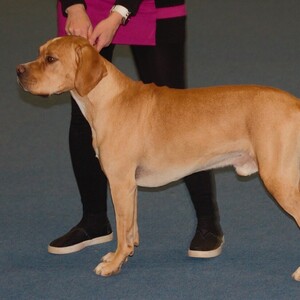
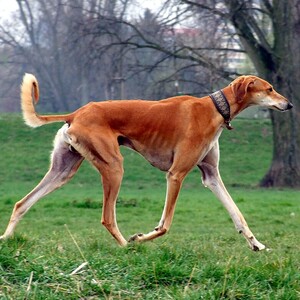
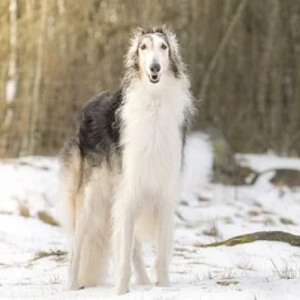
Sloughi. · Sabine.schlenkrich / Wikimedia Commons, CC BY-SA 3.0. Cropped and resized.
The Sloughi (Arabian or Berber greyhound) is a short-haired sighthound from North Africa, bred for centuries to hunt hares, foxes, jackals, gazelles and wild boar. The FCI standard says that most Sloughis today live in Morocco, which is responsible for the standard. It describes it as noble and aloof, but very attached to its owner, whom it will defend if need be; a hardy hunter that also enjoys the comforts of home.
Quick facts
| Common name | Sloughi (Arabian Greyhound, Berber Greyhound) |
| Scientific name | Canis lupus familiaris |
| Country of origin | Morocco |
| Official recognition | FCI, definitively since 8 November 1934 (group 10, sighthounds; standard no. 188); also recognised by the AKC |
| Lifespan | 10–15 years, according to the AKC |
| Size (males) | 66–72 cm at the withers; 18–29 kg according to the AKC |
| Size (females) | 61–68 cm at the withers |
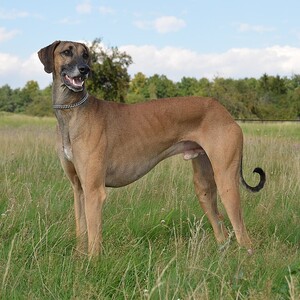
| Coat type | Very short, dense, fine |
| Common colours | Light sand to red sand, with or without a black mask, mantle or brindling |
| Energy level | High |
| Suited to an apartment? | Only with plenty of running |
| Temperament | Noble, aloof, attached to its owner, protective if need be |
| Tendency to aggression | Low |
| Good with children | Moderate |
| Good with other animals | Moderate; chases small animals |
| Genetic predispositions | Progressive retinal atrophy |
- Primary category:Dog breeds
- Explore this animal's categories:
History and origin
The FCI standard says the Sloughi has existed for many centuries in North Africa and has a single, short-haired variety. Wikipedia says the name is another pronunciation of the Arabic word “saluki” and that the two breeds probably share a common ancestor. Neolithic rock paintings in Algeria and paintings in Egyptian tombs show slender dogs with drop ears, a sign of ancient origins.
The AKC says it was developed in the area of Morocco, Algeria, Tunisia and Libya to hunt hares, foxes, jackals, gazelles and wild boar, and that it was valued for its speed, agility and stamina over long distances. Wikipedia adds that it is still used for hunting in North Africa.
How the breed developed
- Neolithic – Slender dogs in rock paintings in Algeria.
- Centuries ago – A valued hunter in North Africa.
- 8 November 1934 – The FCI recognises the breed.
- 1998 – The current FCI standard.
Breed rating
| Feature | Stars |
|---|---|
| Training and intelligence | ★★★☆☆ |
| Easy to train | ★★★★☆ |
| Intelligence | ★★★★☆ |
| Independence | ★★★☆☆ |
| Stubbornness | ★★★★☆ |
| Behaviour and temperament | ★★★☆☆ |
| Affectionate with family | ★★★☆☆ |
| Friendly with children | ★★★☆☆ |
| Good with other dogs | ★★★☆☆ |
| Good with cats and other animals | ★★☆☆☆ |
| Loyalty | ★★★★☆ |
| Tendency to be aggressive | ★★★☆☆ |
| Tendency to bark | ★★★★★ |
| Needs and care | ★★★☆☆ |
| Shedding | ★★★☆☆ |
| Needs frequent grooming | ★★★☆☆ |
| Activity and lifestyle | ★★★☆☆ |
| Energy level | ★★★☆☆ |
| Daily exercise needs | ★★★★☆ |
| Suited to apartment life | ★★☆☆☆ |
| Health and longevity | ★★★☆☆ |
| Life expectancy | ★★★★☆ |
| Predisposition to genetic diseases | ★☆☆☆☆ |
| Working abilities and uses | ★★★☆☆ |
| Good companion dog | ★★★★☆ |
| Good companion dog | ★★★★☆ |
Indicative rating: 5 stars means the highest level. It is based on the ratings the American Kennel Club gives the breed and on the FCI standard.
Physical characteristics
The standard says that its bearing, fine tissues and lean muscles give it the look of a very elegant, “racy” dog. The AKC describes it as an athletic, medium-to-large sighthound with a long, refined, wedge-shaped head and large, dark eyes.
General appearance
The coat is very short, dense and fine, always smooth. The AKC says it is shown in natural condition, and feathering on the ears, tail or legs disqualifies it.
| Feature | Sloughi |
|---|---|
| Size | Large |
| Height at the withers | males: 66–72 cm; females: 61–68 cm |
| Weight | 18–29 kg (AKC) |
| Coat | Very short |
| Eyes | Large, dark |
| Type | Sighthound |
The standard accepts all shades from light sand to red sand (fawn), with or without a black mask, black mantle, black brindling or black overlay.
Training and socialisation
The standard describes it as noble and aloof, but very attached to its owner, whom it will defend if need be. It has a hunter's instinct and can sustain effort, but it also appreciates the comforts of home.
Like any sighthound, it is sensitive and responds better to gentleness and rewards than to harshness. Its chasing instinct is strong, so the recall is never reliable in open spaces.
Tips for effective training
- Be gentle. It is sensitive.
- Keep it on a lead. It chases anything that moves.
- Socialise it early. It is reserved with strangers.
- Let it run in a safe place. It needs to sprint.
Activity needs and lifestyle
It is a hardy sighthound, made for hunting over long distances. It needs daily walks and, several times a week, free running in a large, securely fenced area or lure coursing.
| Activity | How often | Why it matters |
|---|---|---|
| Walks | daily | Fitness |
| Free running in a fenced area | several times a week | Sighthound instinct |
| Lure coursing | occasionally | Simulated hunting |
Tips for a balanced life
- The fence must be high.
- In winter it may need a coat.
- Do not let it off the lead near roads.
Care and health
Coat and skin care
The very short coat is easy to look after: brushing with a rubber mitt once a week. The AKC recommends checking the ears regularly and brushing the teeth often.
Common health problems
The AKC says the Sloughi is generally healthy, and responsible breeders test their dogs for:
| Condition | Description | Common symptoms |
|---|---|---|
| Progressive retinal atrophy | Gradual degeneration of the retina | Poor night vision, then blindness |
Other care
- Ask for the test for retinal atrophy.
- Check the ears regularly.
- Brush its teeth often.
Diet and nutrition
The AKC recommends good-quality food suited to the dog's age, and attention to its weight.
Tips for a healthy diet
The table gives a starting estimate, calculated with the formula from the Merck Veterinary Manual. The first two calorie columns show the calories per day for a healthy adult dog. The last column shows what this means in dry food with 3,500–4,000 kcal per kilogram.
| Dog's weight | Calories per day (neutered) | Calories per day (not neutered) | Dry food per day (approximate) |
|---|---|---|---|
| 18 kg | 980 kcal | 1,100 kcal | 240–310 g |
| 23 kg | 1,180 kcal | 1,320 kcal | 300–380 g |
| 29 kg | 1,400 kcal | 1,570 kcal | 350–450 g |
- Do not let it run right after a meal.
- Split the food into two meals a day.
- In a sighthound, the last ribs may be slightly visible; this is normal.
Foods to avoid
Some human foods are dangerous for dogs: chocolate, coffee, grapes and raisins, onions, garlic, xylitol (a sweetener used in chewing gum), macadamia nuts and alcohol.
Reproduction and development
Physical and emotional maturity
In dogs, sexual maturity usually comes between 6 and 12 months, but in large breeds it can be delayed until about two years. The body also reaches its adult form later than in small breeds.
Mating and pregnancy
Pregnancy lasts about 63 days, counted from ovulation. Mating a female on her first heat is not recommended. The FCI standard requires that only healthy dogs of typical breed appearance are used for breeding.
Caring for the puppies
In large breeds, a litter has around 7 puppies on average. Socialisation starts in the first weeks: gentle handling, everyday noises and new people.
Interesting facts
- Related to the Saluki. The name is another pronunciation of “saluki”.
- A single variety. It exists only with a short coat.
- Neolithic paintings. Similar dogs appear in rock paintings in Algeria.
- A gazelle hunter. It hunted hares, foxes, jackals and gazelles.
- It loves comfort. The standard says it appreciates the comforts of home.
Frequently asked questions
How does it differ from the Saluki?
The Sloughi always has a short coat, without feathering.
How big does it get?
Males measure 66–72 cm, females 61–68 cm.
Is it affectionate?
It is aloof with strangers, but very attached to its owner.
How long does it live?
The AKC gives 10–15 years.