Gordon SetterCharacteristics, history, training and care
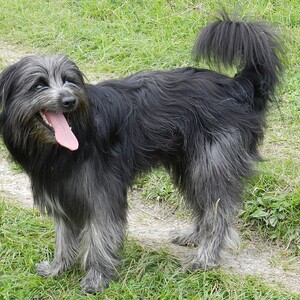
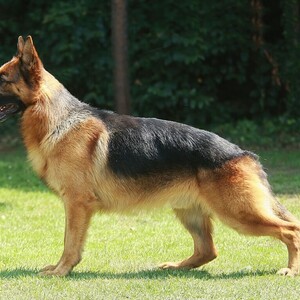
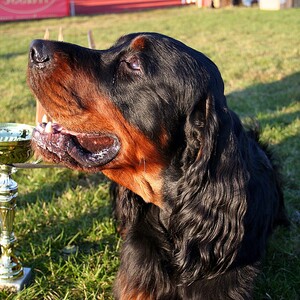
Gordon Setter. · Pleple2000 / Wikimedia Commons, CC BY-SA 3.0. Cropped and resized.
The Gordon Setter is a Scottish pointing dog, the largest and sturdiest of the setters, with a coal-black coat and chestnut red markings. It takes its name from Alexander, 4th Duke of Gordon, who kept a kennel of black and tan setters at Gordon Castle. It is intelligent, dignified, bold and gentle.
Quick facts
| Common name | Gordon Setter |
| Scientific name | Canis lupus familiaris |
| Country of origin | United Kingdom (Scotland) |
| Official recognition | FCI, definitively since 28 May 1963 (group 7, British and Irish pointers and setters, with working trial; standard no. 6); AKC, since 1892 |
| Lifespan | 12–13 years, according to the AKC |
| Size (males) | about 66 cm at the withers; about 29.5 kg |
| Size (females) | about 62 cm at the withers; about 25.5 kg |
| Coat type | Moderately long, flat, silky, with long feathering |
| Common colours | Glossy black with chestnut red markings |
| Energy level | Very high |
| Suited to an apartment? | It can adapt, with daily exercise |
| Temperament | Intelligent, dignified, bold, gentle |
| Tendency to aggression | Low |
| Good with children | Average to good |
| Good with other animals | Average |
| Genetic predispositions | Hip and elbow dysplasia, eye diseases, bloat |
- Primary category:Dog breeds
- Explore this animal's categories:
History and origin
Wikipedia says Alexander, 4th Duke of Gordon (1743–1827), established his kennel of black and tan setters at Gordon Castle, near Fochabers, close to the River Spey. Black and tan setters also existed in other kennels, and many of the duke's dogs were in fact tricolour.
In 1842, George Blunt and Daniel Webster took the breed to the United States, buying two dogs, Rake and Rachel, from the duke's kennel. The AKC recognised the breed in 1892. In Scotland, the setter was used to hunt partridge, grouse, pheasant, snipe and woodcock.
How the breed developed
- End of the 18th century – The Duke of Gordon establishes his setter kennel at Gordon Castle.
- 1842 – The breed reaches the United States, with the dogs Rake and Rachel.
- 1892 – The AKC recognises the breed.
- 28 May 1963 – The FCI recognises the breed.
- 8 September 2026 – the current FCI standard is published.
Breed rating
| Feature | Stars |
|---|---|
| Training and intelligence | ★★★★★ |
| Easy to train | ★★★★★ |
| Intelligence | ★★★★★ |
| Independence | ★★★☆☆ |
| Stubbornness | ★★★★☆ |
| Behaviour and temperament | ★★★★☆ |
| Affectionate with family | ★★★★★ |
| Friendly with children | ★★★☆☆ |
| Good with other dogs | ★★★☆☆ |
| Good with cats and other animals | ★★★☆☆ |
| Loyalty | ★★★★★ |
| Tendency to be aggressive | ★☆☆☆☆ |
| Tendency to bark | ★★★☆☆ |
| Needs and care | ★★★★☆ |
| Shedding | ★★★☆☆ |
| Needs frequent grooming | ★★☆☆☆ |
| Activity and lifestyle | ★★★★☆ |
| Energy level | ★★★★★ |
| Daily exercise needs | ★★★★★ |
| Suited to apartment life | ★★★☆☆ |
| Health and longevity | ★★★★☆ |
| Life expectancy | ★★★★☆ |
| Predisposition to genetic diseases | ★★★☆☆ |
| Working abilities and uses | ★★★★☆ |
| Good hunting dog | ★★★★★ |
| Good companion dog | ★★★★☆ |
Indicative rating: 5 stars means the highest level. It is based on the ratings the American Kennel Club gives the breed and on the FCI standard.
Physical characteristics
The AKC says Gordons are the largest and sturdiest of the setters: a big male can measure 69 cm at the withers and weigh 36 kg. The head is deep rather than broad.
General appearance
The tan spots above the bright brown eyes emphasise a wise and kindly expression. The coat is short and fine on the head and the fronts of the legs, moderately long and flat on the body, with long, silky feathering on the ears, legs, belly and tail.
| Feature | Gordon Setter |
|---|---|
| Size | Large |
| Height at the withers | males: about 66 cm; females: 62 cm |
| Weight | males: about 29.5 kg; females: 25.5 kg |
| Coat | Flat, silky, with feathering |
| Colour | Black with chestnut red |
| Eyes | Brown, bright |
The standard calls for a deep, shining coal black, with no rusty tinge, and bright chestnut red markings: a spot over each eye, on the muzzle, on the throat, two spots on the chest, on the legs and under the tail. Wikipedia says red Gordons are occasionally born, and they cannot be shown.
Training and socialisation
The standard describes it as intelligent, able and dignified, bold, outgoing and with a kindly, even temperament.
The AKC says Gordons are stubborn, but very gentle and loving, and live to please their owner. They are very clever and learn quickly. The commands “come”, their name and “no” are essential for their safety.
Tips for effective training
- Teach the recall first. The AKC says “come” is a command that saves lives.
- Be gentle. They are very sensitive.
- Be patient. They can be stubborn.
- Let it run. The need to run is in its genes.
Activity needs and lifestyle
The AKC says Gordons were bred as personal hunting dogs and even as “nannies” for children. They like to stay by your side, but also to run in the fields. They can live in a flat if they get daily exercise: walks, jogging or bike rides.
| Activity | How often | Why it matters |
|---|---|---|
| Long walks or jogging | daily | Very high energy |
| Free running in a fenced field | several times a week | The need to run |
| Fieldwork | weekly | Pointing instinct |
Tips for a balanced life
- Check the coat for burrs after walks.
- It suits an active family.
- Keep a cloth handy: it drools quite a lot.
Care and health
Coat and skin care
The AKC says brushing at least weekly is essential to stop mats forming; brushed regularly, it sheds little. Every month, the hair on the feet, in the ears and around the tail should be tidied, the nails trimmed and the teeth checked. A monthly bath is recommended.
Common health problems
The AKC says Gordons are generally healthy, but it is worth watching for:
| Condition | Description | Common symptoms |
|---|---|---|
| Hip dysplasia | The hip joint forms incorrectly and, over time, arthritis develops | Limping, difficulty getting up or jumping, hip pain |
| Elbow dysplasia | The elbow joint develops incorrectly and arthritis appears | Limping on the front legs, especially after exercise |
| Gastric dilatation-volvulus (bloat) | The stomach fills with gas and may twist; this is a veterinary emergency | Swollen belly, trying to vomit without success, drooling, restlessness |
| Eye diseases | Inherited eye conditions | Poor vision, cloudy eyes |
Other care
- Check the ears regularly.
- Trim the nails monthly.
- Check the teeth for tartar.
Diet and nutrition
The AKC says a diet with too much protein (over 26%) is not recommended, because it forces growth that is too fast. Fibre of at least 4% helps digestion.
Tips for a healthy diet
The table gives a starting estimate, calculated with the formula from the Merck Veterinary Manual. The first two calorie columns show the calories per day for a healthy adult dog. The last column shows what this means in dry food with 3,500–4,000 kcal per kilogram.
| Dog's weight | Calories per day (neutered) | Calories per day (not neutered) | Dry food per day (approximate) |
|---|---|---|---|
| 25 kg | 1,250 kcal | 1,410 kcal | 310–400 g |
| 30 kg | 1,440 kcal | 1,620 kcal | 360–460 g |
| 36 kg | 1,650 kcal | 1,850 kcal | 410–530 g |
- Split the food into two meals a day to reduce the risk of bloat.
- Do not let it run right after a meal.
- A dog is at the right weight when you can feel its ribs under the coat without pressing hard.
Foods to avoid
Some human foods are dangerous for dogs: chocolate, coffee, grapes and raisins, onions, garlic, xylitol (a sweetener used in chewing gum), macadamia nuts and alcohol.
Reproduction and development
Physical and emotional maturity
In dogs, sexual maturity usually comes between 6 and 12 months, but in large breeds it can be delayed until about two years. The body also reaches its adult form later than in small breeds.
Mating and pregnancy
Pregnancy lasts about 63 days, counted from ovulation. Mating a female on her first heat is not recommended. The FCI standard requires that only healthy dogs of typical breed appearance are used for breeding.
Caring for the puppies
In large breeds, a litter has around 7 puppies on average. Socialisation starts in the first weeks: gentle handling, everyday noises and new people.
Interesting facts
- The largest setter. The AKC says it is the largest and sturdiest of the setters.
- “Black and tan”. Gordons are also called “black and tans”.
- Rake and Rachel. The first Gordons in the United States came from the duke's kennel.
- A nanny for children. The AKC says they have also served as “nannies”.
- Red Gordons. Red Gordons are occasionally born to two black and tan parents.
Frequently asked questions
Where does the name Gordon Setter come from?
From Alexander, 4th Duke of Gordon, who kept a setter kennel at Gordon Castle.
How big does it get?
Males measure about 66 cm and weigh 29.5 kg, females 62 cm and 25.5 kg.
What colour is it?
Glossy black with chestnut red markings.
How long does it live?
The AKC gives 12–13 years.