Common kestrelFalco tinnunculus — habitat, diet and reproduction
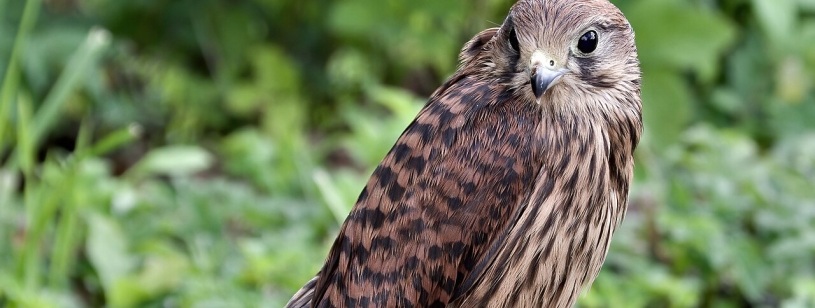
Female common kestrel (Falco tinnunculus) on a rock. · Alexey V. Kurochkin / CC BY-SA 4.0 (https://creativecommons.org/licenses/by-sa/4.0). Cropped and resized.
The common kestrel is a small falcon with a rufous back and a long tail. It is easy to recognise when hunting: it hangs still in the air, wings beating fast and head fixed, above a field. It nests in trees, on cliffs and on city apartment blocks.
Quick facts
| Common name | Common kestrel |
| Scientific name | Falco tinnunculus |
| Lifespan | About 4 years in the wild; some exceed 15 years |
| Length | About 32–39 cm |
| Weight | About 135–250 g; females are heavier |
| Diet | Carnivore: voles, large insects, small birds, lizards |
| Predators | Goshawks and eagle owls; martens at nests |
| Conservation status | Least Concern (LC), globally |
| Distribution | Europe, Asia and Africa |
| Habitat | Fields, grassland, woodland edges and towns |
| Family | Falconidae |
| Wingspan | About 65–82 cm |
- Primary category:Birds
- Explore this animal's categories:Animals of AfricaAnimals of AsiaAnimals of EuropeAnimals of RomaniaAnimals of Romania’s gardens and parksAnimals of Romania’s grasslands and plainsBirdsBirds of preyBirds of RomaniaCCarnivoresEgg-laying animalsFeathered animalsFlying animalsInsect-eating animalsPredatory animals of RomaniaRed and reddish animalsVertebratesWild animals
Interesting facts
- While hovering, its head stays almost motionless, even in wind.
- Kestrels see ultraviolet light and can detect vole urine trails.
- In Bucharest and other cities, kestrels nest on balconies and rooftops of apartment blocks.
- It builds no nest and uses old crow nests or cavities.
Characteristics
The kestrel has long, pointed wings and a long tail. The male has a blue-grey head and tail and a rufous back with small black spots, plus a black band at the tail tip.
The female is slightly larger, with a barred rufous-brown back and tail. Both sexes have a dark “moustache” under the eye, like other falcons.
Behaviour
It hunts from a perch or in flight. Hovering on fast-beating wings lets it watch the ground without a branch to sit on. When it spots prey, it drops in stages and then plunges onto it.
It is active by day. Pairs defend the area around the nest, but hunting ranges may overlap. The call is a sharp, repeated “kee-kee-kee”.
Habitat and distribution
The species lives across almost all of Europe, Asia and Africa. Northern populations migrate south in winter, while southern ones are resident.
In Romania it is the most common small bird of prey, seen over fields, roadsides and grassland as well as in towns.
Diet and feeding
The main prey is small rodents, especially voles. It also takes large insects such as grasshoppers and beetles, lizards and small birds.
In cities, many kestrels hunt sparrows and other small birds. A pair with chicks may catch dozens of rodents a day, making the kestrel an ally of farmers.
Reproduction and life cycle
The kestrel builds no nest. It uses old crow and magpie nests, tree holes, ledges on cliffs and buildings, or nest boxes.
The female usually lays 4–6 reddish, speckled eggs and incubates them for about four weeks while the male brings food. Chicks fly after about a month but are fed for several more weeks.
Name and history
The scientific name Falco tinnunculus comes from Latin. “Falco” means falcon, and “tinnunculus” comes from “tinnulus”, shrill, after its call.
The Romanian name “vânturel” reflects its habit of hanging in the wind above fields. Romania also has the lesser kestrel, a rarer species that eats mainly insects.
Conservation and threats
The species has a very large population and is assessed globally as Least Concern. In parts of Europe, numbers have fallen because of intensive farming.
Pesticides and rodent poisons reduce its food or poison it directly. Nest boxes on poles and buildings have helped local populations. Like all birds of prey, it is protected in Romania.
Frequently asked questions
Why does the kestrel hang still in the air?
To watch the ground with nowhere to perch. It beats its wings fast and uses the wind, keeping its head fixed.
Do kestrels nest on apartment blocks?
Yes. In many Romanian cities they nest on balconies, roofs and ledges of blocks.
What does the common kestrel eat?
Mainly voles, plus large insects, lizards and small birds.
Is the kestrel a falcon?
Yes. It belongs to the falcon family (Falconidae) and is one of Romania’s smallest falcons.