NightingaleInteresting facts and information
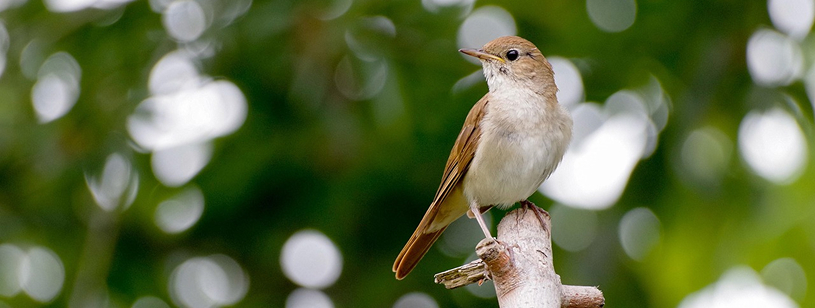
The common nightingale (Luscinia megarhynchos) is a small, brown songbird associated with dense scrub and woodland edges. Its rich song is especially noticeable in spring. European breeding birds migrate to Africa for the winter.
Nightingales migrate between breeding areas in Europe and western Asia and wintering areas in Africa. Their brown plumage makes them less conspicuous than their song.
They use dense scrub, woodland edges and suitable gardens with thick cover.
Quick facts
| Common name | Common nightingale |
| Scientific name | Luscinia megarhynchos |
| Typical lifespan | Usually 2-5 years in the wild |
| Length | About 15-16.5 cm |
| Wingspan | About 23–26 cm |
| Weight | About 18-27 g |
| Diet type | Insectivore (also eats berries in late summer and autumn) |
| Main predators | Cats, foxes, hawks, snakes, small mammals (especially for eggs and chicks) |
| Conservation status | Least Concern (IUCN); strongly declining in some countries, such as Britain |
| Distribution | Breeds in Europe, north-west Africa, the Middle East and Central Asia; winters in tropical Africa |
| Living environment | Woodland with dense undergrowth, thickets, scrub, riverbanks, parks and gardens |
Interesting facts
- A huge repertoire - A male nightingale can sing more than 150 different song types, made up of hundreds of different sounds.
- It sings day and night - Unpaired males sing at night to attract females migrating overhead; once paired, they sing mostly by day.
- Song quality matters - Females are thought to choose males partly by the quality and variety of their song.
- A long-distance migrant - European nightingales spend the winter in tropical Africa, south of the Sahara, thousands of kilometres away.
- Learning to sing - Young males learn their songs by listening to older males.
Records and remarkable features
- The common nightingale (Luscinia megarhynchos) is a small, brown songbird associated with dense scrub and woodland edges. Its rich song is especially noticeable in spring. European breeding birds migrate to Africa for the winter.
Physical characteristics and unique adaptations
The nightingale is a small bird with plain plumage, but it is famous for its voice. Its body suits life hidden in thick vegetation, and its song helps it defend its territory.
Essential physical adaptations
- Small size - About 15-16.5 cm long and 18-27 g in weight, it moves easily through thick bushes.
- Brown plumage - Plain brown above with a reddish-brown tail and pale underparts, which makes it hard to see in the undergrowth.
- A thin bill - Suitable for picking up insects among leaves and on the ground.
- Large eyes - Help it see in the dim light under bushes.
- A complex voice organ - Like other songbirds, the nightingale has a syrinx that can produce two sounds at once and change notes very quickly.
Dimensions and variations between species
| Characteristic | Common nightingale (Luscinia megarhynchos) | Thrush nightingale (Luscinia luscinia) |
|---|---|---|
| Body length | About 15-16.5 cm | About 16-17 cm |
| Weight | About 18-27 g | About 20-30 g |
| Plumage colour | Warm brown, with a reddish tail | Darker, greyer brown, with a faintly mottled breast |
| Range | Southern, western and central Europe, North Africa, western and central Asia | Northern and eastern Europe and western Siberia |
Habits and behaviour
The nightingale is a shy, territorial bird that is heard far more often than it is seen.
Life Mode
- It is active by day and also sings at night, especially at the start of the breeding season.
- Males are territorial and use their song to defend their area.
- Females do not sing.
- It usually stays low down in dense bushes and moves by short hops and flights.
- Outside the breeding season it usually lives alone.
Communication
- A complex song - Males combine whistles, trills and rich, deep "jug-jug" notes, often with long pauses between phrases.
- Singing to attract females - Males start singing soon after they arrive in April, and the song becomes rare after early summer.
- Alarm calls - When disturbed, nightingales make a frog-like croak and a sharp whistle.
Defence techniques
- Camouflage - Its brown colour makes it hard to see among branches and leaves.
- Staying hidden - It rarely leaves dense cover.
- Short flights - It moves low between bushes, where it is less exposed to predators.
Habitat and geographic distribution
The nightingale breeds in Europe, north-west Africa and western and central Asia, and spends the winter in tropical Africa.
Population distribution
| Region | Estimated population |
|---|---|
| Western Europe | Common in Spain, France and Italy; rare and declining in southern England |
| Eastern Europe | Common in Romania, Bulgaria and Hungary |
| Middle East | Breeds in Turkey, Israel and Iran |
| Africa | Breeds in north-west Africa; winters in tropical Africa south of the Sahara |
| Central Asia | Breeds in Kazakhstan and Uzbekistan |
Habitats
- Woodland with dense undergrowth - It prefers thickets and young woodland with plenty of cover near the ground.
- Parks and gardens - In some regions, it lives in large gardens and parks with thick bushes.
- Riverbanks - Damp areas with rich vegetation are good breeding habitats.
- Scrub and hedges - It also uses scrub and the edges between woodland and open land.
Impact of environmental change
- Loss of scrub - Removing dense undergrowth takes away nesting sites.
- Deer browsing - In some areas, deer eat the low vegetation that nightingales need.
- Climate change - Changes in climate may affect migration timing and wintering areas.
- Pesticides - Fewer insects means less food.
Diet and feeding
The nightingale feeds mainly on insects and other invertebrates, and also eats berries in late summer and autumn.
What does the nightingale eat?
| Food type | Specific examples |
|---|---|
| Insects | Beetles, ants, flies, crickets |
| Larvae and worms | Caterpillars, earthworms |
| Spiders and other invertebrates | Spiders, small snails |
| Fruit (late summer and autumn) | Blackberries, elderberries and other berries |
Method of feeding
- Searching the ground - The nightingale looks for insects among fallen leaves.
- Hopping on the ground - Like a robin, it hops, stops and picks up prey.
- Feeding in low branches - It also finds caterpillars and spiders among leaves.
- Eating fruit before migration - In late summer, berries help it build up fat for the long journey.
Reproduction and life cycle
The nightingale breeds in spring and early summer, and males attract partners with their song.
Breeding season
- It starts in April-May, when males arrive from Africa and set up territories.
- Males sing intensely to attract females and mark their area.
- After pairing, males sing less at night.
Nesting and eggs
| Characteristic | Details |
|---|---|
| Nest place | On or near the ground, in dense vegetation |
| Number of eggs | Usually 4-5 olive-brown eggs |
| Incubation period | About 13-14 days |
| Chicks in the nest | About 11-12 days |
| Maturity | 1 year |
Breeding of chicks
- The nest is a cup of dead leaves and grass, well hidden close to the ground.
- The female incubates the eggs alone, and both parents feed the chicks.
- The young leave the nest before they can fly well and are fed by their parents for a few more weeks.
Name and history
Origin of name
- The English word "nightingale" comes from Old English nihtegale, meaning "night singer".
- The scientific name Luscinia megarhynchos comes from Latin and Greek: luscinia is the Latin word for nightingale and megarhynchos means "big bill".
Taxonomic Classification
| Classification | Name |
|---|---|
| Kingdom | Animalia |
| Phylum | Chordata |
| Class | Aves |
| Order | Passeriformes |
| Family | Muscicapidae |
| Genus | Luscinia |
| Species | Luscinia megarhynchos |
Evolution and fossils
- The nightingale was once placed in the thrush family, but it is now classed with the Old World flycatchers (Muscicapidae).
- Its closest relative is the thrush nightingale; where their ranges meet, the two species sometimes interbreed.
- The bluethroat is another close relative in the same genus.
Cultural significance and mythology
Few birds have inspired as many poets, writers and musicians as the nightingale, mostly because of its beautiful song at night.
- Greek mythology - In one version of the myth, Philomela was turned into a nightingale; in Greek versions it was her sister Procne who became the bird.
- Persian poetry - The love of the nightingale (bulbul) for the rose is a classic theme in Persian poetry.
- Symbol of love and spring - In European folklore and poetry, the nightingale's song is linked with love, spring and night.
- Shakespeare - In "Romeo and Juliet", Juliet says: "It was the nightingale, and not the lark."
Conservation status and threats
The nightingale is listed as Least Concern by the IUCN, but it has declined sharply in some countries, especially in Britain.
Conservation status
| Region | Estimated population | Trends |
|---|---|---|
| Western Europe | Common in the south; rare in Britain | In Britain, down by more than 90% since the late 1960s |
| Eastern Europe | Common | Broadly stable |
| Middle East | Locally common | Not well known |
| Africa (wintering areas) | Affected by drought and habitat change | Not well known |
Main threats
- Loss of scrub and undergrowth - Clearing thickets and hedges removes nesting sites.
- Deer - In Britain, growing deer numbers have damaged the low vegetation nightingales need.
- Pesticides - Intensive agriculture reduces insect populations.
- Changes in wintering areas - Drought and habitat loss in Africa may affect survival.
- Predators - Cats, foxes and other predators take eggs and chicks from ground nests.
Protection measures
- Managing scrub - Creating and keeping dense thickets on reserves.
- Reducing pesticides - Protecting insects that nightingales eat.
- Tracking migration - Small tracking devices show where nightingales spend the winter.
- Surveys - Volunteers count singing males to follow population trends.
In popular culture
Literature
- "Ode to a Nightingale" (1819) - One of the best-known poems by the English poet John Keats.
- "The Nightingale" (1843) - A fairy tale by Hans Christian Andersen about a Chinese emperor who prefers a mechanical bird to a real nightingale.
- "The Nightingale and the Rose" (1888) - A fairy tale by Oscar Wilde.
Music
- Beethoven's "Pastoral" Symphony (1808) - The flute imitates a nightingale.
- "The Nightingale" (1914) - An opera by Igor Stravinsky, based on Andersen's tale.
- "A Nightingale Sang in Berkeley Square" (1940) - A famous British popular song.
- In 1924, the BBC broadcast the cellist Beatrice Harrison playing in her garden while wild nightingales sang along.