Rough CollieCharacteristics, history, training and care
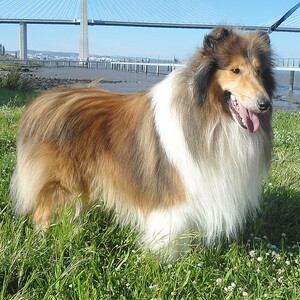
Rough Collie. · WisewynD / Wikimedia Commons, CC BY-SA 3.0. Cropped and resized.
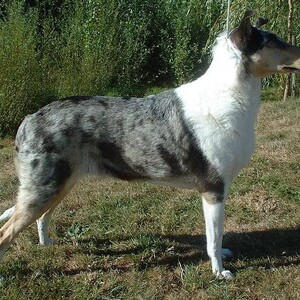
The Rough Collie is a large, elegant Scottish herding dog with a very abundant coat, a mane and a wedge-shaped head. It is identical to the Smooth Collie apart from the length of its coat. The standard describes it as friendly, with no trace of nervousness or aggression, cheerful, active and good with children and other dogs.
Quick facts
| Common name | Rough Collie (Long-haired Collie) |
| Scientific name | Canis lupus familiaris |
| Country of origin | United Kingdom |
| Official recognition | FCI, definitively since 13 April 1955 (group 1, sheepdogs; standard no. 156); also recognised by the AKC |
| Lifespan | 12–14 years, according to the AKC |
| Size (males) | 56–61 cm at the withers; 27–34 kg according to the AKC |
| Size (females) | 51–56 cm at the withers; 23–29 kg according to the AKC |
| Coat type | Very dense, with a straight, harsh topcoat and a soft undercoat |
| Common colours | Sable, tricolour, blue merle |
| Energy level | Moderate |
| Suited to an apartment? | Only with plenty of exercise |
| Temperament | Friendly, cheerful, active, good with children |
| Tendency to aggression | Very low |
| Good with children | Very good |
| Good with other animals | Good |
| Genetic predispositions | Collie eye anomaly, bloat |
- Primary category:Dog breeds
- Explore this animal's categories:
History and origin
The FCI standard says the breed is believed to descend from dogs brought to Scotland by the Romans, crossed with local dogs. The Rough Collie is the refined version of the old working collie of the Scottish shepherd, selectively bred for at least a hundred years.
Wikipedia says that after Queen Victoria bought a Rough Collie, seen at Balmoral Castle, the breed became fashionable. Breeding for shows changed its appearance considerably.
How the breed developed
- Antiquity – The Romans bring dogs to Scotland.
- 19th century – Queen Victoria makes the breed fashionable.
- 13 April 1955 – The FCI recognises the breed.
- 1954–1973 – The “Lassie” series makes the breed famous worldwide.
Breed rating
| Feature | Stars |
|---|---|
| Training and intelligence | ★★★★☆ |
| Easy to train | ★★★★☆ |
| Intelligence | ★★★★☆ |
| Independence | ★★☆☆☆ |
| Stubbornness | ★★★☆☆ |
| Behaviour and temperament | ★★★★☆ |
| Affectionate with family | ★★★★☆ |
| Friendly with children | ★★★★★ |
| Good with other dogs | ★★★☆☆ |
| Good with cats and other animals | ★★★☆☆ |
| Loyalty | ★★★★★ |
| Tendency to be aggressive | ★☆☆☆☆ |
| Tendency to bark | ★★★★★ |
| Needs and care | ★★★☆☆ |
| Shedding | ★★★☆☆ |
| Needs frequent grooming | ★★★☆☆ |
| Activity and lifestyle | ★★★☆☆ |
| Energy level | ★★★☆☆ |
| Daily exercise needs | ★★★★☆ |
| Suited to apartment life | ★★☆☆☆ |
| Health and longevity | ★★★★☆ |
| Life expectancy | ★★★★☆ |
| Predisposition to genetic diseases | ★★★☆☆ |
| Working abilities and uses | ★★★☆☆ |
| Good herding dog | ★★★★☆ |
| Good companion dog | ★★★★★ |
Indicative rating: 5 stars means the highest level. It is based on the ratings the American Kennel Club gives the breed and on the FCI standard.
Physical characteristics
The AKC describes it as a large but lithe herding dog, 56–66 cm tall, with one of the most spectacular coats in the dog world.
General appearance
The head, seen from the front or in profile, resembles a well-blunted wedge, with a smooth outline. The coat follows the shape of the body and is very dense: the topcoat is straight and harsh, and the undercoat soft and very tight. The mane and frill are very abundant, and the tail is profusely coated.
| Feature | Rough Collie |
|---|---|
| Size | Large |
| Height at the withers | males: 56–61 cm; females: 51–56 cm |
| Weight | males: 27–34 kg; females: 23–29 kg (AKC) |
| Coat | Very dense, with a mane |
| Head | Like a blunted wedge |
| Tail | Profusely coated |
The accepted colours are sable (from light gold to dark mahogany), tricolour and blue merle, usually with white markings.
Training and socialisation
The standard describes it as having a friendly disposition, with no trace of nervousness or aggression: a wonderful companion, friendly, cheerful and active, good with children and other dogs.
The AKC says it is very bright and easy to train and enjoys learning. It responds best to positive methods and excels at obedience, agility and herding.
Tips for effective training
- Use positive methods. The AKC says it responds best to them.
- Go to puppy classes. For socialisation and training.
- Teach it not to bark at everything. The AKC gives it the top score for barking.
- Try dog sports. It excels at obedience and agility.
Activity needs and lifestyle
The AKC says it is usually fairly active and needs regular exercise: aerobic activity, the chance to run and play, fetch, a fenced yard and daily walks. It should not be left alone in the yard.
| Activity | How often | Why it matters |
|---|---|---|
| Walks | daily | Exercise |
| Running and fetch | several times a week | Aerobic exercise |
| Obedience or agility | weekly | It enjoys learning |
Tips for a balanced life
- It suits families with children.
- Do not isolate it in the yard.
- Set aside time for brushing.
Care and health
Coat and skin care
The AKC says the long coat must be groomed to stop it tangling, especially behind the ears and at the elbows, and to remove the shedding undercoat. A weekly brush right down to the skin solves the problem.
Common health problems
The AKC says it is a healthy, robust breed with an average life expectancy of 12 years. Puppies should have their eyes checked at 6 to 8 weeks for:
| Condition | Description | Common symptoms |
|---|---|---|
| Collie eye anomaly | Hereditary eye disease | From no visible problem to poor eyesight |
| Gastric dilatation-volvulus (bloat) | The stomach fills with gas and may twist; this is a veterinary emergency | Swollen belly, trying to vomit without success, drooling, restlessness |
Other care
- Ask for the puppy's eye check.
- Brush its teeth regularly.
- Go for annual check-ups.
Diet and nutrition
The AKC says it does well on good-quality food, especially meat-based, and that there is a risk of bloat.
Tips for a healthy diet
The table gives a starting estimate, calculated with the formula from the Merck Veterinary Manual. The first two calorie columns show the calories per day for a healthy adult dog. The last column shows what this means in dry food with 3,500–4,000 kcal per kilogram.
| Dog's weight | Calories per day (neutered) | Calories per day (not neutered) | Dry food per day (approximate) |
|---|---|---|---|
| 23 kg | 1,180 kcal | 1,320 kcal | 300–380 g |
| 28 kg | 1,360 kcal | 1,530 kcal | 340–440 g |
| 34 kg | 1,580 kcal | 1,770 kcal | 400–510 g |
- Split the food into two meals a day to reduce the risk of bloat.
- Do not let it run right after a meal.
- A dog is at the right weight when you can feel its ribs under the coat without pressing hard.
Foods to avoid
Some human foods are dangerous for dogs: chocolate, coffee, grapes and raisins, onions, garlic, xylitol (a sweetener used in chewing gum), macadamia nuts and alcohol.
Reproduction and development
Physical and emotional maturity
In dogs, sexual maturity usually comes between 6 and 12 months, but in large breeds it can be delayed until about two years. The body also reaches its adult form later than in small breeds.
Mating and pregnancy
Pregnancy lasts about 63 days, counted from ovulation. Mating a female on her first heat is not recommended. The FCI standard requires that only healthy dogs of typical breed appearance are used for breeding.
Caring for the puppies
In large breeds, a litter has around 7 puppies on average. Socialisation starts in the first weeks: gentle handling, everyday noises and new people.
Interesting facts
- Lassie. The most famous Collie in films and TV series.
- The Queen's dog. Queen Victoria made the breed fashionable.
- Only the coat differs. It is identical to the Smooth Collie, except for the coat.
- Roman ancestors. It is believed to come from dogs brought to Scotland by the Romans.
- Easy to train. The AKC says it enjoys learning.
In popular culture
Lassie
Wikipedia says Lassie was played by a line of Rough Collies belonging to Rudd Weatherwax, which appeared in numerous films, several TV series and a radio programme. The “Lassie” series ran from 1954 to 1973.
Frequently asked questions
Is Lassie a Rough Collie?
Yes, Lassie was played by dogs of this breed.
How big does it get?
Males measure 56–61 cm, females 51–56 cm.
Is it good with children?
Yes, the standard says it is good with children.
How long does it live?
The AKC gives 12–14 years.