Fallow deerDama dama — habitat, diet and reproduction
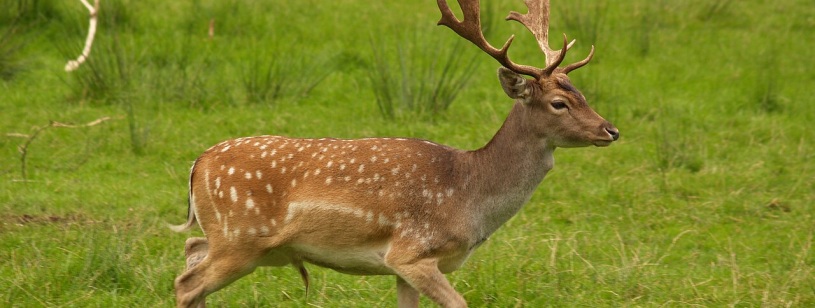
Male fallow deer (Dama dama) in a meadow. · Johann-Nikolaus Andreae / CC BY-SA 2.0 (https://creativecommons.org/licenses/by-sa/2.0). Cropped and resized.
The fallow deer is a medium-sized deer with a reddish summer coat covered in white spots. Males grow broad, flattened antlers shaped like shovels. The species comes from Asia Minor but has been taken by people across Europe, including Romania.
Quick facts
| Common name | Fallow deer |
| Scientific name | Dama dama |
| Lifespan | About 12–16 years |
| Height | About 80–95 cm at the shoulder |
| Weight | Males about 60–100 kg; females about 30–50 kg |
| Diet | Herbivore: grass, leaves, acorns, chestnuts, shoots |
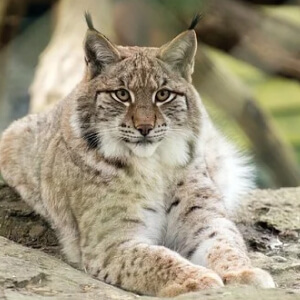
| Predators | Wolves and lynx; foxes and dogs take fawns |
| Conservation status | Least Concern (LC) |
| Distribution | Native to Turkey; introduced across Europe and beyond |
| Habitat | Open broadleaf woods, parks, wooded grassland |
| Family | Cervidae |
| Antlers | Males only, broad and flattened |
- Primary category:Mammals
- Explore this animal's categories:
Interesting facts
- There are white, black and very pale fallow deer, often kept in parks.
- Antlers drop each spring and regrow by late summer.
- In autumn, males give a deep, repeated belching groan.
- The Romans took fallow deer to many corners of their empire.
Characteristics
The fallow deer is smaller than the red deer and larger than the roe deer. In summer the coat is reddish with white spots on the back and flanks; in winter it turns grey-brown and the spots fade.
The tail is fairly long, black on top, with a black-edged white rump patch. Adult males have broad antlers with points along the edge and a prominent Adam’s apple.
Behaviour
Fallow deer live in herds. Females with young and males form separate groups for most of the year.
In October, males defend mating stands and groan deeply to attract females, fighting by pushing antlers. They are most active at dawn and dusk and flee with a bouncing gait, all four feet off the ground.
Habitat and distribution
The species originates in Anatolia, in today’s Turkey. Phoenicians, Romans and Normans spread it across Europe, where it was kept in hunting parks before reaching the wild.
In Romania it lives free in some hunting areas, mainly in the west and south, and in wildlife parks, preferring open oak woods mixed with meadows.
Diet and feeding
The fallow deer grazes mainly on grass but also eats leaves, buds, shoots, acorns, chestnuts and fallen fruit.
In autumn, acorns and beechnuts are an energy-rich food. In winter it strips bark and eats dry grass. Where deer are too numerous, young forest regenerates poorly.
Reproduction and life cycle
The female usually gives birth to a single fawn in June or July after about seven and a half months. The spotted fawn hides in grass for its first weeks.
The mother returns several times a day to nurse it. Fawns then join the herd and mature at one and a half to two years.
Name and history
The scientific name Dama dama comes from Latin, where “dama” named an animal similar to a roe deer.
The Romanian name “lopătar” refers to the shovel-shaped antlers. A rare relative, the Persian fallow deer (Dama mesopotamica), lives in Iran and Israel and is endangered.
Conservation and threats
The fallow deer is assessed as Least Concern and is numerous in many European countries, although the original wild population in Turkey has become very small.
Where predators are absent, numbers are controlled by hunting. As an introduced species in many areas, it may compete with native deer.
Frequently asked questions
Why is it called “lopătar” in Romanian?
Because males have broad, flat antlers shaped like a shovel (“lopată”).
Does the fallow deer live in Romania?
Yes, in some hunting areas and parks, mainly in the west and south. People brought it there.
How do you tell it from a roe deer?
The fallow deer is larger, has a long tail and a spotted summer coat, and males have broad antlers.
What does the fallow deer eat?
Grass, leaves, shoots, acorns and chestnuts.