Aye-ayeInteresting facts and information
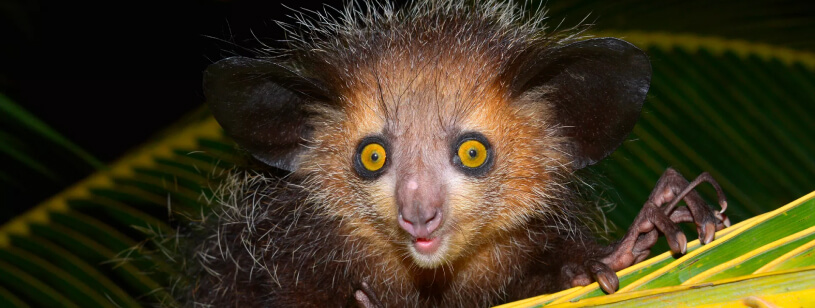
The aye-aye (Daubentonia madagascariensis) is a nocturnal lemur native to Madagascar and the only living member of its family. It taps on wood, listens for clues to hidden food, gnaws an opening and uses a slender finger to extract insect larvae.
Aye-ayes use several forest habitats. Habitat loss and persecution linked to negative local beliefs threaten them, although attitudes differ between communities.
Quick facts
| Common name | Aye-aye |
| Scientific name | Daubentonia madagascariensis |
| Typical lifespan | Wild lifespan is poorly known; animals in managed care can live for more than two decades |
| Length | About 30-40 cm (head and body); tail about 44-53 cm |
| Weight | About 2.5–2.8 kg; individuals vary |
| Diet type | Omnivore (insect larvae, seeds, nuts, fruit, nectar, fungi) |
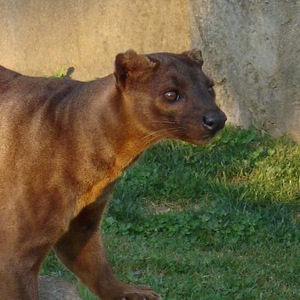
| Main predators | Fossa, possibly large snakes and birds of prey; people |
| Conservation status | Endangered (IUCN) |
| Distribution | Madagascar |
| Living environment | Rainforests, dry forests, mangroves, plantations |
Interesting facts
- Specialised fingers – A thin middle finger helps with tapping and extracting food.
- Percussive foraging – Tapping and listening help reveal food inside wood. This differs from producing ultrasonic calls like an echolocating bat.
- Growing incisors – The front teeth grow continuously and are worn down through use.
- Conservation concern – Aye-ayes face habitat loss and persecution; no precise wild population estimate is given here.
- Mistaken for a squirrel - When it was first described in the 18th century, the aye-aye was classified as a kind of squirrel, because of its rodent-like front teeth.
- A hidden extra thumb - In 2019, scientists discovered that the aye-aye has a tiny "pseudo-thumb" on each hand that helps it grip branches.
Records and remarkable features
- Nocturnal lemur – The aye-aye is the largest living nocturnal lemur; this does not make it the largest nocturnal primate in every comparison.
- A specialised hand – The slender middle finger is adapted for tapping and retrieving food.
- Finding food in wood – Aye-ayes combine tapping, listening, gnawing and probing rather than relying on bat-like sonar.
- A family of one – The aye-aye is the only living member of its family, Daubentoniidae.
Physical characteristics and adaptations
The aye-aye (Daubentonia madagascariensis) is a nocturnal lemur with large ears, continuously growing incisors and specialised fingers. These features help it find and extract food in trees.
Key physical adaptations
- A very long, thin middle finger - Used to tap on wood and pull out larvae; it has a ball-and-socket joint that lets it move in many directions.
- Rodent-like incisors - These teeth never stop growing and are used to gnaw holes in wood and hard nuts.
- Large eyes - Help it see at night.
- Large, mobile ears - Very sensitive, they help it hear larvae moving and hollow spaces inside wood.
- A long, bushy tail - Longer than its body, it helps with balance.
- Coarse, dark fur - Long guard hairs over a soft undercoat protect it from rain.
Dimensions and variations
| Characteristic | Size |
|---|---|
| Body length | Around 30–40 cm |
| Length of tail | About 44-53 cm |
| Weight | About 2.5–2.8 kg |
| Length of the middle finger | About 8 cm |
Habits and behaviour
The aye-aye is a nocturnal, tree-living lemur that spends almost all its life in the forest canopy.
Daily life
- Active at night - It sleeps during the day in a nest and comes out at night to search for food.
- Nests - It builds round nests of leaves and branches in the forks of trees, with a single small entrance, and may use several nests in turn.
- A good climber - It moves through the trees by climbing and leaping, using its tail for balance.
Social interactions
- Mostly alone - Aye-ayes usually forage alone, but their home ranges overlap and they sometimes travel or feed together.
- Scent marking - They mark their ranges with scent and urine.
- Dominant females - As in many lemurs, females are dominant over males and get first access to food.
Defense techniques
- Hiding - Its dark fur makes it hard to see in the trees at night.
- Quick escape - It can leap quickly between branches to escape predators such as the fossa.
- Nests - Sleeping in closed nests during the day helps protect it from predators.
Habitat and geographic distribution
The aye-aye lives only in Madagascar, where it is found in rainforests, dry forests, mangroves and even near plantations.
Distribution context
| Region | Population information |
|---|---|
| Eastern rainforests | The main stronghold |
| Northern and western forests | Present, often at low density |
| Protected areas | Important refuges, but numbers are not known exactly |
Habitat types
- Rainforests - Its main habitat, with tall trees and plenty of food.
- Dry forests and mangroves - In some areas, the aye-aye lives in drier forests and coastal mangroves.
- Plantations - It is sometimes found in coconut, lychee and other plantations, where it eats fruit and nuts.
Environmental change
- Deforestation - Habitat loss is the biggest threat to the aye-aye.
- Persecution - In some villages, the aye-aye is believed to bring bad luck and is killed when it is seen.
- Climate change - May affect Madagascar's forests and the food they provide.
Diet and feeding
The aye-aye is an omnivore with one of the most unusual ways of feeding among primates. It taps on wood with its long middle finger, listens for larvae and then gnaws and probes to pull them out.
What does the aye-aye eat?
| Food group | Examples and context | Frequency in the diet |
|---|---|---|
| Insect larvae | Beetle larvae living inside wood | Very often |
| Seeds and nuts | Ramy nuts, coconuts | Often |
| Fruit | Mangoes, lychees and other fruit | Often |
| Nectar | Nectar from the flowers of the traveller's tree | Seasonally |
| Fungi | Fungi growing on trees | Occasionally |
Feeding methods
- Tapping - It taps quickly on the bark with its middle finger and listens for hollow spaces and moving larvae.
- Gnawing - When it finds a larva, it gnaws a hole in the wood with its strong front teeth.
- Probing - It then inserts its thin middle finger into the hole and hooks out the larva.
- Opening nuts and coconuts - It gnaws a hole in the shell and scoops out the inside with its middle finger.
Reproduction and life cycle
Aye-ayes breed slowly: a female usually has one baby every two to three years.
Breeding season
- There is no fixed breeding season; females can come into breeding condition at any time of year.
- When a female is ready to mate, she calls loudly, and several males may gather and compete for her.
- Mating takes place in the trees and can last a long time.
Gestation and birth
| Characteristic | Details |
|---|---|
| Gestation | About 160-170 days |
| Number of young per birth | 1 |
| Nursing period | About 7 months or more |
| Sexual maturity | About 2-3 years |
Raising young
- The baby is born in a nest and depends completely on its mother.
- For its first weeks, it stays in the nest while the mother forages.
- As it grows, it starts to follow its mother through the trees and learns how to find food.
- Young aye-ayes stay with their mothers for about two years before becoming independent.
Survival
- Because each female has so few young, aye-aye populations recover slowly.
- In captivity, aye-ayes have lived for more than 20 years; their lifespan in the wild is not well known.
Name and history
Origin of the name
- The name "aye-aye" was first recorded by the French naturalist Pierre Sonnerat in the 1780s. Its origin is uncertain; it may come from a cry of surprise or fear made by local people when they saw the animal.
- The genus name Daubentonia honours the French naturalist Louis-Jean-Marie Daubenton.
Taxonomic classification
| Classification | Name |
|---|---|
| Kingdom | Animalia |
| Phylum | Chordata |
| Class | Mammalia |
| Order | Primates |
| Suborder | Strepsirrhini |
| Family | Daubentoniidae |
| Genus | Daubentonia |
| Species | Daubentonia madagascariensis |
Evolution and fossils
- The aye-aye's ancestors split from those of other lemurs very early, probably more than 50 million years ago.
- At first, it was classified as a rodent, because of its rodent-like front teeth.
- The extinct giant aye-aye, Daubentonia robusta, was a larger relative of the living species.
Cultural significance and mythology
Attitudes towards aye-ayes vary between communities. Some negative beliefs have led to persecution; these beliefs are cultural traditions, not facts about the animal’s powers.
The aye-aye in myths and legends
- Local beliefs – Some communities associate aye-ayes with bad luck, while others protect them. These beliefs do not show that the animal causes misfortune.
- Taboos - In Madagascar, many traditional rules called fady concern animals; in some places it is fady to harm an aye-aye, while in others it is fady to let one live.
The aye-aye in modern symbolism
- A symbol of conservation - The aye-aye has become a symbol of Madagascar's unique and threatened wildlife.
- A misunderstood animal - It is often used as an example of how superstition can threaten wildlife.
Conservation status and threats
The aye-aye faces threats from habitat loss and persecution. Protecting habitat and working with local communities are important conservation measures.
Conservation status
| Region | Assessment scope | Trend |
|---|---|---|
| Madagascar (whole range) | Endangered (IUCN) | Decreasing |
| Protected areas and reserves | Important refuges | Depends on how well the forest is protected |
Main pressures
- Deforestation - Madagascar has lost a large part of its forests since the mid-20th century, destroying aye-aye habitat.
- Persecution - Aye-ayes are sometimes killed because of beliefs that they bring bad luck, or because they raid crops such as coconuts.
- Hunting - In some areas, aye-ayes are hunted for food.
- Fragmented forests - As forests are broken up, aye-ayes are forced to cross open land, where they are more vulnerable.
Protection measures
- Protected areas - National parks and reserves in Madagascar protect aye-aye habitat.
- Education - Programmes work with local communities to reduce fear of the aye-aye.
- Legal protection - The aye-aye is protected by law, and international trade is banned under CITES.
- Captive breeding - Zoos in Madagascar, Europe and North America breed aye-ayes to keep a healthy backup population.
In popular culture
With its strange appearance, the aye-aye has attracted attention in films, books and on the internet.
Films and books
- The Aye-Aye and I (Gerald Durrell, 1992) - The famous naturalist describes his expedition to Madagascar to collect aye-ayes for a captive breeding programme.
- Madagascar (2005) - In the DreamWorks animated films, Maurice, the loyal assistant of King Julien, is an aye-aye.
Mascots and symbols
- Conservation - The aye-aye appears in many campaigns to protect Madagascar's wildlife.
- Stamps and souvenirs - It has appeared on stamps and other items from Madagascar.
- Internet fame - Because of its unusual looks, the aye-aye often appears in lists of the world's "strangest animals".