BeagleCharacteristics, history, training and care
The Beagle is a small scent hound developed for hunting in packs. It is active, curious and strongly guided by scent. As a companion it needs exercise, social contact and training suited to the individual dog.
Quick facts
| Common name | Beagle |
| Scientific name | Canis lupus familiaris |
| Country of origin | United Kingdom |
| Official Recognition | Recognized by FCI and AKC |
| Typical lifespan | About 12-15 years |
| Dimensions (Male) | About 33-40 cm |
| Dimensions (Female) | About 33-38 cm |
| Weight (Male) | About 10-14 kg |
| Weight (Females) | About 9-12 kg |
| Coat type | Short, dense, weather-resistant |
| Common colours | Tricolour (white, black and tan), bicolour such as lemon and white or red and white |
| Energy Level | High |
| Suitable for an apartment? | Depends on exercise, training, health and the individual dog |
| Temperament | Friendly, curious, stubborn |
| Behaviour towards unfamiliar people and dogs | Individual behaviour varies; socialisation, training and management matter |
| Compatibility with children | Depends on the individual; adult supervision and suitable handling are essential |
| Compatibility with other animals | Depends on socialisation, prey drive and the animals involved |
| Health considerations | Obesity, eye disorders, epilepsy, ear infections |
- Primary category:Dog breeds
- Explore this animal's categories:
History and Origin
The modern Beagle was developed in Britain as a scent hound. Dogs used for similar tasks have a much longer history, but they should not automatically be identified as the same modern breed.
Evolution of the breed
- Early history - Small hounds used for hunting hares in packs were known in England for centuries, and the name "beagle" appears in English texts from the late Middle Ages.
- Small hounds known as pocket beagles were kept historically; modern Beagles should be assessed against current breed standards.
- The 19th century - British breeders, notably Reverend Phillip Honeywood in Essex from the 1830s, developed the modern Beagle as a pack hound for hunting hares.
- The 20th century - The Beagle became one of the most popular family dogs and is also used as a detection dog thanks to its excellent nose.
Breed Evaluation
The Beagle is a clever, friendly and active dog, but it can also be independent and hard to train because of its strong hunting instinct. These are general editorial ratings, not measured scores; individual dogs vary.
| Characteristic | Stars |
|---|---|
| Training and Intelligence | ★★★☆☆ |
| Easy to train | ★★☆☆☆ |
| Intelligence | ★★★★★ |
| Level of independence | ★★★★☆ |
| Level of stubbornness | ★★★★☆ |
| Behavior and Temperament | ★★★★★ |
| Affectionate with family | ★★★★★ |
| Friendly with children | ★★★★★ |
| Compatible with other dogs | ★★★★★ |
| Compatible with cats and other animals | ★★★★☆ |
| Degree of loyalty | ★★★★☆ |
| Tendency to be aggressive | ★☆☆☆☆ |
| Tendency to bark | ★★★★★ |
| Needs and Care | ★★★☆☆ |
| Shedding level | ★★★☆☆ |
| Requires frequent care | ★★☆☆☆ |
| Activity and Lifestyle | ★★★★★ |
| Energy level | ★★★★★ |
| Daily exercise requirement | ★★★★★ |
| Suitable for apartment living | ★★★☆☆ |
| Health and Longevity | ★★★★☆ |
| Life expectancy | ★★★★★ |
| Predisposition to genetic diseases | ★★★☆☆ |
| Work and Utility Features | ★★★★★ |
| Good guard dog | ★★★☆☆ |
| Good companion dog | ★★★★★ |
Physical Characteristics
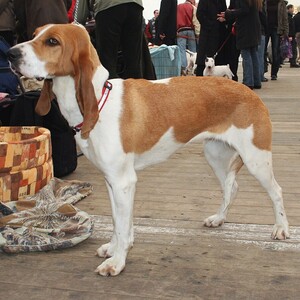
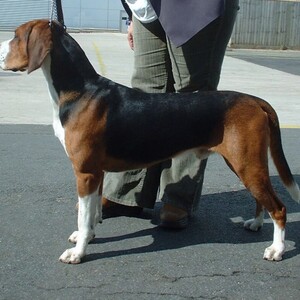
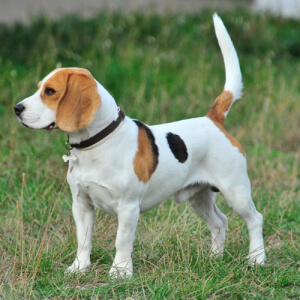
The Beagle is a compact, sturdy scent hound with hanging ears and a short coat.
General appearance
- A compact, muscular body, built for stamina rather than speed.
- A short, dense, weather-resistant coat.
- Long, hanging ears with rounded tips, typical of the breed.
- Large brown or hazel eyes with a gentle, pleading expression.
- The tail is carried upright and often has a white tip, which can help make the dog visible in vegetation.
| Characteristic | Beagle |
|---|---|
| Size | Small to medium (about 33-40 cm at the shoulder) |
| Weight | About 9-14 kg |
| Coat | Short, dense |
| Muzzle | Medium length, square |
| Shedding tendency | Moderate |
| Build | Sturdy but agile |
The Beagle is a sturdy, hardy breed, well suited to hunting and outdoor activities.
Training and Socialization
The Beagle is intelligent but independent, which makes training a challenge. Bred for hunting, it has a strong urge to follow scents, which can distract it during training.
Tips for effective training
- Rewards are the key - The Beagle is very food-motivated, so food rewards work well in training.
- Short, clear commands - It responds well to simple commands, but may stop listening if sessions are too long or boring.
- Early socialisation - Meeting people, other animals and different places from an early age helps prevent shyness and anxiety.
- Focus exercises - With its great nose, the Beagle is easily distracted; scent games can help keep its attention.
- Patience - It can be stubborn, so training must be consistent and patient.
The Beagle is sociable and playful, but without good training it can be hard to control, especially in open spaces where it may run off after an interesting smell.
Activity and Lifestyle Needs
The Beagle is an active dog that needs plenty of exercise to prevent boredom and destructive behaviour.
| Activity | Recommended duration |
|---|---|
| Daily walks | About 60 min or more |
| Interactive games | About 20-30 min |
| Obedience training | About 10-15 min |
| Sniffing activities | Search and scent games |
Recommendations for a balanced lifestyle
- Needs exercise - Although it can live in an apartment, the Beagle needs daily walks and time outdoors.
- Tends to wander - Because of its hunting instinct, it may run off following a scent, so it should be kept in fenced areas or on a lead.
- Does not like being alone - It may develop separation anxiety if left alone for long periods, leading to howling or destructive behaviour.
- Good for active families - The Beagle is happiest in a home with plenty of company and activity.
The Beagle is an energetic dog that needs regular physical and mental stimulation to be happy and balanced.
Care and Health
The Beagle's coat is easy to care for, but the breed is prone to some health problems, especially weight gain.
Fur and skin care
- Weekly brushing - The short coat needs brushing 1-2 times a week to remove loose hair.
- Occasional baths - A bath every few weeks, or only when needed, is enough.
- Ear cleaning - Because of its long, hanging ears, the Beagle is prone to ear infections, so the ears should be checked and cleaned regularly.
Common health problems
| Condition | Description | Common symptoms |
|---|---|---|
| Obesity | Beagles gain weight easily if overfed | Weight gain, low energy |
| Hip dysplasia | Abnormal development of the hip joint | Difficulty moving, limping |
| Epilepsy | A neurological disorder that occurs in the breed | Seizures, confusion, loss of balance |
| Eye problems | Including glaucoma, cataracts and cherry eye | Poor vision, red or cloudy eyes |
| Ear infections | Long ears can trap dirt and moisture | Bad smell, scratching |
Other aspects of care
- Regular veterinary checks - to monitor general health and discuss inherited-disease screening and appropriate care.
- Teeth cleaning - Beagles are prone to tartar, so dental care is important.
- Healthy weight - As a keen eater, the Beagle should get measured portions.
Diet and Nutrition
The Beagle has a big appetite and is prone to overeating and obesity.
Recommendations for a balanced diet
Choose a complete, balanced food suited to the dog’s life stage and health. Adjust portions to body condition and activity, and discuss feeding plans with a veterinarian.
| Food type | Daily Amount (Adults) | Frequency |
|---|---|---|
| Premium dry food | Individual amount; follow complete-food guidance and veterinary advice | 2 meals/day |
| Home cooked food | Individual amount; follow a complete diet’s guidance and veterinary advice | 2 meals/day |
| Raw food: bacterial contamination is a concern | Individual amount; follow complete-food guidance and veterinary advice | 2 meals/day |
Forbidden foods
Chocolate can poison dogs. Bones can cause choking or digestive injury. Other foods can also be unsafe, so seek veterinary advice after a suspected harmful ingestion.
Because Beagles love food and gain weight easily, a balanced diet, measured portions and regular exercise are important.
Reproduction and Development
Breeding requires veterinary planning, suitable health screening and care for the mother and puppies. Pregnancy and birth can involve complications.
Physical and emotional maturity
- Physical maturity: The Beagle reaches adult size at about 12 months, but continues to fill out until about 1.5 years.
- Emotional maturity: It stays playful and curious all its life, but usually becomes calmer after about 2 years.
Mating and Gestation
- Breeding decisions require veterinary assessment of maturity, health and suitable screening; reaching a fixed age does not establish that breeding is appropriate.
- Duration of gestation: Approximately 58-68 days, usually about 63 days.
- Average number of puppies: Usually about 5-8 puppies per litter.
Puppy care
- The first 3 weeks: Puppies must be kept warm, fed by their mother and protected from loud noises and stress.
- Between 4-8 weeks: Solid food is introduced gradually, and contact with littermates and people is essential for socialisation.
- Moving to a new home: When puppies go to their new homes, basic training and socialisation should continue.
Curiosities and Interesting Facts
- Beagles are scent hounds with a strong interest in following smells; no fixed olfactory-receptor count or breed ranking is asserted here.
- Laboratory dogs - Because of its size and gentle nature, the Beagle has long been used in medical and drug research; many organisations now help rehome beagles from laboratories.
- A food thief - Beagles are famous for stealing food from tables and even opening cupboards.
- A singing hound - Beagles bay or howl with a special musical sound when they find an interesting scent.
- The Beagle Brigade - In the United States, beagles work at airports to sniff out forbidden fruit, meat and plants in travellers' luggage.
- A president's dogs - US President Lyndon B. Johnson had beagles called Him and Her.
The Dog in Popular Culture
The Beagle is one of the best-known dogs in cartoons, books and films.
Famous movies and series
- Snoopy, the fictional dog in Charles M. Schulz’s Peanuts, is a beagle.
- "Shiloh" - The 1991 children's novel by Phyllis Reynolds Naylor, later made into a film, tells the story of a boy who rescues a mistreated beagle.
Beagle as symbol
- Laboratory dog - Although this is controversial, the Beagle has been one of the most common dogs in medical research because of its gentle nature and medium size.
- Detection dog - Its excellent nose and friendly, non-threatening appearance make it ideal for sniffing luggage at airports.
- HMS Beagle - Charles Darwin sailed around the world on HMS Beagle, a ship named after the breed.