ChinchillaChinchilla — long-tailed and short-tailed species
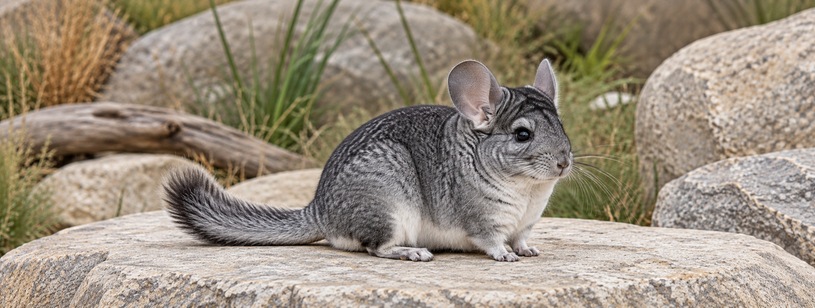
Chinchillas are South American rodents with exceptionally dense fur, large ears and furry tails. Wild chinchillas inhabit rocky landscapes. Those kept as pets need cool surroundings, a high-fibre diet, exercise and compatible chinchilla company.
The name covers two closely related species. The long-tailed chinchilla is more commonly associated with pets. Both species are threatened in the wild, despite the many chinchillas bred by people.
Quick facts
| Common name | Chinchilla |
| Scientific name | Genus Chinchilla — two living species |
| Typical lifespan | An average of around 10–15 years in human care; some live beyond 20 |
| Length | Many pet chinchillas reach around 25 cm, excluding the tail |
| Weight | Often 450–680 g in pet chinchillas described by MSD; varies by species and individual |
| Diet type | Herbivorous; hay forms the basis of a pet chinchilla’s diet |
| Conservation status | Both wild species: Endangered, according to the Mammal Diversity Database |
| Geographical distribution | South America; the two wild species have different ranges. |
| Habitat | Rocky slopes, crevices and vegetation adapted to dry conditions |
| Species | Chinchilla laniger, widely known as C. lanigera, and Chinchilla chinchilla |
| Origin | South America |
| Tail | Furry; the long-tailed chinchilla may have a tail around 15 cm long |
| Coat | Very dense; commonly grey, with other colours in captive-bred varieties |
| Activity | Mainly in the evening, at night and around dawn |
| Social life | Groups in the wild; compatible companions in captivity |
| Gestation | An average of about 111 days |
| Young | Usually small litters; MSD describes an average of 2, with variation |
Interesting facts
- Chinchillas groom by rolling in fine dust. Dust baths maintain the coat; ordinary water bathing is not part of routine care.
- They can release a patch of fur when grabbed. This defence, called fur slip, may help an animal escape a predator. It does not make grabbing a chinchilla by its fur safe.
- They hold food in their front paws. They often sit on their hindquarters while handling it.
- Young are born furred and with open eyes. They are more developed at birth than the young of many other rodents.
- A furry tail helps distinguish them from guinea pigs. Guinea pigs have no externally visible tail.
- Strong hind limbs support agile movement. Chinchillas jump and climb over rocky ground.
Records and remarkable features
Radar’s longevity record
Guinness World Records lists Radar, a chinchilla that lived for 29 years and 229 days. Born in Germany in 1985, Radar died in California in 2014.
This was exceptional. An ordinary pet chinchilla has a much shorter expected lifespan, with health and appropriate care mattering throughout its life.
An unusually dense coat
Dozens of fine hairs can grow from a single follicle, the small structure in the skin that produces hair. This density is one of the chinchilla’s most striking adaptations.
Fur that protects against cold can become a disadvantage in an overheated room. A fluffy appearance does not mean an animal tolerates any temperature.
Characteristics
Physical appearance
Chinchillas have rounded bodies, broad heads, large dark eyes, long whiskers and rounded ears. Whiskers help them investigate their surroundings. The tail is furry, and the hind limbs power their jumps.
Many pet chinchillas have bodies up to around 25 cm long, with a tail adding about 15 cm. These are approximate figures: species, sex and individual differences affect size. Females are often larger than males.
The two species
| Species | Distinguishing features |
|---|---|
| Long-tailed chinchilla | Chinchilla laniger, also widely called C. lanigera; relatively longer tail and ears |
| Short-tailed chinchilla | Chinchilla chinchilla, called C. brevicaudata in older literature; more robust build, relatively shorter ears and tail |
The Mammal Diversity Database uses Chinchilla laniger, matching the spelling in the original description. Lanigera remains common in guides. These names refer here to the same long-tailed species.
Colours and relatives
Captive-bred chinchillas may be grey, white, black, beige or combinations of colours. Colour alone does not determine species. The animal illustrated is a grey pet chinchilla.
Their family, Chinchillidae, also includes viscachas. Chinchillas and guinea pigs are both rodents, but belong to different families and do not automatically share the same care requirements.
Habits and behaviour
When are chinchillas active?
They are mainly active in the evening and at night, with activity around dawn as well. During the day they need undisturbed rest and somewhere quiet to retreat.
Wild chinchillas move between rocks and shelters to forage and avoid danger. A pet retains the need to explore, so exercise areas must be safe. Electrical cables and unsuitable objects to chew should be inaccessible.
Company and communication
Chinchillas are social and can form colonies. Pets need one or more compatible chinchilla companions. Unfamiliar animals should be introduced gradually; putting them straight into the same cage can cause conflict.
They communicate through calls, body posture and scent. Squeals or barking-like sounds can occur when frightened, but their meaning depends on the situation.
Relationships with people
A chinchilla may become comfortable with familiar carers, yet many do not enjoy being picked up or held for long. A calm approach and an available retreat give the animal more choice.
Do not chase, squeeze or grab a chinchilla by its fur. Fur loss can be a defensive response, rather than acceptance of handling.
Habitat and geographical distribution
Where do wild chinchillas live?
Chinchillas originate in South America. They are associated with rocky Andean regions and Chilean slopes, but the two species do not have identical ranges.
Long-tailed chinchillas also occur in lower-elevation, semi-arid landscapes. A study in Las Chinchillas National Reserve examined colonies on terrain about 400–1,700 m above sea level. Wild chinchillas should therefore not all be described as living only on very high peaks.
Rock crevices and surrounding vegetation offer shelter. The Chilean study found an association between colony sites, rocks and plants of the genus Puya.
Housing pet chinchillas
- Horizontal and vertical exercise space, with stable platforms and routes that reduce the risk of falls.
- Hiding and resting places, sufficient for every animal.
- Comfortable surfaces for feet; continuously standing on wire mesh can cause injury.
- A cool, dry, well-ventilated environment, away from direct sunlight.
RSPCA guidance gives an ideal housing range of about 10–18°C. Heat and high humidity are dangerous. No single temperature threshold guarantees safety in all conditions.
Dust bathing
Provide an appropriate container with fine dust intended for chinchillas, kept clean and maintained regularly. Rolling in it helps maintain the coat. Building sand is unsuitable, and routine cleaning should not involve an improvised water bath.
Diet and feeding
What do chinchillas eat?
Good-quality hay, always available, forms the basis of a pet chinchilla’s diet. Fibre supports digestion, while prolonged chewing helps wear teeth that grow continuously.
| Component | Role in the diet |
|---|---|
| Hay and suitable grass | Main source of fibre; hay available at all times |
| Grass-based chinchilla pellets | Complement the diet in an amount suited to the animal |
| Fresh water | Always available; check cleanliness and that the drinker works daily |
| Treats | Few and carefully chosen; they should not replace hay or turn the diet into a sugary or fatty menu |
Feeding in the wild
Wild chinchillas eat available plants, including leaves, stems and other plant parts. The menu varies with resources and season. A plant eaten by a wild chinchilla is not automatically suitable food for a pet.
What should carers check daily?
Dietary changes should be gradual. Seed- and nut-rich mixes are not an appropriate staple, and sweets intended for people should be avoided.
A loss of appetite or an obvious reduction in droppings needs prompt veterinary advice. These can indicate dental or digestive trouble and should not be dismissed as fussiness.
Reproduction and life cycle
Pregnancy and birth
Gestation averages about 111 days. The MSD Veterinary Manual describes an average litter of two, within a wider range of 1–6 young.
Females may produce more than one litter in a year, but repeated breeding is not risk-free. Correct sex identification and appropriate group management help prevent unplanned breeding.
How do the young develop?
Young are born furred and with open eyes, and can move early. They are precocial, meaning relatively well developed at birth. Nevertheless, they still depend on their mother and her milk.
Weaning usually occurs at around 6–8 weeks. Trying solid food is not a reason to separate a young animal from its mother immediately.
How long do chinchillas live?
MSD gives an average of about 10–15 years, with some reaching 20 or more. Keeping chinchillas is a long-term commitment involving daily care and access to suitable veterinary services.
Radar’s record is not a lifespan every owner should expect.
Names and history
| Classification level | Name |
|---|---|
| Class | Mammalia — mammals |
| Order | Rodentia — rodents |
| Family | Chinchillidae |
Scientific and common names
Chinchilla is both a familiar animal name and the scientific name of a genus in Chinchillidae. In Romanian, the name șinșilă is also used.
Long-tailed and short-tailed chinchillas are two species. Colour varieties developed by breeders are not additional species.
Relationships with people
Chinchillas were hunted heavily for their fur, and commercial demand severely reduced wild populations. Captive breeding subsequently became widespread, and chinchillas also became pets.
Two situations therefore coexist: many chinchillas are bred by people, while their wild relatives continue to need protection.
Conservation and threats
Both wild species are Endangered
The Mammal Diversity Database lists both species as Endangered (EN). This status concerns wild populations; it is not assessed by counting animals in homes and breeding facilities.
Main threats
- Hunting for fur, which had a major historical impact.
- Habitat degradation and fragmentation, including activities affecting vegetation and rocky shelters.
- Mining and other changes in land use, in parts of the animals’ range.
Protection and responsible care
In Chile, Las Chinchillas National Reserve, established in 1983, protects important long-tailed chinchilla habitat. CONAF describes an active conservation plan for the species. Protecting shelter and vegetation matters alongside colony monitoring.
Pet care raises different priorities: avoiding overheating, providing suitable food, maintaining dental health and ensuring compatible company. Breathing difficulties, loss of appetite or clear behavioural changes require veterinary assessment.
Frequently asked questions
What is a chinchilla?
A South American rodent of the genus Chinchilla, with very dense fur, large ears and a furry tail. Two living species are recognised.
How long does a chinchilla live?
Around 10–15 years on average in human care; some reach 20 years or more.
What do chinchillas eat?
Good-quality hay available at all times, complemented by appropriate chinchilla pellets and fresh water. Treats should be limited.
Should a chinchilla have a water bath?
Routine coat care uses fine dust intended for chinchillas. Water bathing is not part of normal grooming care.
Can a chinchilla live alone?
It is social and needs compatible chinchilla company. Unfamiliar animals should be introduced gradually.
Are chinchillas active by day or night?
Mainly in the evening and at night, with activity around dawn. They need undisturbed rest during the day.
Are chinchillas endangered?
Both wild species are listed as Endangered. Pet chinchillas do not remove the threats to wild populations.
Is a chinchilla the same as a guinea pig?
No. They are rodents from different families. Chinchillas have larger ears and a visible furry tail, and their care requirements differ.
Did you know? About chinchillas
- Chinchillas groom by rolling in fine dust.
- Dense fur makes them vulnerable to excessive heat.
- Young are born furred and with open eyes.
- Wild species and pet chinchillas have distinct conservation contexts.