Neon tetraParacheirodon innesi — habitat, diet and reproduction
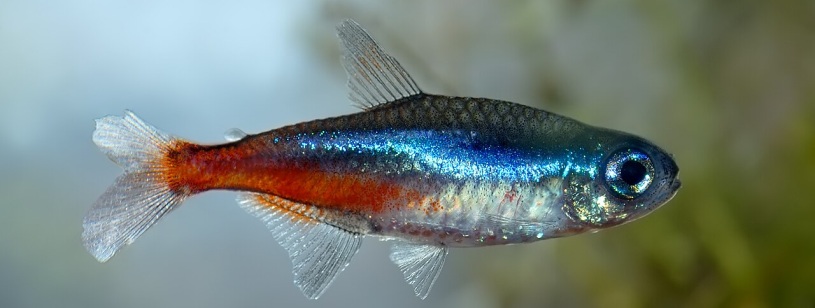
Neon tetra (Paracheirodon innesi), showing its blue stripe and red rear half. · André Karwath aka Aka / CC BY-SA 2.5 (https://creativecommons.org/licenses/by-sa/2.5). Cropped and resized.
The neon tetra is a small Amazonian fish recognised by its blue stripe and red rear half. Its blue sheen comes from light reflected by specialised skin cells. Neon tetras move in groups and search for tiny foods among plants and in the water.
Quick facts
| Common name | Neon tetra |
| Scientific name | Paracheirodon innesi |
| Lifespan | Several years with suitable care |
| Length | Up to about 2.5 cm excluding the tail fin |
| Diet | Omnivore: small invertebrates and plant material |
| Predators | Larger fish |
| Conservation status | Least Concern (LC) |
| Distribution | South America, in the Amazon basin |
| Habitat | Fresh water, including clearwater and blackwater tributaries |
| Family | Acestrorhamphidae |
| Reproduction | Egg laying without parental care |
| Social behaviour | Lives in groups |
- Primary category:Fish
- Explore this animal's categories:
Interesting facts
- The blue stripe reflects light rather than generating it.
- Its colour can shift with lighting and the fish’s condition.
- Red is concentrated on the rear half of the body, helping identification.
- Its small size makes it vulnerable to some otherwise peaceful aquarium fish.
Characteristics
The slender body has small, mostly transparent fins. A blue stripe runs along each side, above a red area concentrated on the rear half. The front of the belly is pale.
Cells called iridophores contain microscopic structures that selectively reflect light, producing structural colour. Changes in their arrangement alter the visible shade. Colours may become less conspicuous in darkness. Persistent changes should be assessed alongside swimming, breathing, appetite and water conditions.
Behaviour
Neon tetras are social fish. They swim together, spread out to forage and gather when threatened. A solitary fish does not reproduce the species’ usual social setting.
Plants provide shelter, while an open area allows group movement. Tankmates should be peaceful and unable to swallow them. Mature biological filtration is essential: newly set-up water can contain harmful substances even when it looks clear.
Habitat and distribution
The species comes from the Amazon basin, including tributaries of the Solimões system. Vegetation and plant debris provide shelter.
Some habitats contain dark water coloured by substances from leaves and wood. This natural colour is not the same as pollution. Other populations inhabit clearer waters. Stable conditions are important when keeping the species in captivity.
Diet and feeding
Neon tetras eat small invertebrates, including larvae and crustaceans, as well as plant material. Their small mouths limit food size.
Captive fish need finely sized complete food and suitable variety. Oversized pieces may remain uneaten despite apparent interest. Portions should suit the group, with waste kept low to protect water quality.
Reproduction and life cycle
Females lay eggs and fertilisation is external. Parents do not guard the clutch and may eat eggs. Breeding requires more carefully controlled conditions than simply maintaining adults.
Larvae initially use their own reserves. Once feeding begins, they need extremely small foods. Light, water quality and food availability influence development. A healthy group in a community aquarium does not automatically produce surviving young.
Name and history
Myers described the species in 1936 as Hyphessobrycon innesi. It is now placed in Paracheirodon within Acestrorhamphidae; older references may list Characidae.
The trade name neon also applies to related species. Identification should use the scientific name and body pattern rather than the blue stripe alone.
Conservation and threats
The neon tetra is globally Least Concern. Protecting water quality and riverside vegetation remains important for wild populations.
Aquarium fish should never be released into the wild. Responsible ownership includes preparing enough space for a social group before purchase.
Frequently asked questions
Does a neon tetra produce light?
No. Its sheen comes from light reflected by microscopic structures in the skin.
Can it be kept alone?
It is a social fish. A suitable aquarium should accommodate a group and provide shelter.
Why can its colour change at night?
Reflective cells respond to light, so the stripe can change shade or become less conspicuous in darkness.
Do parents care for the young?
They provide no parental care and may eat eggs. Fry need suitable conditions and very small foods.