Black and Tan CoonhoundCharacteristics, history, training and care
Quick facts
| Common name | Black and Tan Coonhound |
| Scientific name | Canis lupus familiaris |
| Country of origin | United States of America |
| Official Recognition | Recognised by AKC in 1945 |
| Typical lifespan | About 10-12 years |
| Dimensions (Male) | About 63-68 cm / 29-45 kg |
| Dimensions (Female) | About 58-63 cm / 25-40 kg |
| Coat type | Short, dense, smooth |
| Common colours | Black with tan markings |
| Energy Level | High |
| Suitable for an apartment? | Depends on exercise, training, health and the individual dog |
| Temperament | Friendly, independent, persevering |
| Behaviour towards unfamiliar people and dogs | Individual behaviour varies; socialisation, training and management matter |
| Compatibility with children | Depends on the individual; adult supervision and suitable handling are essential |
| Compatibility with other animals | Depends on socialisation, prey drive and the animals involved |
| Health considerations | Hip dysplasia, ear infections, bloat |
- Primary category:Dog breeds
- Explore this animal's categories:
History and Origin
The Black and Tan Coonhound is an American breed, developed to trail and "tree" raccoons and other animals that climb trees.
Evolution of the breed
- Origins in the 18th and 19th centuries - The breed is believed to come from crosses between Bloodhounds and black-and-tan foxhounds, giving it an excellent nose and great stamina.
- A hunters' companion - It was bred mainly in the Appalachian and Blue Ridge Mountains and the American South, to follow raccoons at night and sometimes larger game such as bears and cougars.
- Recognised in 1945 - The Black and Tan Coonhound was the first coonhound breed recognised by the American Kennel Club (AKC); today it is valued both as a hunter and as a family dog.
Breed Evaluation
The Black and Tan Coonhound is a clever, friendly and energetic working dog, suited to active people and families with enough space. These are general editorial ratings, not measured scores; individual dogs vary.
| Characteristic | Stars |
|---|---|
| Training and Intelligence | ★★★★☆ |
| Easy to train | ★★★☆☆ |
| Intelligence | ★★★★★ |
| Level of independence | ★★★★☆ |
| Level of stubbornness | ★★★★☆ |
| Behavior and Temperament | ★★★★☆ |
| Affectionate with family | ★★★★★ |
| Friendly with children | ★★★★★ |
| Compatible with other dogs | ★★★★☆ |
| Compatible with cats and other animals | ★★★☆☆ |
| Degree of loyalty | ★★★★★ |
| Tendency to be aggressive | ★☆☆☆☆ |
| Tendency to bark | ★★★★★ |
| Needs and Care | ★★★☆☆ |
| Shedding level | ★★★☆☆ |
| Requires frequent care | ★★★☆☆ |
| Activity and Lifestyle | ★★★★★ |
| Energy level | ★★★★★ |
| Daily exercise requirement | ★★★★★ |
| Suitable for apartment living | ★☆☆☆☆ |
| Health and Longevity | ★★★★☆ |
| Life expectancy | ★★★★☆ |
| Predisposition to genetic diseases | ★★★☆☆ |
| Work and Utility Features | ★★★★★ |
| Good hunting dog | ★★★★★ |
| Good companion dog | ★★★★☆ |
Physical Characteristics
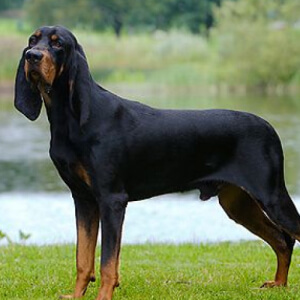
The Black and Tan Coonhound is a large, strong, athletic hound with an excellent ability to follow scent.
General appearance
- A well-proportioned, muscular body with strong bones.
- A short, dense, smooth coat that protects it in bad weather.
- A long head with very long, hanging ears that hang in folds.
- Hazel to dark brown eyes with a gentle, friendly expression.
- A long tail, carried high when the dog is working.
| Characteristic | Black and Tan Coonhound |
|---|---|
| Size | Large (about 58-68 cm at the shoulder) |
| Weight | About 25-45 kg |
| Coat | Short, dense, slightly glossy |
| Muzzle | Long, deep |
| Shedding tendency | Moderate |
| Build | Strong and sturdy |
The Black and Tan Coonhound is an impressive dog with great stamina, built to work in difficult conditions.
Training and Socialization
The Black and Tan Coonhound is clever and independent, but it can be stubborn when it finds an interesting scent. Training must therefore be consistent and motivating.
Tips for effective training
- Early socialisation - It should meet people, other animals and different places from an early age, as it can be reserved with strangers.
- Reward-based training - It responds well to treats and praise, but not to harsh corrections.
- Managing the nose - As a scent hound, it must learn to come when called and should be kept on a lead or in secure areas, especially near roads.
- Patience with stubbornness - It may ignore commands when it is following a trail, so training must be firm but patient.
- Managing its voice - The coonhound is a vocal breed; commands such as "quiet" help reduce unnecessary baying.
The Black and Tan Coonhound is intelligent but independent, and training must be structured and consistent to direct its energy.
Activity and Lifestyle Needs
The Black and Tan Coonhound is an active, hardy breed that needs regular exercise and space to explore.
| Activity | Recommended duration |
|---|---|
| Daily walks | About 60 min or more |
| Running in a secure area | About 30 min |
| Scent games | About 20-30 min |
| Obedience training | About 10-15 min/day |
Recommendations for a balanced lifestyle
- Best in a house with a large garden - It is not ideal for apartments, as it needs space and its voice can disturb neighbours.
- Needs regular activity - As a hunting dog, it needs long walks, runs and scent games.
- Can become destructive if bored - Without enough exercise, it may chew things or dig in the garden.
- Weather - Its short coat protects it from moderate cold and heat, but it must be protected from extreme temperatures.
The Black and Tan Coonhound is an active dog, suited to people who love hiking and outdoor activities.
Care and Health
The Black and Tan Coonhound is generally healthy, but its ears and joints need regular attention.
Fur and skin care
- Weekly brushing - The short coat needs little care, but brushing removes dead hair and dirt.
- Baths only when needed - It should be washed only when dirty, so as not to remove the skin's natural oils.
- Ear checks - Its very long ears can trap moisture and lead to infections, so they should be cleaned weekly.
Common health problems
| Condition | Description | Common symptoms |
|---|---|---|
| Hip and elbow dysplasia | Abnormal development of the joints | Limping, stiff joints |
| Ear infections | Caused by the long, hanging ears | Scratching, bad smell |
| Bloat (gastric torsion) | Higher risk because of its deep chest | Swollen belly, difficulty breathing |
Other aspects of care
- Regular veterinary checks - Essential for monitoring the joints and ears.
- Meal planning should suit the individual dog. Feeding arrangements do not guarantee prevention of gastric dilatation and volvulus; discuss risk with a veterinarian.
- Healthy weight - Regular exercise and a balanced diet help prevent joint problems.
The Black and Tan Coonhound is a healthy, sturdy breed, but its ears and joints need attention.
Diet and Nutrition
The Black and Tan Coonhound needs a balanced diet with good-quality protein to support its activity.
Recommendations for a healthy diet
Choose a complete, balanced diet suited to age, size and health. Plan home-prepared diets and supplements with a qualified veterinarian; raw pet food can carry harmful bacteria.
| Food type | Daily Amount (Adults) | Frequency |
|---|---|---|
| Premium dry food | Individual amount; follow a complete diet’s guidance and veterinary advice | 2 meals/day |
| Home cooked food | Individual amount; follow a complete diet’s guidance and veterinary advice | 2 meals/day |
| Raw food: bacterial contamination is a concern | Individual amount; follow complete-food guidance and veterinary advice | 2 meals/day |
Forbidden foods
Chocolate, grapes and raisins, onions and xylitol - toxic to dogs. / Cooked bones - can splinter and cause intestinal blockage. / Fatty and processed foods - can cause digestive problems. / Overfeeding - leads to weight gain and joint problems.
The Black and Tan Coonhound should be fed according to its activity, avoiding overfeeding and digestive problems.
Reproduction and Development
Breeding requires veterinary planning, suitable health screening and care for the mother and puppies. Pregnancy and birth can involve complications.
Physical and emotional maturity
- Physical maturity: It reaches adult size at about 12-18 months, but continues to fill out until about 2 years.
- Emotional maturity: Although independent, it usually becomes calmer and more focused at about 2-3 years.
Mating and Gestation
- Breeding decisions require veterinary assessment of maturity, health and suitable screening; reaching a fixed age does not establish that breeding is appropriate.
- Duration of gestation: Approximately 58-68 days, usually about 63 days.
- Average number of puppies: Usually about 6-8 puppies.
Puppy care
- The first 3 weeks: Puppies depend completely on their mother for warmth and milk.
- Between 4-8 weeks: They begin to explore and play with littermates and people; early socialisation helps prevent shyness.
- Moving to a new home: When puppies go to their new homes, basic training and socialisation should continue.
Good food and a stimulating environment are essential for healthy growth.
Curiosities and Interesting Facts
- A night hunter - It was bred to follow raccoons at night and bay loudly when the animal is "treed", so hunters can find it.
- Bloodhound ancestry - It inherited an excellent nose and can follow an old, "cold" trail.
- A musical voice - Its deep, ringing bay is often described as "singing".
- Great stamina - Once on a trail, it can keep going for hours over long distances.
- Not for beginners - Because of its independence and strong instincts, it suits experienced owners best.
- The first coonhound - It was the first of the coonhound breeds to be recognised by the AKC, in 1945.
The Dog in Popular Culture
The Black and Tan Coonhound is part of the rural hunting traditions of the American South.
Black and Tan Coonhound in Media and Culture
- A Southern hunting dog - Coonhounds often appear in country songs and stories about hunting in the American South.
Importance in American culture
- Coonhound events - The breed takes part in "nite hunts", field trials and other events that test its hunting ability.