IguanaInteresting facts and information
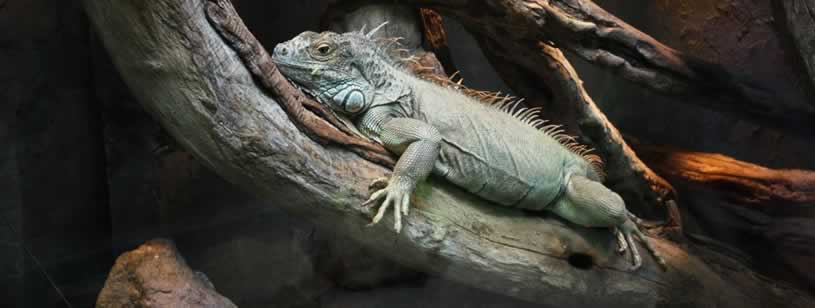
Iguanas are lizards found mainly in the Americas. The iguana family includes species with very different habitats and diets: the green iguana lives in trees, while the marine iguana of the Galápagos feeds in the sea.
The best-known species, the green iguana (Iguana iguana), is a familiar sight in the tropical forests of Latin America, where it helps spread seeds and shapes the vegetation it feeds on.
Iguanas are often seen as calm, harmless animals, but they can bite, scratch and lash out with their tail when they feel threatened. Habitat loss, illegal trade and capture for the pet trade put pressure on several species.
Quick facts
| Common name | Iguana |
| Scientific name | Iguanidae; Iguana for green and Lesser Antillean iguanas |
| Typical lifespan | About 10-20 years in the wild, sometimes longer in captivity |
| Maximum speed | Quick sprints on land over short distances; good swimmers |
| Dimensions | Green iguana: 1.2-2 m long (including tail) |
| Weight | Usually 4-8 kg |
| Diet type | Herbivore (leaves, flowers, fruit; algae for the marine iguana) |
| Main predators | Snakes, birds of prey, wild cats, introduced mammals, humans |
| Conservation status | Varies: green iguana Least Concern; marine iguana Vulnerable; Lesser Antillean iguana Critically Endangered (IUCN) |
| Distribution | Central and South America, the Caribbean, the Galápagos; introduced in Florida and elsewhere |
| Habitat | Tropical forests, dry forests, rocky areas, mangroves, coasts |
- Primary category:Reptiles
- Explore this animal's categories:
Interesting facts
- Iguanas can survive big falls - Green iguanas can drop from branches 12-15 metres high to the ground and walk away unhurt.
- They have a "third eye" - On top of the head, they have a parietal eye that senses light and shadows, which may help them notice predators approaching from above.
- They can drop their tails - When grabbed, a green iguana can shed part of its tail, which keeps twitching and distracts the attacker. A new tail grows back.
- They are excellent swimmers - They swim by sweeping their tail from side to side, and green iguanas can stay underwater for up to about 30 minutes.
- Males fight during the breeding season - They defend their territories against other males with head-bobbing displays, bites and tail lashes.
Records and remarkable features
- Iguanas are lizards found mainly in the Americas. The family includes species with very different habitats and diets; the green iguana and the marine iguana are separate species.
- The marine iguana of the Galápagos Islands is the only lizard in the world that feeds in the sea, diving for algae.
Characteristics
Iguanas are plant-eating reptiles that are active by day, with sturdy bodies, long tails and rough scales. These features help them survive in tropical forests and dry regions.
Main physical characteristics
| Feature | Details |
|---|---|
| Size | Green iguana: 1.2-2 m long (including tail) |
| Weight | Usually 4-8 kg; some large males weigh more |
| Colour | Green, grey, brown, orange or black, depending on the species, age and region |
| Tail | Long and strong, used for swimming, balance and defence |
| Feet | Strong, with sharp claws for climbing |
| Eyes | See colours well and are quick to detect movement |
| Parietal eye | Senses changes in light, such as the shadow of a bird of prey |
| Scales | Tough scales protect the skin and help reduce water loss |
| Dewlap | A large flap of skin under the throat, used for display and to help control body temperature |
Special adaptations
- Warming up - Iguanas bask in the morning sun to raise their body temperature and become active.
- A tail as a whip - When attacked, they can lash out hard with their tail.
- Sharp claws for climbing - Green iguanas are excellent climbers and spend most of their time in trees.
- Colour change - Males often become brighter or more orange in the breeding season, and iguanas can darken a little to absorb more heat.
- Diving - Marine iguanas slow their heart rate when they dive, so they can stay underwater for many minutes while feeding.
Habits and behaviour
Iguanas are active by day and mostly live alone, but several may gather where there is plenty of food or good basking spots. They are very alert to predators, and when danger threatens they flee, hide or lash out with their tail.
Social behaviour
- Solitary but tolerant - Iguanas do not live in true colonies, but they are often seen together in sunny spots or trees.
- Territories in the breeding season - Males become aggressive and defend their territories, using head-bobbing, their dewlap and bright colours to warn rivals.
- Silent communicators - Iguanas do not call; they communicate with head-bobs, body postures and their dewlap.
Feeding and survival methods
- Herbivores - Green iguanas eat leaves, flowers and fruit, which give them fibre, nutrients and water.
- Occasional animal food - Young iguanas may sometimes swallow insects, but plants make up almost all of their diet.
- Getting water - Iguanas drink water and also get a lot of moisture from the plants they eat.
Defence and survival strategies
- Diving into water - Green iguanas often rest on branches over rivers and drop into the water to escape danger.
- Jumping down - If threatened in a tree, they can leap to the ground or water without being hurt.
- A tail that breaks off - Some species can shed part of their tail to escape predators, and the tail then grows back.
- Camouflage - Their colours help them blend in with leaves and branches.
Habitat and geographic distribution
Iguanas live in tropical and subtropical regions, where it is warm and plants are plentiful. Most prefer warm, humid areas, but some species are adapted to dry places.
Habitat types
| Habitat | Main regions |
|---|---|
| Rainforests | South America, Central America, Caribbean |
| Dry forests and savannas | Mexico, Venezuela, Brazil |
| Rocky and dry areas | Galápagos Islands, Caribbean islands |
| Mangroves and coasts | Central and South America; introduced in Florida and Puerto Rico |
Geographic distribution
- Central and South America - Green iguanas live from Mexico through Central America to Brazil and Paraguay.
- The Caribbean - The Lesser Antillean iguana (Iguana delicatissima) is native to a few islands of the Lesser Antilles, and rock iguanas (Cyclura) live on other Caribbean islands.
- The USA - Green iguanas were introduced to Florida, where they have become an invasive species.
- The marine iguana (Amblyrhynchus cristatus) lives in the Galápagos Islands and feeds on marine algae. It rests and breeds on land.
Impact of climate change and human activities
- Habitat loss - Deforestation reduces the places where iguanas can feed and lay their eggs.
- Climate change - Warmer seas reduce the algae that marine iguanas eat, especially during El Niño years.
- Illegal pet trade - Iguanas are captured and sold as exotic pets, which harms wild populations.
- Invasive iguanas - In Florida and Puerto Rico, introduced green iguanas damage gardens, seawalls and canal banks.
Iguanas are adaptable reptiles, but climate change and human activities put several species at risk.
Diet and feeding
Most iguanas are herbivores that feed on leaves, flowers and fruit. Microbes in their gut help them break down tough plant fibres and get nutrients from a plant-based diet.
Types of food
| Food group | Examples |
|---|---|
| Leaves | Leaves of tropical trees and climbing plants |
| Flowers | Hibiscus and other tropical flowers |
| Fruit | Figs, mangoes, papaya and other wild fruit |
| Shoots and buds | Young plants and new growth |
| Algae | Seaweed (the main food of the marine iguana) |
Feeding methods
- Cutting teeth - Iguanas have small, serrated teeth that help them tear and slice leaves.
- Choosing food carefully - They prefer young, tender leaves and avoid some toxic plants.
- Water from food - Although they drink, iguanas get much of their water from the plants they eat.
As plant-eaters, iguanas play a role in their ecosystems by spreading seeds and shaping vegetation.
Reproduction and life cycle
Iguanas lay eggs, and the success of each generation depends on the weather and the food supply.
Life cycle stages
| Stage | Approximate timing | Details |
|---|---|---|
| Mating | Once a year, often in the dry season | Males defend territories and attract females with displays. |
| From mating to egg-laying | About 2 months | The female digs a nest burrow in the soil, where she lays her eggs. |
| Eggs per clutch | About 20-70 eggs (green iguana) | The eggs are buried for protection. |
| Incubation | About 90-120 days | The young hatch fully independent. |
| Juveniles | 1-2 years | They hide in vegetation from predators and grow quickly. |
| Maturity | About 2-4 years | They start to breed, and males become territorial. |
| Lifespan | About 10-20 years in the wild, sometimes longer in captivity | In the wild, they face many predators. |
Reproductive behaviour
- Aggressive males - In the breeding season, males defend their territories with head-bobbing displays and tail lashes.
- Choosing a nest site - Females dig burrows in sandy or soft soil, where they bury their eggs. Sometimes many females nest in the same area.
- Independent from birth - The young get no care from their parents and must look after themselves from the start.
Many young iguanas are eaten by predators, so populations that are heavily hunted or lose their habitat can decline quickly.
Name and history
Iguanas have been known to Europeans since the first explorers reached the Caribbean and Latin America, and Indigenous peoples knew them long before.
Origin of the name
- "Iguana" comes, through Spanish, from iwana, the word for this lizard in the language of the Taíno people of the Caribbean.
- The scientific name Iguana iguana goes back to a description by Carl Linnaeus in 1758 and refers to the green iguana, the best-known species.
- Other names - In Central America, the green iguana is sometimes called gallina de palo, "tree chicken", because its meat is eaten.
Taxonomic classification
| Taxonomic category | Name |
|---|---|
| Kingdom | Animalia |
| Phylum | Chordata |
| Class | Reptilia |
| Order | Squamata |
| Family | Iguanidae |
| Genus | Iguana |
| Species | Iguana iguana, Iguana delicatissima |
Iguanas in history and culture
- Described by early explorers - Spanish chroniclers of the 16th century described iguanas and how they were eaten.
- Important in Indigenous cultures - Iguanas were an important food, and they appear in the art and beliefs of peoples such as the Maya.
- Hunted for meat and eggs - In some regions, iguana meat and eggs are still considered a delicacy.
- Studied by scientists - Galápagos iguanas, in particular, are a classic example of how animals adapt to island life.
Iguanas are fascinating reptiles and remain an important part of tropical ecosystems.
Cultural significance and mythology
In Latin America and the Caribbean, iguanas have long been part of daily life, as food, as symbols and as characters in stories.
Iguanas in mythology and folk belief
- Maya religion - The great Maya god Itzamna is often linked with lizards or iguanas, and the Maya imagined parts of the world as a giant reptile.
- A traditional food - In Central America, iguana meat and eggs have been eaten for thousands of years and are part of local food traditions.
- Galápagos wonders - The marine iguanas of the Galápagos, which amazed Charles Darwin in 1835, have become a symbol of the islands.
Iguana symbolism
- Adaptability and survival - Iguanas are tough reptiles and symbols of flexibility and persistence.
- Patience - Iguanas often bask motionless for hours, which makes them a symbol of calm and patience.
- An ancient look - With their spines and scales, iguanas are often compared to small dinosaurs or dragons.
Conservation status and threats
The conservation status of iguanas differs between species and regions: some are common, while others are endangered because of habitat loss, hunting and introduced predators.
Conservation status
| Species | Status (IUCN) |
|---|---|
| Green iguana (Iguana iguana) | Least Concern |
| Lesser Antillean iguana (Iguana delicatissima) | Critically Endangered (decreasing population) |
| Marine iguana (Amblyrhynchus cristatus) | Vulnerable (affected by El Niño and climate change) |
| Grand Cayman blue iguana (Cyclura lewisi) | Endangered (recovered from near extinction) |
Main threats
- Habitat loss - Deforestation and the spread of farms and buildings reduce the places where iguanas can feed and nest.
- Hunting and illegal trade - Iguanas are captured for the pet trade, and some species are hunted for meat and eggs.
- Introduced predators and competitors - On islands, cats, dogs, rats and mongooses threaten native iguanas, and introduced green iguanas interbreed with the Lesser Antillean iguana.
- Climate change - Warmer seas and stronger El Niño events reduce the algae that marine iguanas need.
- Pollution - Oil spills and other pollution harm marine iguanas and their food.
Conservation efforts
- Captive breeding - Threatened species, such as the Grand Cayman blue iguana, are bred in special centres and released into the wild.
- Protected areas - National parks in Central America, the Caribbean and the Galápagos protect important iguana habitats.
- Monitoring populations - Biologists use tags, tracking devices and surveys to study iguana numbers and behaviour.
- Laws against illegal trade - Iguanas are listed under CITES, the Convention on International Trade in Endangered Species.
Although iguanas are tough and adaptable, protecting them is important for the biodiversity of tropical ecosystems.
In popular culture
Iguanas in literature
- The Night of the Iguana (Tennessee Williams, 1961) - A famous play, set in Mexico, in which a captured iguana becomes a symbol of the characters' situation; it was made into a film in 1964.
- Iguana (Alberto Vázquez-Figueroa, 1982) - A novel about a lonely man nicknamed "Iguana" who rules over a barren island in the Galápagos.
Iguanas in film and television
- Planet Earth II (BBC, 2016) - A famous scene shows newly hatched marine iguanas racing to escape from swarms of snakes on a Galápagos beach.
- Godzilla (1998) - In this film, the giant monster is a mutated iguana.
Iguanas as a cultural symbol
- Crafts and souvenirs - In tropical regions, iguanas appear in paintings, carvings and jewellery.
- Music - The singer Iggy Pop got his nickname from his first band, The Iguanas.