Death’s-head hawkmothAcherontia atropos — habitat, diet and reproduction
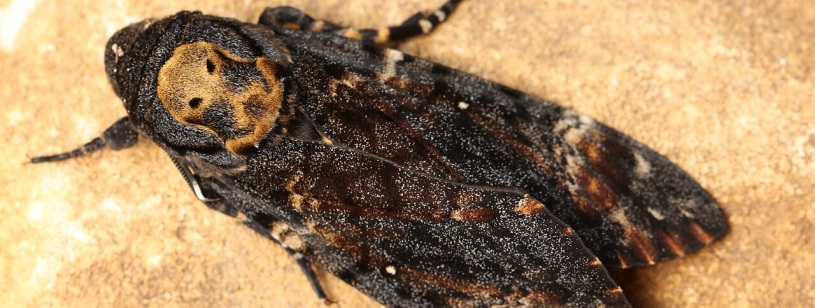
Death’s-head hawkmoth (Acherontia atropos) showing its thorax pattern. · Alastair Rae from London, United Kingdom / CC BY-SA 2.0 (https://creativecommons.org/licenses/by-sa/2.0). Cropped and resized.
The death’s-head hawkmoth is a large night-flying moth with a yellowish skull-like pattern on its thorax. It is one of the few moths that can make sounds: when disturbed, it squeaks. In summer it migrates from Africa to Europe, reaching Romania, and sometimes enters beehives to steal honey.
Quick facts
| Common name | Death’s-head hawkmoth |
| Scientific name | Acherontia atropos |
| Lifespan | The adult a few weeks |
| Length | Wingspan about 9–13 cm; caterpillar up to about 13–15 cm |
| Diet | Caterpillars: potato, tomato, jasmine leaves; adults: honey, sap, fruit |
| Predators | Birds, bats, bees defending the hive |
| Conservation status | Not evaluated; widespread |
| Distribution | Africa, Middle East, southern Europe; migrates to northern Europe in summer |
| Habitat | Open land, gardens, potato fields |
| Family | Sphingidae |
| Activity | Nocturnal |
Interesting facts
- The skull-like pattern on its back made it a symbol of death in superstitions for centuries.
- The moth squeaks by pushing air through its proboscis, like a tiny whistle.
- It can enter beehives without being attacked, by mimicking the bees’ scent, and drinks honey.
- The caterpillar can reach the length of a hand and has three colour forms: green, yellow and brown.
Characteristics
The death’s-head hawkmoth is one of the largest moths in Europe. Its forewings are mottled dark brown and its hindwings yellow with black bands. The abdomen has yellow and black stripes and a blue line.
The thorax bears a yellowish pattern with two black spots resembling a skull. Its proboscis is short and thick, suited to piercing honeycomb rather than deep flowers.
Behaviour
It is a nocturnal, powerful flier. In summer, many moths leave Africa and southern Europe and head north, travelling hundreds of kilometres.
When disturbed, it gives a sharp squeak by pushing air through its proboscis. It sometimes enters hives at night; its scent resembles that of bees, helping it avoid immediate attack.
Habitat and distribution
The species lives in Africa, the Middle East and southern Europe and migrates north in summer as far as Britain and Scandinavia.
In Romania it occurs as a migrant, mainly in summer and autumn, and caterpillars are sometimes found in potato fields.
Diet and feeding
Caterpillars eat leaves of potato, tomato, aubergine, jasmine and other plants. They are large and eat a lot but rarely cause serious damage.
Adults drink sap, juice from very ripe fruit and especially honey stolen from hives. Unlike many hawkmoths, they do not feed from deep flowers.
Reproduction and life cycle
The female lays eggs singly on host plants. The caterpillar grows fast and becomes very large, with a curved “horn” at the rear.
To pupate, it burrows 20–25 cm into the soil and builds a chamber. In cold regions, many pupae do not survive the winter.
Name and history
The scientific name Acherontia atropos comes from Greek mythology: Acheron was a river of the underworld, and Atropos was the Fate who cut the thread of life.
Because of its skull pattern, the moth appeared in superstitions as a bad omen. It became famous through the film “The Silence of the Lambs”, whose poster shows a death’s-head moth.
Conservation and threats
The species is not threatened and is widespread. The number reaching Europe varies greatly from year to year with the weather.
Pesticides used in potato fields can affect its caterpillars.
Frequently asked questions
Why is it called the death’s-head hawkmoth?
Because its back bears a yellowish pattern resembling a skull.
Is it dangerous?
No. It does not bite or sting; it only squeaks when disturbed.
Does it live in Romania?
Yes, as a migrant. It arrives from the south in summer and autumn, and caterpillars sometimes appear in potato fields.
What does it eat?
Caterpillars eat potato and tomato leaves, and adults drink honey, sap and fruit juice.