SalamanderInteresting facts and information
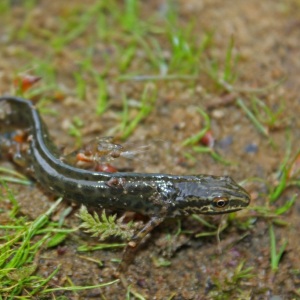
Salamanders are amphibians in the order Caudata, which includes newts. They usually have long bodies and tails as adults. Some live mainly on land, others in water, and their life cycles differ greatly between species.
Many salamanders are small and live hidden under stones and logs, but the Chinese giant salamanders can reach about 1.8 m long. Salamanders are important predators of insects and other small animals and are good indicators of a healthy environment.
Habitat loss, pollution and disease threaten many salamander species. Conservation needs differ between species and regions.
Quick facts
| Common name | Salamander |
| Scientific name | Caudata (also called Urodela) |
| Typical lifespan | About 5-25 years in many species; over 50 years in giant salamanders and about 100 in the olm |
| Length | About 2 cm - 1.8 m (from tiny Thorius salamanders to Chinese giant salamanders) |
| Weight | From less than 1 g to about 50 kg or more |
| Diet type | Carnivorous (insects, worms, crustaceans, small fish) |
| Main predators | Snakes, birds, fish, mammals, other amphibians |
| Conservation status | Assess separately by species and population; different taxa and regions have different needs |
| Geographical distribution | North America, Europe, North Africa, Asia, Central and South America |
| Habitat | Damp forests, streams, rivers, ponds, caves |
| Social behaviour | Mostly solitary |
| Special adaptations | Regeneration, toxic skin secretions, breathing through the skin |
- Primary category:Amphibians
- Explore this animal's categories:
Interesting facts
- Masters of regeneration - Many salamanders can regrow lost legs and tails, and some can even repair parts of their eyes, heart and spinal cord.
- No lungs - The largest family of salamanders, the lungless salamanders (Plethodontidae), have no lungs at all and breathe through their moist skin and mouth.
- Born of fire? - In the Middle Ages, people believed that salamanders could live in fire, probably because they crawled out of logs thrown onto the fire.
- Giant salamanders - Chinese giant salamanders can grow to about 1.8 m long, making them the largest amphibians on Earth, and they can live for more than 50 years.
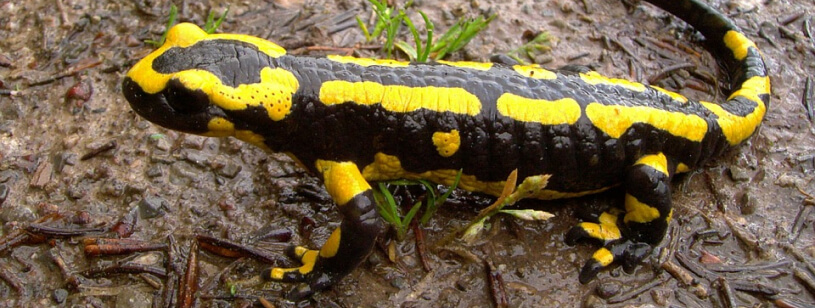
- Poisonous skin - The fire salamander (Salamandra salamandra) releases toxins from its skin that deter predators; the rough-skinned newt of North America has a toxin strong enough to kill a person if eaten.
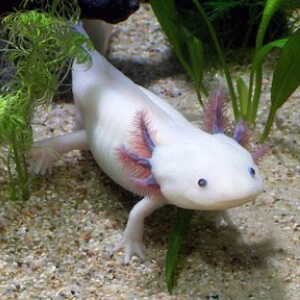
- Axolotls usually retain larval features as sexually mature adults. Metamorphosis can occur under particular conditions, so never is too absolute.
Records and remarkable features
- Salamanders are amphibians in the order Caudata, which includes newts. They usually have long bodies and tails as adults. Some live mainly on land, others in water, and their life cycles differ greatly between species.
- The longest-lived - The olm, a blind cave salamander from Europe, may live for about 100 years and can survive for years without food.
- The longest pregnancy - High in the Alps, the alpine salamander can carry its young for up to three or four years before giving birth.
- The smallest - Some tiny Mexican salamanders of the genus Thorius are only about 2-3 cm long including the tail.
Characteristics
Salamanders are amphibians with long bodies, moist skin, short legs and long tails. Many live in water as larvae and on land as adults, while others spend their whole lives in water or on land.
Physical aspect
- A long, flexible body - Helps them move through water, leaf litter and narrow cracks.
- Moist skin without scales - They need damp places, because their skin dries out easily.
- Short legs - Most have four toes on the front feet and five on the back feet.
- Many colours - From brown and green to bright yellow, orange or red patterns that warn predators that they are poisonous.
Special adaptations
- Some salamanders can regenerate lost limbs and other tissues. The capacity differs between species, organs and life stages.
- Skin breathing - Lungless salamanders take in all their oxygen through their skin and the lining of their mouth.
- Camouflage and toxins - Some species are well camouflaged, while others have bright colours that warn of poisonous skin.
- Aquatic larvae - Most salamander larvae live in water and have feathery external gills; a few species, such as the axolotl, keep their gills as adults.
Habits and behaviour
Most salamanders are shy, solitary and active at night or on rainy days, avoiding heat and dry air.
Social behaviour
- Living alone - Most salamanders live alone and meet mainly to breed.
- Territories - Some lungless salamanders defend small territories, marking them with scent.
- Winter rest - In cold climates, they spend the winter in burrows, rotting logs, caves or mud.
Survival Techniques
- Toxic secretions - Species such as the fire salamander release toxins from glands in their skin.
- Camouflage - Many salamanders blend in with leaves, soil and stones.
- Dropping the tail - Some salamanders can drop their tail when attacked, distracting the predator, and later grow a new one.
Habitat and geographic distribution
Salamanders live mainly in the Northern Hemisphere, in North America, Europe, North Africa and Asia, and one large group has spread through Central and South America. They live in damp places, from forests and streams to caves.
| Region | Example groups | Habitat Preferred |
|---|---|---|
| North America | Ambystoma, Plethodon, Taricha | Damp forests, mountain streams, ponds |
| Europe and North Africa | Salamandra salamandra, Triturus, Proteus | Forests, springs, ponds, caves |
| Asia | Andrias (giant salamanders), Hynobius | Mountain rivers, streams, forests |
| Central and South America | Bolitoglossa, Oedipina | Tropical forests, cloud forests |
Types of Habitat
- Mountain rivers and streams - The home of giant salamanders and many stream salamanders.
- Damp forests - The ideal habitat for many European and American salamanders, which hide under logs and leaves.
- Caves and underground water - The olm (Proteus anguinus) lives only in dark underground waters.
Human Impact and Threats
- Deforestation and pollution - Destroy the damp forests and clean streams they need.
- Climate change - Heat and drought dry out their habitats.
- Collection and trade - Giant salamanders are caught for food, and some species are collected for the pet trade.
Diet and feeding
Salamanders are carnivores that eat many kinds of small animals, depending on their size and habitat. Many catch prey with a quick, sticky tongue.
What does the salamander eat?
| Type of food | Consumer species |
|---|---|
| Insects (beetles, crickets, ants) | Most land-living salamanders |
| Worms, slugs and larvae | Ambystoma, Plethodon, Salamandra |
| Small crustaceans and snails | Aquatic salamanders, such as the olm |
| Fish, frogs and crabs | Giant salamanders |
| Other amphibians and their eggs | Larger salamanders and newts |
Feeding techniques
- A fast tongue - Some lungless salamanders can shoot out their sticky tongue in a few thousandths of a second to catch insects.
- Ambush - Giant salamanders wait motionless on the river bed and snap up prey that comes close.
- Suction - Aquatic salamanders open their mouths quickly to suck in prey with water.
Adaptation to Food Availability
- Land salamanders usually hunt at night or after rain.
- Salamanders use little energy and can go a long time without food; the olm can survive for years.
- Some species eat other amphibians when other food is scarce.
Reproduction and life cycle
Salamanders reproduce in many different ways. Most lay eggs, but some give birth to larvae or even fully formed young.
| Characteristic | Details |
|---|---|
| Age of sexual maturity | About 1-3 years in small species; much later in large species |
| Breeding season | Often spring or autumn, depending on the species and climate |
| Type of reproduction | Egg-laying; some species give birth to larvae or to fully formed young |
| Number of eggs | From a few to several hundred, depending on the species |
| Larval stage | From a few weeks to several years; some species skip it and hatch as tiny adults |
| Life expectancy | About 5-25 years in many species; more than 50 years in giant salamanders and about 100 in the olm |
Breeding process
- Courtship - Males use displays and scent signals to attract females; male newts often develop crests and bright colours.
- Sperm packets - In most salamanders, the male leaves a packet of sperm, which the female picks up with her cloaca.
- Eggs or live young - Eggs are laid in water or in damp places on land; the fire salamander gives birth to larvae in streams, and the alpine salamander to fully formed young.
- Direct development - Many lungless salamanders lay eggs on land, which hatch into tiny salamanders without a water-living larval stage.
Strategy for the survival of the young
- Guarding eggs - In some species, the mother or father guards the eggs; male giant salamanders guard their nests in river banks.
- Hidden eggs - Eggs are hidden under stones, in plants or in damp soil.
- Aquatic larvae - Larvae with external gills grow in water until they are ready to live on land.
Name and history
Salamanders have been known since ancient times and have long been linked with fire, regeneration and magic.
Origin and etymology of the name
- The word "salamander" comes, through Latin, from the Greek salamandra, an old name of unknown origin.
- The order name Caudata comes from the Latin cauda, "tail", because salamanders keep their tails as adults, unlike frogs.
Salamander in the History of Humanity
- Ancient Greece and Rome - Writers such as Aristotle and Pliny the Elder claimed that salamanders could put out fires with the cold of their bodies.
- The Middle Ages - The salamander became a symbol of fire in alchemy, and asbestos cloth was sold as "salamander's wool".
- The Renaissance - King Francis I of France chose the salamander surrounded by flames as his emblem, and it can still be seen at the Château de Chambord.
- East Asia - Giant salamanders appear in Chinese and Japanese stories and are called "baby fish" in Chinese because their cries sound like a baby.
Salamander in Folklore and Superstition
- Fire spirits - The Swiss physician Paracelsus described salamanders as spirits of fire.
- A burning memory - The artist Benvenuto Cellini wrote that as a child he saw a salamander in the fire, and his father slapped him so that he would never forget it.
Cultural significance and mythology
Because of its mysterious life and the old belief that it could survive fire, the salamander became a powerful symbol of courage, faith and endurance.
- Heraldry - The salamander in flames appears on coats of arms as a symbol of courage.
- Fire safety - The salamander is used as a symbol by some firefighters and makers of fire-resistant materials.
- Japan - The Japanese giant salamander, called hanzaki, is honoured at a yearly festival in the town of Maniwa.
Conservation status and threats
Salamanders are among the most threatened animals in the world: more than half of all species are at risk of extinction, mainly because of habitat loss, pollution and disease.
| IUCN Status | Species Affected | Affected Regions |
|---|---|---|
| Least Concern (LC) | Tiger salamander (Ambystoma tigrinum), great crested newt (Triturus cristatus) | North America, Europe |
| Near Threatened (NT) | Jordan's salamander (Plethodon jordani) | Southern Appalachians, USA |
| Vulnerable (VU) | Olm (Proteus anguinus) | Dinaric Alps, south-eastern Europe |
| Critically Endangered (CR) | Chinese giant salamander (Andrias davidianus), axolotl (Ambystoma mexicanum) | China, Mexico |
Main threats
- Water pollution - Chemicals pass easily through salamanders' thin skin.
- Deforestation - Destroys the damp forests where land salamanders live.
- Climate change - Heat and drought dry out their habitats.
- Disease - The fungus Batrachochytrium salamandrivorans, spread by the pet trade, has wiped out fire salamanders in parts of the Netherlands and Belgium.
- Overharvesting - Chinese giant salamanders have been caught in huge numbers for food.
Conservation efforts
- Protecting habitats - National parks and reserves protect forests, streams and caves.
- Fighting disease - Scientists study deadly fungi, and some countries have restricted the import of salamanders to stop their spread.
- Captive breeding - Zoos and conservation centres breed threatened species, such as the axolotl and giant salamanders.
- Education - Campaigns teach people about salamanders and the importance of clean water.
In popular culture
- War with the Newts (Karel Čapek, 1936) - A famous satirical novel in which intelligent giant newts are used by people and eventually rise up against them.
- Pokémon - The fire Pokémon Charmander's name combines "char" and "salamander".
- Fantasy - In many fantasy books and games, salamanders are magical creatures of fire.