Dandie Dinmont TerrierCharacteristics, history, training and care
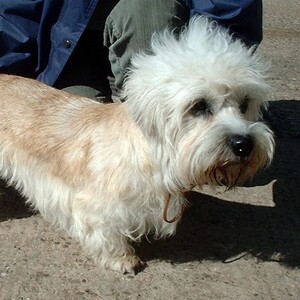
Dandie Dinmont Terrier. · Sannse / Wikimedia Commons, CC BY-SA 3.0. Cropped and resized.
The Dandie Dinmont Terrier is a small terrier from the border between England and Scotland, with a very long body, short legs and a full, silky topknot on its head. It is named after a character in Walter Scott's novel “Guy Mannering”. It is independent, highly intelligent, determined, affectionate and dignified.
Quick facts
| Common name | Dandie Dinmont Terrier (Dandie) |
| Scientific name | Canis lupus familiaris |
| Country of origin | Great Britain (the Anglo-Scottish border) |
| Official recognition | FCI, definitively since 12 May 1955 (group 3, small-sized terriers; standard no. 168); also recognised by the AKC |
| Lifespan | 12–15 years, according to the AKC |
| Size (males) | 20–28 cm at the withers; 8–11 kg |
| Size (females) | 20–28 cm at the withers; 8–11 kg (lower weights are preferred) |
| Coat type | Double, about 5 cm long: soft undercoat and harsher topcoat; silky topknot on the head |
| Common colours | Pepper (from bluish black to silvery grey) or mustard (from reddish brown to pale fawn) |
| Energy level | Moderate |
| Suited to an apartment? | Yes, if it goes out every day |
| Temperament | Independent, highly intelligent, determined, affectionate, dignified |
| Tendency to aggression | Low |
| Good with children | Good, especially with older children |
| Good with other animals | Average; hunting instinct |
| Genetic predispositions | Spinal problems (long body), lymphoma and other cancers |
- Primary category:Dog breeds
- Explore this animal's categories:
History and origin
The breed comes from the border country between England and Scotland. In the 17th century, these terriers hunted badgers and otters. Wikipedia says that the dogs of the Allan family of Holystone, Northumberland, contributed to its beginnings in the early 18th century; the head of the family, Willie “Piper” Allan, used them to hunt otters.
The breed remained little known until 1815, when Sir Walter Scott's novel “Guy Mannering” was published. The character Dandie Dinmont, a farmer who kept terriers called “Mustard” and “Pepper”, is thought to have been partly inspired by James Davidson, regarded as the creator of the modern breed.
How the breed developed
- 17th century – Border terriers hunt badgers and otters.
- Early 18th century – The dogs of the Allan family of Holystone contribute to the development of the breed.
- 1815 – Walter Scott's novel “Guy Mannering”, which gives the breed its name, is published.
- 12 May 1955 – The FCI recognises the breed.
- 8 September 2026 – the current FCI standard is published.
Breed rating
| Feature | Stars |
|---|---|
| Training and intelligence | ★★★★☆ |
| Easy to train | ★★★★☆ |
| Intelligence | ★★★★★ |
| Independence | ★★★★☆ |
| Stubbornness | ★★★★☆ |
| Behaviour and temperament | ★★★★☆ |
| Affectionate with family | ★★★★☆ |
| Friendly with children | ★★★☆☆ |
| Good with other dogs | ★★★☆☆ |
| Good with cats and other animals | ★★☆☆☆ |
| Loyalty | ★★★★★ |
| Tendency to be aggressive | ★★☆☆☆ |
| Tendency to bark | ★★★☆☆ |
| Needs and care | ★★★★☆ |
| Shedding | ★★☆☆☆ |
| Needs frequent grooming | ★★★☆☆ |
| Activity and lifestyle | ★★★★☆ |
| Energy level | ★★★☆☆ |
| Daily exercise needs | ★★★☆☆ |
| Suited to apartment life | ★★★★☆ |
| Health and longevity | ★★★★☆ |
| Life expectancy | ★★★★☆ |
| Predisposition to genetic diseases | ★★★☆☆ |
| Working abilities and uses | ★★★★☆ |
| Good watchdog | ★★★★☆ |
| Good companion dog | ★★★★☆ |
Indicative rating: 5 stars means the highest level. It is based on the ratings the American Kennel Club gives the breed and on the FCI standard.
Physical characteristics
The standard describes a terrier with an unmistakable head, covered in silky hair, large, wise eyes and a long, low, weasel-like body. The legs are short and strong, and the coat is weather-resistant.
General appearance
The head is large but in proportion, with a full, silvery-white or cream topknot. The large, round eyes are dark hazel. The ears hang close to the cheeks and end almost in a point, with feathering. The short tail, 20–25 cm long, is curved like a scimitar.
| Feature | Dandie Dinmont Terrier |
|---|---|
| Size | Small |
| Height at the withers | 20–28 cm |
| Weight | 8–11 kg |
| Coat | Double, about 5 cm long |
| Eyes | Large, round, dark hazel |
| Tail | Short, curved like a scimitar |
There are two colours: pepper, from bluish black to light silvery grey, with a silvery-white topknot, and mustard, from reddish brown to pale fawn, with a creamy-white topknot. A few white hairs on the chest are allowed.
Training and socialisation
The standard describes it as a game, workmanlike, independent, highly intelligent, determined, persistent, sensitive, affectionate and dignified terrier.
The AKC says it is a big dog in a small body. Like any terrier, it can be stubborn and overconfident, but with plenty of patience and rewards it gives very good results. It is calmer than other terrier breeds.
Tips for effective training
- Use rewards. It is sensitive and responds well to warm praise.
- Keep it on a lead. The AKC says it will run after anything it thinks is prey.
- Be patient. It is independent, like all terriers.
- Protect its back. Avoid jumps off furniture.
Activity needs and lifestyle
The AKC recommends about half an hour twice a day: a brisk walk or ball games in the garden. Outside it must be kept on a lead or in a well-fenced area.
| Activity | How often | Why it matters |
|---|---|---|
| Brisk walk | twice a day, 30 minutes each | Moderate exercise |
| Ball games | daily | Burns off energy |
| Scent games | weekly | Its terrier instinct |
Tips for a balanced life
- Do not let it jump off the sofa or bed.
- Always keep it on a lead or in a fenced garden.
- It adapts well to indoor life.
Care and health
Coat and skin care
The AKC says the Dandie does not shed, but the dead hair must be stripped out of the coat at least twice a year. Long hairs are plucked daily with the fingers, and the coat is brushed daily to prevent tangles. The topknot is combed often.
Common health problems
The AKC says the breed is usually healthy. Wikipedia draws attention to two problems:
| Condition | Description | Common symptoms |
|---|---|---|
| Intervertebral disc disease | A disc between the vertebrae ruptures and presses on the spinal cord | Back or neck pain, unsteady walking on the hind legs; in severe cases, paralysis |
| Lymphoma and other cancers | The breed is affected by cancer more often than average | Enlarged lymph nodes, weight loss, tiredness |
Other care
- Check the ears regularly for signs of infection.
- Brush its teeth often, with dog toothpaste.
- Trim the nails when they start to touch the floor.
Diet and nutrition
The AKC says some dogs put on weight easily. For a long-backed dog, the right weight matters a great deal.
Tips for a healthy diet
The table gives a starting estimate, calculated with the formula from the Merck Veterinary Manual. The first two calorie columns show the calories per day for a healthy adult dog. The last column shows what this means in dry food with 3,500–4,000 kcal per kilogram.
| Dog's weight | Calories per day (neutered) | Calories per day (not neutered) | Dry food per day (approximate) |
|---|---|---|---|
| 8 kg | 530 kcal | 600 kcal | 130–170 g |
| 9.5 kg | 610 kcal | 680 kcal | 150–190 g |
| 11 kg | 680 kcal | 760 kcal | 170–220 g |
- Give table scraps very rarely or not at all.
- Training treats count towards the daily portion.
- A dog is at the right weight when you can feel its ribs without pressing hard.
Foods to avoid
Some human foods are dangerous for dogs: chocolate, coffee, grapes and raisins, onions, garlic, xylitol (a sweetener used in chewing gum), macadamia nuts and alcohol.
Reproduction and development
Physical and emotional maturity
In dogs, sexual maturity usually comes between 6 and 12 months. Small breeds become adults faster than large ones, usually at around one year.
Mating and pregnancy
Pregnancy lasts about 63 days, counted from ovulation. Mating a female on her first heat is not recommended. The FCI standard requires that only healthy dogs of typical breed appearance are used for breeding.
Caring for the puppies
In small breeds, a litter has 3–4 puppies on average. The puppies are very small and fragile in the first weeks, so they must be kept warm and handled with care. Socialisation starts early: gentle handling, everyday noises and new people.
Interesting facts
- Named after a character. The breed bears the name of a character in a novel, not of a place or a real person.
- Pepper and mustard. The two colours are called “pepper” and “mustard”.
- An otter hunter. In the 17th century it hunted badgers and otters.
- A vulnerable breed. The Kennel Club considers it a vulnerable native British breed.
- It does not shed. The coat is kept in shape by stripping and brushing.
In popular culture
“Guy Mannering” by Walter Scott
The breed is named after Dandie Dinmont, a character in Sir Walter Scott's novel “Guy Mannering” (1815), a farmer who kept terriers called “Mustard” and “Pepper”. The novel made the breed known beyond the border country.
Frequently asked questions
Where does the breed's name come from?
From Dandie Dinmont, a character in Walter Scott's novel “Guy Mannering”.
How big does it get?
It measures 20–28 cm at the withers and weighs 8–11 kg.
Does it shed?
No, but the coat must be stripped and brushed regularly.
Is it a family dog?
Yes. It is affectionate and calmer than other terriers, and suits older children especially well.
How long does it live?
The AKC gives 12–15 years.