Spanish Water DogCharacteristics, history, training and care
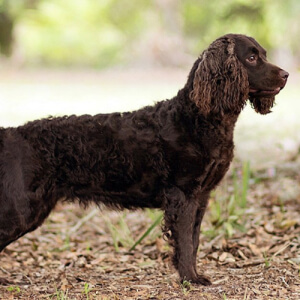
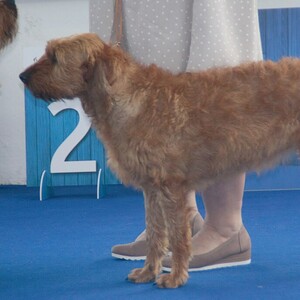
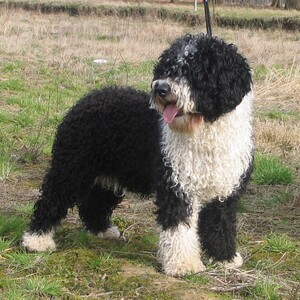
Spanish Water Dog. · Brindis320 / Wikimedia Commons, public domain. Cropped and resized.
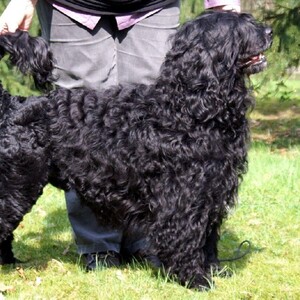
The Spanish Water Dog (Perro de agua español) is a rustic, medium-sized dog with a curly, woolly coat, used as a herding dog, a hunting dog and a helper to fishermen. The FCI standard describes it as faithful, obedient, cheerful, hard-working, alert and balanced, with an extraordinary ability to learn, adapting to any situation.
Quick facts
| Common name | Spanish Water Dog (Perro de agua español) |
| Scientific name | Canis lupus familiaris |
| Country of origin | Spain |
| Official recognition | FCI, definitively since 30 May 1999 (group 8, water dogs; standard no. 336); also recognised by the AKC |
| Lifespan | 12–14 years, according to the AKC |
| Size (males) | 44–50 cm at the withers; 18–22 kg |
| Size (females) | 40–46 cm at the withers; 14–18 kg |
| Coat type | Always curly and woolly; forms cords when long |
| Common colours | White, black, brown; black and white or brown and white |
| Energy level | High |
| Suited to an apartment? | Only with plenty of exercise |
| Temperament | Faithful, obedient, cheerful, hard-working, alert |
| Tendency to aggression | Low; reserved with strangers |
| Good with children | Good |
| Good with other animals | Moderate; some have a strong prey drive |
| Genetic predispositions | Hip dysplasia, eye diseases, food allergies |
- Primary category:Dog breeds
- Explore this animal's categories:
History and origin
The FCI standard says this dog has been present in the Iberian Peninsula for a very long time and shares its origin with the old Barbet. Most live in Andalusia, where it is used as a herding dog and where for centuries it was known as the “Turkish dog”. Its coat is adapted to the humidity and drought of marshy areas.
Wikipedia says that at the end of the 20th century three populations were identified: the Marismeño, from the Guadalquivir marshes; the Serrano, from southern Andalusia; and the Norteño, from Cantabria and Asturias, recognised in Spain in 2012 as a separate breed. Today it is kept mainly as a companion animal.
How the breed developed
- Centuries ago – The “Turkish dog” of Andalusia.
- Late 20th century – Three populations are identified.
- 30 May 1999 – The FCI recognises the breed.
- 2012 – The northern variety becomes a separate breed in Spain.
Breed rating
| Feature | Stars |
|---|---|
| Training and intelligence | ★★★☆☆ |
| Easy to train | ★★★★★ |
| Intelligence | ★★★★☆ |
| Independence | ★★★★☆ |
| Stubbornness | ★★★★☆ |
| Behaviour and temperament | ★★★☆☆ |
| Affectionate with family | ★★★★☆ |
| Friendly with children | ★★★★☆ |
| Good with other dogs | ★★★☆☆ |
| Good with cats and other animals | ★☆☆☆☆ |
| Loyalty | ★★★★☆ |
| Tendency to be aggressive | ★★☆☆☆ |
| Tendency to bark | ★★★★☆ |
| Needs and care | ★★★★☆ |
| Shedding | ★★★★★ |
| Needs frequent grooming | ★★★☆☆ |
| Activity and lifestyle | ★★★★☆ |
| Energy level | ★★★★☆ |
| Daily exercise needs | ★★★★☆ |
| Suited to apartment life | ★★★☆☆ |
| Health and longevity | ★★★★☆ |
| Life expectancy | ★★★☆☆ |
| Predisposition to genetic diseases | ★★☆☆☆ |
| Working abilities and uses | ★★☆☆☆ |
| Good companion dog | ★★★★☆ |
| Good companion dog | ★★★★☆ |
Indicative rating: 5 stars means the highest level. It is based on the ratings the American Kennel Club gives the breed and on the FCI standard.
Physical characteristics
The standard describes it as a rustic, well-proportioned dog of medium weight, with an elongated, harmonious shape, athletic, with well-developed muscles thanks to regular exercise.
General appearance
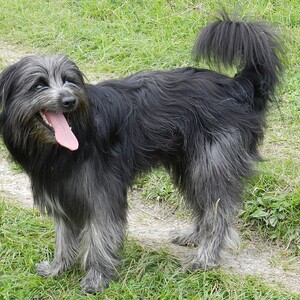
The coat is always curly, with a woolly texture. When short, it is curly; when long, it forms cords. Puppies are always born with curly hair. Clipping is permitted, but it must be complete and even, never “cosmetic”.
| Feature | Spanish Water Dog |
|---|---|
| Size | Medium |
| Height at the withers | males: 44–50 cm; females: 40–46 cm |
| Weight | males: 18–22 kg; females: 14–18 kg |
| Coat | Curly, woolly |
| Eyes | Brown, covered by hair |
| Type | Water dog |
The standard accepts white, black or brown in various shades and black and white or brown and white. Tricolours, black and tan and hazelnut and tan are not accepted.
Training and socialisation
The standard describes it as faithful, obedient, cheerful, hard-working, alert and balanced, with an extraordinary ability to learn. The AKC says it is very intelligent, very eager to please and thrives on positive, clicker-type training; harsh methods make it lose its enthusiasm.
The AKC warns that, being a herding dog, some have a very strong prey drive and need a reliable recall. They are very loyal to their owners but can be reserved with strangers, so early socialisation is important.
Tips for effective training
- Use a clicker and rewards. It enjoys problems to solve.
- Practise the recall. Some have a strong prey drive.
- Socialise it early. It is reserved with strangers.
- Avoid harshness. It loses its enthusiasm.
Activity needs and lifestyle
The AKC says it needs a good run at least once a day. Once its bones have finished growing, it can take long, intense exercise and is a good companion for running, hiking or snowshoeing.
| Activity | How often | Why it matters |
|---|---|---|
| Running | daily | Energy |
| Hiking or swimming | weekly | Stamina |
| Training or agility | several times a week | A busy mind |
Tips for a balanced life
- Do not brush its coat.
- Keep its mind busy.
- Moderate exercise until growth is complete.
Care and health
Coat and skin care
The AKC says the basic rule is that the coat is never brushed and should be the same length all over. How often it is clipped is up to the owner; some let it grow for months so that it forms cords. The AKC gives it 1 out of 5 for shedding.
Common health problems
The AKC says responsible breeders check their dogs for:
| Condition | Description | Common symptoms |
|---|---|---|
| Hip dysplasia | The hip joint forms incorrectly and, over time, arthritis develops | Limping, difficulty getting up or jumping, hip pain |
| Eye diseases | Inherited conditions | Poor vision |
| Food allergies | Occur occasionally | Itching, digestive problems |
Other care
- Check the ears regularly.
- Brush its teeth, ideally every day.
- Ask for the parents' hip and eye tests.
Diet and nutrition
The AKC says it does well on good-quality food suited to its age and activity, although some have food allergies.
Tips for a healthy diet
The table gives a starting estimate, calculated with the formula from the Merck Veterinary Manual. The first two calorie columns show the calories per day for a healthy adult dog. The last column shows what this means in dry food with 3,500–4,000 kcal per kilogram.
| Dog's weight | Calories per day (neutered) | Calories per day (not neutered) | Dry food per day (approximate) |
|---|---|---|---|
| 14 kg | 810 kcal | 910 kcal | 200–260 g |
| 18 kg | 980 kcal | 1,100 kcal | 240–310 g |
| 22 kg | 1,140 kcal | 1,280 kcal | 280–370 g |
- Adjust the portion to its level of effort.
- Treats count towards the daily portion.
- A dog is at the right weight when you can feel its ribs under the coat without pressing hard.
Foods to avoid
Some human foods are dangerous for dogs: chocolate, coffee, grapes and raisins, onions, garlic, xylitol (a sweetener used in chewing gum), macadamia nuts and alcohol.
Reproduction and development
Physical and emotional maturity
In dogs, sexual maturity usually comes between 6 and 12 months. Most breeds become adults at around 13–15 months.
Mating and pregnancy
Pregnancy lasts about 63 days, counted from ovulation. Mating a female on her first heat is not recommended. The FCI standard requires that only healthy dogs of typical breed appearance are used for breeding.
Caring for the puppies
In dogs, a litter has 5–6 puppies on average, and the number rises with the size of the breed. Socialisation starts in the first weeks: gentle handling, everyday noises and new people.
Interesting facts
- “The Turkish dog”. That is what it was called in Andalusia.
- The coat is not brushed. It is clipped evenly or forms cords.
- A helper to fishermen. It worked with fishermen on the Cantabrian coast.
- Related to the Barbet. The standard says they share the same origin.
- Curly puppies. They are always born with curly hair.
Frequently asked questions
Is its coat brushed?
No; it is clipped evenly.
Does it shed?
Very little; the AKC gives it 1 out of 5.
Is it easy to train?
Yes, very, with positive methods.
How long does it live?
The AKC gives 12–14 years.