Romanian Mioritic Shepherd DogCharacteristics, history, training and care
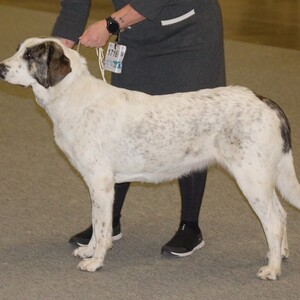
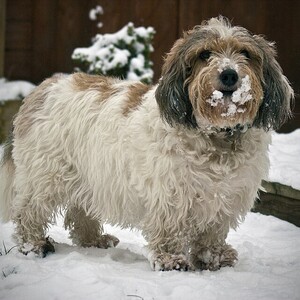
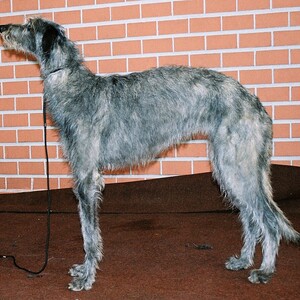
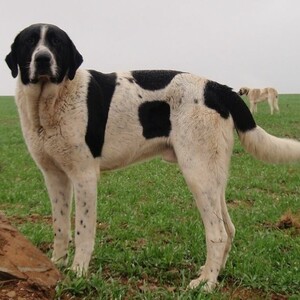
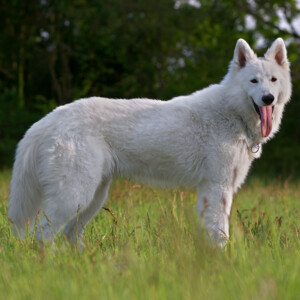
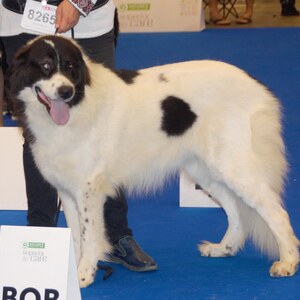
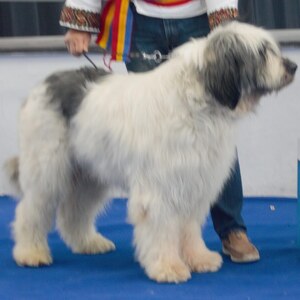
White Romanian Mioritic Shepherd Dog with grey patches · Canarian / Wikimedia Commons, CC BY 4.0. Cropped and resized.
The Romanian Mioritic Shepherd Dog is a large dog with a long, dense coat, bred by shepherds in the Carpathian Mountains. It guards the flock against bears, wolves and lynx, and at home it is calm and gentle with its family. It suits a household with a yard, not a flat.
Quick facts
| Common name | Romanian Mioritic Shepherd Dog (Mioritic) |
| Scientific name | Canis lupus familiaris |
| Country of origin | Romania (Carpathian Mountains) |
| Official recognition | FCI, definitively since 9 June 2015 (group 1, standard no. 349); AKC, in the Foundation Stock Service programme since May 2018 |
| Lifespan | 12–14 years |
| Size (males) | at least 70 cm at the withers; ideally 75 cm |
| Size (females) | at least 65 cm at the withers; ideally 70 cm |
| Weight | about 45–59 kg, in proportion to height |
| Coat type | Long (at least 10 cm), straight and harsh, with a dense, soft undercoat |
| Common colours | White with black or grey patches; solid white; solid grey |
| Energy level | Moderate |
| Suited to an apartment? | No, it needs a fenced yard |
| Temperament | Calm, balanced, brave, reserved with strangers |
| Tendency to aggression | Low with the family; protective with strangers |
| Good with children | Very good with the family's children |
| Good with other animals | Good with animals it grows up with; it treats them as its “flock” |
| Genetic predispositions | Hip dysplasia; as with all large dogs, a risk of bloat |
- Primary category:Dog breeds
- Explore this animal's categories:
History and origin
The Mioritic developed in the Carpathian Mountains, where shepherds always chose the dogs most useful to the flock. The FCI standard says the breed was selected from a “natural breed” of the Carpathians, and the main reason was usefulness.
The name comes from the folk ballad “Miorița”. Dictionaries explain the adjective mioritic as “Miorița” + the suffix “-ic” and also give it the meaning of a Romanian shepherd dog with a long, abundant white coat.
How the breed developed
- Centuries of work at the sheepfold – The dogs guarded the sheep against wild animals, especially the bear, the wolf and the lynx.
- 1981 – The Romanian Kennel Association writes the first breed standard.
- 29 March 2002 – The standard is revised to the format required by the FCI.
- 9 June 2015 – The FCI definitively recognises the breed, on the same day as the Romanian Carpathian Shepherd Dog.
- May 2018 – The American Kennel Club admits it to its Foundation Stock Service programme, the first step towards recognition in the United States.
- 22 September 2022 – The FCI publishes the current version of the standard.
Breed rating
| Feature | Stars |
|---|---|
| Training and intelligence | ★★★☆☆ |
| Easy to train | ★★★☆☆ |
| Intelligence | ★★★★☆ |
| Independence | ★★★★★ |
| Stubbornness | ★★★★☆ |
| Behaviour and temperament | ★★★★☆ |
| Affectionate with family | ★★★★★ |
| Friendly with children | ★★★★★ |
| Good with other dogs | ★★★☆☆ |
| Good with cats and other animals | ★★★★☆ |
| Loyalty | ★★★★★ |
| Tendency to be aggressive | ★★☆☆☆ |
| Tendency to bark | ★★☆☆☆ |
| Needs and care | ★★☆☆☆ |
| Shedding | ★★☆☆☆ |
| Needs frequent grooming | ★★☆☆☆ |
| Activity and lifestyle | ★★★☆☆ |
| Energy level | ★★★☆☆ |
| Daily exercise needs | ★★★☆☆ |
| Suited to apartment life | ★☆☆☆☆ |
| Health and longevity | ★★★★☆ |
| Life expectancy | ★★★★☆ |
| Predisposition to genetic diseases | ★★☆☆☆ |
| Working abilities and uses | ★★★★★ |
| Good livestock guardian | ★★★★★ |
| Good companion dog | ★★★★☆ |
Indicative rating: 5 stars means the highest level. It is based on the ratings the American Kennel Club gives the breed and on the description in the FCI standard.
Physical characteristics
The Mioritic is large, but not heavy. The body is slightly longer than the height, in a ratio of 11 to 10. Males are noticeably taller and stronger than females.
General appearance
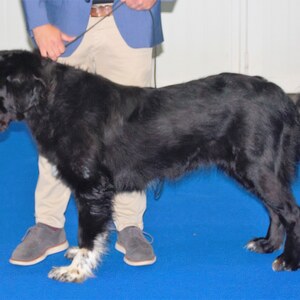
The long coat covers the head, body and legs. The hair is shorter on the legs, and the tail is well furnished. Beneath the harsh outer hair there is a dense, soft, lighter-coloured undercoat that protects it from cold and damp.
| Feature | Romanian Mioritic Shepherd Dog |
|---|---|
| Size | Large |
| Height at the withers | males: at least 70 cm (ideally 75 cm); females: at least 65 cm (ideally 70 cm) |
| Weight | about 45–59 kg |
| Coat | Straight and harsh, at least 10 cm long, with a dense undercoat |
| Head and muzzle | Strong muzzle, slightly shorter than the skull, tapering towards the nose; the nose is black |
| Ears | V-shaped, 10–15 cm long, hanging close to the cheeks |
| Eyes | Brown, oblique, with a calm gaze |
| Tail | Hangs to the hock or lower; raised in movement, but not curled over the back |
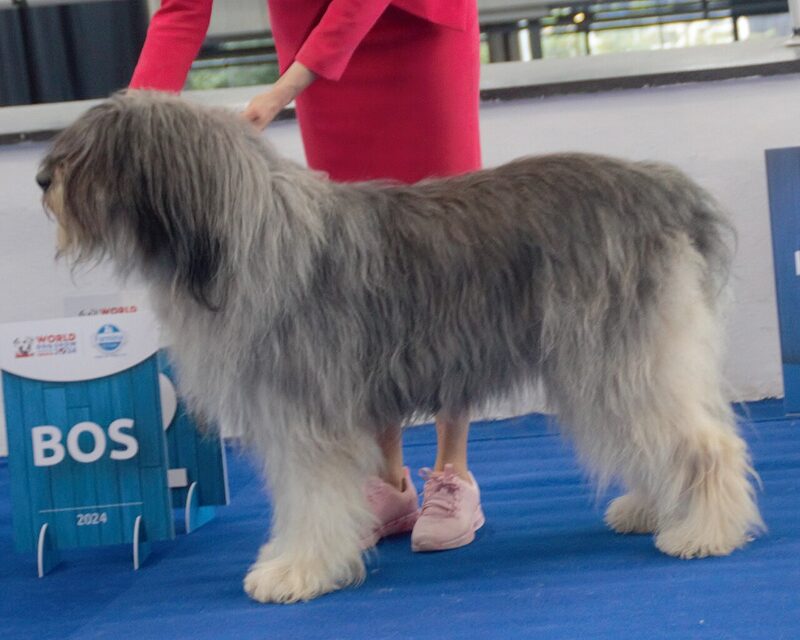
The accepted colours are white with black or grey patches, solid white and solid grey. The ear tips must be dark grey or black. The standard calls them “earrings”.
Training and socialisation
The Mioritic learns, but it makes its own decisions. It was bred to guard the flock without human help, so it is independent and stubborn. The guarding instinct does not need to be taught. From an early age, the puppy must be taught not to respond to every noise by barking and attacking.
Tips for effective training
- Start early. Get the puppy used to people, cars, other animals and noises from the first months.
- Be calm and consistent. The same rules, every day, from every member of the family.
- Use rewards. Food and praise work better than punishment with a sensitive, self-confident dog.
- Practise the basic commands: “sit”, “stay”, “come” and walking on the lead. With a dog weighing over 45 kg, they are a matter of safety.
- Introduce your guests. The Mioritic accepts strangers only after checking them out and seeing that the family welcomes them.
Activity needs and lifestyle
The Mioritic has moderate energy. It does not run for hours, but it needs daily exercise and a territory to watch over.
| Activity | How often | Why it matters |
|---|---|---|
| Walk on the lead | daily | Exercise, strong muscles and socialisation |
| Free time in the fenced yard | daily | It patrols its territory, as it does at the sheepfold |
| Obedience exercises | a few minutes every day | Keeps the commands fresh and the dog under control |
| Outings to new places | weekly | Gets it used to new people and situations |
Tips for a balanced life
- The fence must be high and solid. The Mioritic considers everything it can see from its guarding spot to be its territory.
- It likes to stay close to its favourite person. Do not keep it isolated, tied up far from the house.
- The dense coat helps it cope well with cold, but in summer it needs shade and fresh water.
Care and health
Coat and skin care
The coat looks hard to maintain, but breeders quoted by the AKC say the breed needs little grooming. A thorough brush once a week is enough. Baths are rare. If it gets muddy, let it dry, then brush it.
Common health problems
The breed was kept for a long time at sheepfolds, so there is little medical data about it. The AKC mentions two problems that also occur in other large dogs:
| Condition | Description | Common symptoms |
|---|---|---|
| Hip dysplasia | The hip joint forms incorrectly and, over time, arthritis develops | Limping, difficulty getting up or jumping, hip pain |
| Gastric dilatation-volvulus (bloat) | The stomach fills with gas and may twist; this is a veterinary emergency | Swollen belly, trying to vomit without success, drooling, restlessness |
Other care
- Check the eyes, ears and teeth every day.
- Trim the nails when they start to touch the floor.
- Dewclaws (extra toes) on the hind legs are permitted by the standard. Check their nails, as they do not wear down when walking.
Diet and nutrition
The Mioritic, like many livestock guardian dogs, makes good use of its food. Breeders quoted by the AKC say it often eats less than the packaging recommends. So the amount should be set according to the dog's weight and condition, not a fixed figure.
Tips for a healthy diet
The table gives a starting estimate, calculated with the formula from the Merck Veterinary Manual. The first two calorie columns show the calories per day for a healthy adult dog. The last column shows what this means in dry food with 3,500–4,000 kcal per kilogram.
| Dog's weight | Calories per day (neutered) | Calories per day (not neutered) | Dry food per day (approximate) |
|---|---|---|---|
| 45 kg | 1,950 kcal | 2,190 kcal | 490–630 g |
| 50 kg | 2,110 kcal | 2,370 kcal | 530–680 g |
| 55 kg | 2,260 kcal | 2,540 kcal | 560–730 g |
| 60 kg | 2,410 kcal | 2,720 kcal | 600–780 g |
- Split the food into two meals a day. This lowers the risk of bloat.
- Puppies get four meals a day while they are growing.
- The dog is at the right weight when you can feel its ribs under the coat without pressing hard. If it puts on weight, reduce the portion.
- Fresh water should always be available.
Foods to avoid
Some human foods are dangerous for dogs: chocolate, coffee, grapes and raisins, onions, garlic, xylitol (a sweetener used in chewing gum), macadamia nuts and alcohol.
Reproduction and development
Physical and emotional maturity
In dogs, sexual maturity usually comes between 6 and 12 months. In large breeds like the Mioritic, it may be delayed until around two years.
Mating and pregnancy
Gestation lasts about 63 days, counted from ovulation. Mating a female on her first heat is not recommended. The standard requires that only healthy dogs with the typical appearance of the breed be used for breeding.
Caring for the puppies
In large breeds, a litter has on average around 7 puppies. At first the puppies stay close to their mother and the “pack” that has taken them in. Socialisation begins now: gentle handling, short brushing sessions and the first meetings with new people.
Interesting facts
- It wears “earrings”. The standard requires the ear tips to be dark grey or black and calls them exactly that.
- The coat is at least 10 cm long. A coat shorter than 8 cm is a serious fault at shows.
- Tail and ears stay intact. The standard forbids docking the tail and cropping the ears.
- It fights large predators. The standard describes it as a brave and effective fighter against the bear, the wolf and the lynx.
- Recognised on the same day. The Mioritic and the Carpathian were definitively recognised by the FCI on 9 June 2015.
- Aggression disqualifies it. At shows, an aggressive or very fearful Mioritic is excluded from competition.
In popular culture
The Mioritic Shepherd Dog on stamps
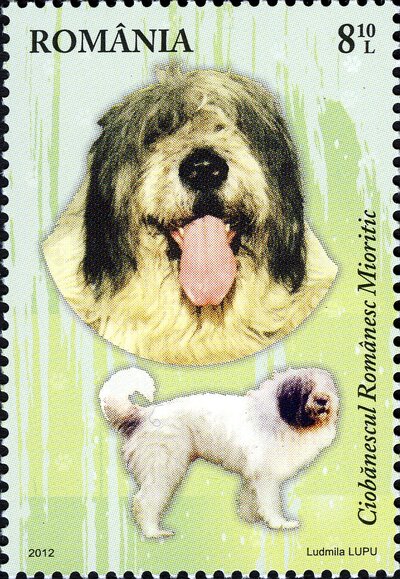
In 2012, the Romanian Post issued a stamp featuring the Romanian Mioritic Shepherd Dog, with a face value of 8.10 lei. The stamp shows the dog's head and a white dog with a grey head.
A name taken from “Miorița”
“Miorița” is one of the best-known Romanian folk ballads and tells the story of some shepherds and a young ewe. The breed takes its name from this ballad, which is tied to shepherd life. See also our page on the domestic sheep, the animal it guards.
Frequently asked questions
How big does a Mioritic Shepherd Dog get?
Males measure at least 70 cm at the withers and females at least 65 cm. They weigh about 45–59 kg.
Can a Mioritic live in a flat?
It is not suitable. It needs a fenced yard where it can move around and guard its territory.
Is the Mioritic good with children?
Yes, it is gentle and patient with the family's children. It is reserved with strangers, so visits should be supervised.
How long does a Mioritic Shepherd Dog live?
Its life expectancy is 12–14 years.
How often does it need brushing?
A thorough brush once a week is enough. Baths are rare; mud is brushed out once the coat has dried.