English BulldogCharacteristics, history, training and care
The English Bulldog, often registered simply as Bulldog, is a stocky companion dog with a short muzzle. Its body shape can be associated with significant health and breathing problems, so health and welfare need careful attention.
Quick facts
| Common name | English Bulldog |
| Scientific name | Canis lupus familiaris |
| Country of origin | United Kingdom |
| Official Recognition | Recognized by FCI and AKC |
| Typical lifespan | About 8-10 years |
| Dimensions (Male) | About 31-40 cm |
| Dimensions (Female) | About 30-38 cm |
| Weight (Male) | About 23-25 kg |
| Weight (Females) | About 18-23 kg |
| Coat type | Short, fine, smooth |
| Common colours | Fawn, red, brindle, white, piebald (white with patches) |
| Energy Level | Low to moderate |
| Suitable for an apartment? | Depends on exercise, training, health and the individual dog |
| Temperament | Calm, affectionate, stubborn |
| Behaviour towards unfamiliar people and dogs | Individual behaviour varies; socialisation, training and management matter |
| Compatibility with children | Depends on the individual; adult supervision and suitable handling are essential |
| Compatibility with other animals | Depends on socialisation, prey drive and the animals involved |
| Health considerations | Breathing problems (BOAS), hip dysplasia, skin fold infections, eye problems |
- Primary category:Dog breeds
- Explore this animal's categories:
History and Origin
The English Bulldog descends from old British mastiff-type dogs. Its name comes from bull-baiting, a cruel "sport" popular in England from the Middle Ages until the early 19th century, in which dogs attacked a tethered bull.
Evolution of the breed:
- Bull-baiting dogs - Early bulldogs were bred for strength and courage; they were taller, lighter and more athletic than today's Bulldog.
- The 1835 ban - After the Cruelty to Animals Act of 1835 banned bull-baiting in Britain, the old bulldog nearly disappeared. Breeders then selected calmer, heavier dogs as companions.
- The modern Bulldog - Today it is a family dog valued for its calm, affectionate nature and unique look. It has long been used as a symbol of Britain, linked with courage and determination.
Breed Evaluation
The English Bulldog is valued for its calm temperament and strong attachment to its owner, but it needs careful care because of its health problems. These are general editorial ratings, not measured scores; individual dogs vary.
| Characteristic | Stars |
|---|---|
| Training and Intelligence | ★★★☆☆ |
| Easy to train | ★★☆☆☆ |
| Intelligence | ★★★☆☆ |
| Level of independence | ★★★★☆ |
| Level of stubbornness | ★★★★☆ |
| Behavior and Temperament | ★★★★★ |
| Affectionate with family | ★★★★★ |
| Friendly with children | ★★★★★ |
| Compatible with other dogs | ★★★★☆ |
| Compatible with cats and other animals | ★★★★☆ |
| Degree of loyalty | ★★★★★ |
| Tendency to be aggressive | ★☆☆☆☆ |
| Tendency to bark | ★★☆☆☆ |
| Needs and Care | ★★★☆☆ |
| Shedding level | ★★★☆☆ |
| Requires frequent care | ★★★★☆ |
| Activity and Lifestyle | ★★★☆☆ |
| Energy level | ★★☆☆☆ |
| Daily exercise requirement | ★★☆☆☆ |
| Suitable for apartment living | ★★★★★ |
| Health and Longevity | ★★☆☆☆ |
| Life expectancy | ★★★☆☆ |
| Predisposition to genetic diseases | ★★★★☆ |
| Work and Utility Features | ★★★☆☆ |
| Good guard dog | ★★★☆☆ |
| Good companion dog | ★★★★★ |
Physical Characteristics
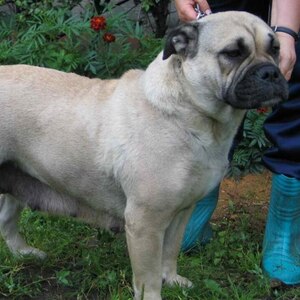
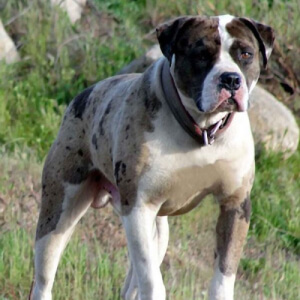
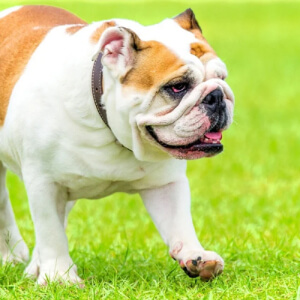
The English Bulldog has an instantly recognisable look: a strong, compact, low-slung dog with a massive head.
- A short, wide body with a deep chest and a back that rises slightly behind the shoulders ("roach back").
- A large head with a very short, flat muzzle, typical of brachycephalic (short-faced) breeds.
- Loose skin on the face that forms deep wrinkles and needs regular care.
- Small, thin "rose" ears set high and wide apart.
- A short tail, either straight or "screwed" (twisted).
| Characteristic | English Bulldog |
|---|---|
| Size | Medium, low and compact (about 31-40 cm at the shoulder) |
| Weight | About 18-25 kg |
| Coat | Short, fine, smooth |
| Muzzle | Very short (brachycephalic) |
| Shedding tendency | Moderate |
| Build | Heavy, solid |
The English Bulldog is a unique breed, but it has special care needs, especially for its breathing, body temperature and joints.
Training and Socialization
The English Bulldog is intelligent but stubborn, which can make training a challenge. Training should be patient, consistent and positive, as this breed does not respond well to harsh corrections.
Effective training tips:
- Reward-based training - The English Bulldog is very food-motivated, so food rewards and praise work well.
- Short, clear commands - It does not respond well to long sessions; training sessions should last about 5-10 minutes.
- Early socialisation - Meeting people, other animals and different places from an early age helps prevent shyness or aggression.
- Consistency and patience - It can be hard to persuade, but persistence pays off.
- No hard training - The English Bulldog is not an athletic dog and should never be pushed into strenuous exercise.
Important commands for a well-mannered English Bulldog:
"Wait" and "Stay" - To prevent impulsive behaviour. / "Down" and "Quiet" - To help calm the dog. / "Come" - Essential for the dog's safety. / "Leave it" - Useful to stop the dog from swallowing dangerous objects.
Activity and Lifestyle Needs
The English Bulldog is a relaxed breed that does not need much exercise, but it does need daily movement to keep a healthy weight.
| Activity | Recommended duration |
|---|---|
| Short walks | About 20-30 min/day, split into short outings |
| Gentle games | About 10-15 min |
| Obedience training | About 5-10 min/day |
| Intense exercise | Not recommended |
Important factors for the English Bulldog lifestyle:
- Good for apartments - It does not need much space, as it is a calm dog.
- Does not tolerate heat - It must be protected from high temperatures, as it can overheat very quickly.
- Tends to be lazy - Without encouragement, it may become inactive and overweight.
- Not a sporty dog - It is not suited to agility or demanding activities, and most Bulldogs cannot swim, so they must be watched near water.
Care and Health
The English Bulldog needs careful care, especially because of its body shape and inherited health problems.
Care of fur and skin:
Weekly brushing - Removes dead hair and keeps the skin healthy. / • Cleaning facial wrinkles - The skin folds should be cleaned and dried regularly, even daily, to prevent infections. / • Occasional baths - Use a mild shampoo for sensitive skin, and dry the folds carefully.
Common health problems:
| Condition | Description | Common symptoms |
|---|---|---|
| Brachycephalic airway syndrome (BOAS) | Breathing problems caused by the very short muzzle and narrow airways | Snoring, noisy or heavy breathing, overheating |
| Hip dysplasia | Abnormal development of the hip joint; very common in the breed | Limping, difficulty moving |
| Skin problems | Infections, especially in the skin folds | Itching, bad smell, redness |
| Eye problems | Such as cherry eye, entropion and dry eye | Red, watery or irritated eyes |
Other aspects of care:
- Regular veterinary checks - For monitoring breathing, skin, eyes and joints.
- Ear and eye care - Weekly checks and cleaning help prevent infections.
- Healthy weight - Being overweight is common in the breed and makes breathing and joint problems worse.
Diet and Nutrition
The English Bulldog is not very active and gains weight easily if it is not fed carefully.
Rules for a healthy diet:
Choose a complete, balanced diet suited to age, size and health. Plan home-prepared diets and supplements with a qualified veterinarian; raw pet food can carry harmful bacteria.
| Food type | Daily Amount (Adults) | Frequency |
|---|---|---|
| Premium dry food | Individual amount; follow a complete diet’s guidance and veterinary advice | 2 meals/day |
| Home cooked food | Individual amount; follow a complete diet’s guidance and veterinary advice | 2 meals/day |
| Raw food: bacterial contamination is a concern | Individual amount; follow a complete diet’s guidance and veterinary advice | 2 meals/day |
Prohibited foods:
Chocolate, grapes and raisins, onions and xylitol - toxic to dogs. ; Too much dairy - can cause digestive upsets. ; Cooked bones - can splinter and injure the gut. ; Processed and fast food - can cause digestive problems and weight gain.
Reproduction and Development
Because of its large head and narrow hips, the English Bulldog has great difficulty giving birth naturally, and most puppies are born by Caesarean section. Breeding requires veterinary planning, suitable health screening and care for the mother and puppies.
Physical and emotional maturity
- Physical maturity: English Bulldogs reach adult size at about 12-18 months, but continue to fill out until about 2 years.
- Emotional maturity: They can stay playful and puppy-like until about 2-3 years.
Mating and Gestation
- Breeding decisions require veterinary assessment of maturity, health and suitable screening; reaching a fixed age does not establish that breeding is appropriate.
- Duration of pregnancy: Approximately 63 days.
- Caesarean births: Studies suggest that more than 80% of Bulldog litters are born by Caesarean section.
- Average number of puppies: Usually about 4-6 puppies per litter.
Puppy Care
- The first 3 weeks: Puppies must be kept warm, as they cannot yet control their body temperature.
- Between 4-8 weeks: Solid food is introduced gradually, and early socialisation is essential.
- Moving to a new home: When puppies go to their new homes, they need gentle training and plenty of contact with people.
Curiosities and Interesting Facts
- Bull-baiting ancestry — The Bulldog’s ancestors were used in bull-baiting in England before the practice was outlawed in 1835.
- A misleading face - Although it looks fierce, the English Bulldog is usually very gentle and affectionate.
- Loud breathing and snoring - Because of its short muzzle, the Bulldog often snores loudly and snorts.
- The Bulldog has been used as an emblem of Britain; this is a cultural association rather than an official national mascot designation.
- Winston Churchill - The British wartime leader was often compared to a bulldog because of his determination.
- A champion napper - The English Bulldog loves to sleep and can relax on the sofa for hours.
- Sensitive to heat - Because of its short muzzle, the Bulldog has trouble cooling down and is at high risk of heatstroke.
The Dog in Popular Culture
The English Bulldog is one of the most familiar breeds in popular culture, often used as a symbol of strength, courage and determination.
Famous films and shows
- "Tom and Jerry" - The tough but fatherly dog Spike is a bulldog.
- Cartoons and advertising - The Bulldog's grumpy-looking face has made it a favourite in cartoons and advertisements.
English Bulldog as Symbol
- College mascots - Yale University's bulldog Handsome Dan, first adopted in 1889, is considered the first live college mascot in the USA, and the University of Georgia's mascot, Uga, is also an English Bulldog.
- Military mascot - The US Marine Corps has long used an English Bulldog as its mascot, linked with the nickname "Devil Dogs".
- Art and literature - The breed appears in many paintings, books and advertisements, linked with determination and strong character.