Common starlingSturnus vulgaris — song, flocks, diet and migration
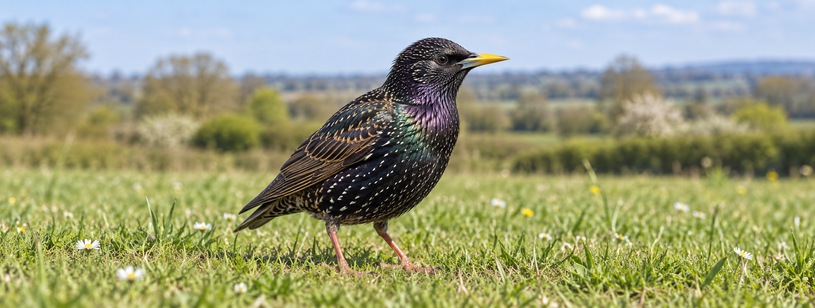
Common starling, Sturnus vulgaris, with iridescent plumage and pale feather tips.
The common starling is a compact songbird with dark, iridescent plumage and a remarkable ability to imitate sounds. Also called the European starling, Sturnus vulgaris is famous for large flocks that turn and reshape themselves in the sky.
It feeds on grassland, farmland, lawns and other open ground, taking invertebrates as well as fruit and seeds. Its short tail and slender, pointed bill are useful identification clues. Some populations migrate, while others remain in the same broad region throughout the year.
Quick facts
| Common name | Common starling; European starling |
| Scientific name | Sturnus vulgaris |
| Typical lifespan | About 5 years for a bird that has reached breeding age, according to BTO data. |
| Length | 19–22 cm in the Romanian Ornithological Society account; published ranges vary slightly. |
| Weight | Approximately 55–100 g, depending on the individual. |
| Diet type | Omnivorous: insects and other invertebrates, fruit, seeds and grain. |
| Main predators | Falcons and domestic cats; risk depends on the place and circumstances. |
| Conservation status | Globally Least Concern (LC); some populations are declining. |
| Geographical distribution | Native to Eurasia and northern Africa; introduced to parts of the Americas, southern Africa, Australia and New Zealand. |
| Habitat | Open ground with short vegetation and suitable tree holes or building cavities for nesting. |
| Wingspan | Around 31–40 cm in the range reported by Audubon. |
| Activity | Mainly daytime; often gathers at communal night roosts. |
| Social life | Forms flocks, sometimes very large, especially outside the breeding season. |
| Migration | Partially migratory; movements vary between populations. |
| Nest | An existing tree hole, building cavity or suitable nest box. |
| Eggs | Usually 4–6 in the Romanian species account; clutch size varies. |
| Incubation | Around two weeks; 11–14 days in the Romanian account. |
| Leaving the nest | Around three weeks after hatching; parents continue feeding young for a while. |
- Primary category:Birds
- Explore this animal's categories:Animals of AfricaAnimals of AsiaAnimals of AustraliaAnimals of EuropeAnimals of North AmericaAnimals of RomaniaAnimals of Romania’s gardens and parksAnimals of Romania’s grasslands and plainsAnimals of South AmericaAnimals that live in groupsBirdsBirds of RomaniaBirds that winter in RomaniaCEgg-laying animalsFeathered animalsFlying animalsInsect-eating animalsIntelligent animalsMigratory animalsMigratory birdsOmnivoresPredatory animals of RomaniaSpotted animalsVertebratesWetland animalsWild animals
Interesting facts
- Its song can include borrowed sounds. Starlings combine whistles, rattles, clicks and imitations of other birds or sounds made around people.
- Spots become less conspicuous as feathers wear. Pale tips on fresh feathers gradually wear away, revealing more of the dark, glossy plumage by spring.
- The bill changes colour seasonally. It is generally dark in winter and yellow in the breeding season.
- Not every starling migrates. Populations include both migrants and birds that remain through winter.
- The bill helps expose hidden food. A bird can insert it into the ground or vegetation and force it open to reach invertebrates.
Records and remarkable features
A documented lifespan beyond 17 years
BTO reports a ringed starling reaching 17 years, 7 months and 25 days. This is a record in the ringing evidence presented by the organisation, rather than the age most individuals reach.
The typical figure of about five years applies to birds that have survived to breeding age. Early mortality means it cannot be treated as the expected outcome for every newly hatched chick.
Flocks that fill the sky
Thousands of birds can gather at a roost, and some gatherings are much larger. Numbers vary with location, season and day. A spectacular evening flock is not, by itself, a measurement of the population across an entire region.
Characteristics
How can you recognise a common starling?
Look for a stocky body, a relatively short tail and a long, straight, sharply pointed bill. The legs are pinkish-brown. In flight, the pointed wings give the bird a triangular outline.
At a distance it may appear almost black. Closer views reveal green and violet iridescence. Pale feather tips are especially obvious in fresh autumn and winter plumage.
Adult or juvenile?
| Age or season | Typical appearance |
|---|---|
| Breeding adult | Dark, strongly iridescent plumage; usually a yellow bill; pale spots may be less conspicuous. |
| Adult in autumn and winter | More clearly spotted feathers, with pale tips; generally a dark bill. |
| Juvenile | Mostly grey-brown rather than glossy adult plumage; dark bill. |
During moult, a young bird can show a mixture of juvenile and adult feathers. Use several features together rather than identifying it from a single colour patch.
Starling or blackbird?
A male common blackbird can also have dark plumage and a yellow bill, but its tail is longer. The starling has a more compact outline and often obvious pale spots or iridescent feathers. Shape remains useful when poor light hides the colours.
Habits and behaviour
Why do their flocks move together?
Before settling to roost, starlings may form shifting aerial gatherings called murmurations. The flock can stretch, turn and compress as the birds respond to one another.
A field study by Ballerini and colleagues found that the birds studied interacted, on average, with roughly six or seven neighbours. Local interactions help explain how a flock can remain cohesive while its density and shape change.
This was a result from the studied flocks, not a rigid count that every starling follows at every moment. Changes in direction can also occur when a predator approaches.
Song and mimicry
Starlings learn sounds and can incorporate them into their repertoire. Some imitations resemble another species closely enough to make identification from one isolated sound difficult.
Songs and calls take part in social interactions, including breeding. A male may sing beside his chosen nest site and wave his wings while attracting a female.
Where do they sleep?
Outside the nesting season, many birds use communal night roosts. These can include reedbeds, groups of trees and buildings. Gathering in a flock gives more birds an opportunity to detect approaching danger.
Habitat and geographical distribution
Where is it native?
Sturnus vulgaris is native to Eurasia and northern Africa. It favours open feeding areas near suitable nesting places, including tree holes and cavities in buildings.
People have introduced it elsewhere, including North America, parts of South America, southern Africa, Australia and New Zealand. Presence in a region does not necessarily mean the species originated there.
Starlings in Romania
In Romania it is a breeding bird and partial migrant. It occurs on farmland and grassland and in orchards, parks and gardens. Higher mountain areas are generally less suitable than low, open landscapes.
Some birds leave for warmer regions, while others stay, particularly in southern areas and milder winters. Birds from populations farther north can also arrive during the colder months.
What makes suitable habitat?
- Accessible food: short vegetation and ground containing invertebrates.
- Nesting places: hollow trees or other suitable cavities.
- Resting shelter: vegetation or structures used for roosting.
Diet and feeding
What does a starling eat?
It is an omnivore. In the breeding season it takes many insects and other invertebrates, including larvae, beetles, spiders, snails and earthworms. Fruit and seeds become more important when available, particularly in autumn and winter.
Food varies with season and place. A bird feeding on cherries in an orchard may search grassland for insects at another time of year.
Finding food beneath the surface
Starlings walk and run over the ground, pausing to probe grass and soil with the bill. They can also pick fruit from trees and catch some flying insects.
After inserting the bill into vegetation or ground, the bird can open it to expose food hidden from view. This probing action is a characteristic part of its feeding behaviour.
Ecological and agricultural roles
Starlings consume invertebrates and provide prey for other animals. Their relationship with farming depends on context: they may eat insects that damage plants, while flocks can also cause losses in orchards, vineyards and grain crops.
Damage needs to be assessed for the actual place and season. A bird appearing in a garden does not automatically create a serious problem.
Reproduction and life cycle
A nest inside a cavity
The male selects a site and starts bringing material. The nest can contain grass, small twigs, feathers and other available items. The female helps arrange it, and fresh green leaves may also be added.
The species uses existing cavities, such as a tree hole, an opening in a building or a suitable nest box.
Eggs and young
| Stage | Common starling breeding information |
|---|---|
| Egg laying | Usually April–June in Romania; one or two broods annually in the Romanian Ornithological Society account. |
| Clutch | Usually 4–6 eggs in that account, with variation between nests and regions. |
| Incubation | About two weeks; 11–14 days in the Romanian account. Both parents may incubate, with the female taking the main role. |
| Nestlings | Both parents feed them. They leave at around three weeks after hatching. |
| After fledging | Parents continue feeding young for a time; leaving the nest does not mean immediate independence. |
How long does a starling live?
BTO gives a typical figure of about five years for a bird that has reached breeding age. Some live longer, while others die much sooner.
Survival depends on food, weather, disease, predators and other conditions. An exceptional ringing record documents one individual, rather than a lifespan guaranteed to every starling.
Names and history
What does Sturnus vulgaris mean?
Sturnus is the Latin name for a starling, and vulgaris means common. The scientific name is attributed to Linnaeus, 1758.
| Classification level | Name |
|---|---|
| Class | Aves — birds |
| Order | Passeriformes — an order containing many songbirds |
| Family | Sturnidae |
| Genus | Sturnus |
| Species | Sturnus vulgaris |
Spread through human introductions
Nineteenth-century introductions helped establish populations beyond the natural range. In North America, the common starling eventually occupied a very large area.
Where introduced, it can compete with native birds for nesting cavities. The origin and ecological effects of a population need to be considered in the context of that particular region.
Cultural significance and mythology
Mozart’s starling
The ability to imitate sounds also attracted Wolfgang Amadeus Mozart. In a 1784 notebook entry he recorded buying a starling and wrote down the bird’s version of a theme from his Piano Concerto No. 17, K. 453.
He kept the bird for about three years. When it died in 1787, Mozart wrote a poem for it. These records connect the starling’s mimicry with a well-documented episode in musical history.
Conservation and threats
Is the common starling endangered?
Globally, it is classified as Least Concern. A favourable global category can nevertheless coexist with substantial declines in particular populations.
In the United Kingdom it is on the Red List of birds of conservation concern. This regional assessment is different from the global IUCN category and cannot automatically be applied to Romania or another country.
What threatens it?
- Reduced food availability: changes in farming can reduce accessible invertebrates.
- Loss of nesting places: removing hollow trees or sealing cavities can limit available sites.
- Habitat change: loss of grassland and increasingly uniform landscapes alter feeding opportunities.
How can it be helped?
Retaining varied habitat and suitable nesting trees supports local birds. Diverse vegetation and reduced pesticide use in gardens can help sustain the food they depend on.
Watch roosts from a distance without disturbing the birds. Binoculars allow observation without repeatedly approaching a nest entrance.
In popular culture
The starling in Henry IV, Part 1
In William Shakespeare’s Henry IV, Part 1, Hotspur says he would teach a starling to repeat the name “Mortimer” in order to annoy the king.
The reference appears in Act 1, Scene 3 and uses the bird’s mimicry for comic effect. Real birds vary in what they learn; a starling does not repeat every word merely because it hears it once.
Frequently asked questions
How do you recognise a common starling?
It has a compact body, short tail, slender pointed bill and dark plumage with green-violet iridescence. Pale spots are more obvious in autumn and winter.
What do starlings eat?
They are omnivores, eating insects, larvae, earthworms and other invertebrates, as well as fruit, seeds and grain in seasonally changing proportions.
Do all starlings migrate?
No. The species is partially migratory. Some populations move to warmer regions, while others remain through winter.
Why do starlings form large flocks?
They gather to feed and roost. During flight, responses to nearby birds help the flock stay coordinated and react to danger.
Can a starling imitate human speech?
Some can learn human sounds, especially when heard repeatedly. Ability and repertoire vary between individuals.
Where do starlings nest?
They use existing cavities, including tree holes, gaps in buildings and suitable nest boxes. Both parents help care for young.
How many eggs does a starling lay?
The Romanian account gives a typical clutch of 4–6 eggs and one or two broods annually. Numbers vary between nests and regions.
Is a starling the same as a blackbird?
No. The common starling is Sturnus vulgaris; the common blackbird is Turdus merula. Starlings have a shorter tail, a compact outline and often spotted or iridescent plumage.
Did you know? About the common starling
- Starlings can imitate other birds and sounds made around people.
- Pale feather tips are more conspicuous during the colder season.
- Some populations migrate, while others stay through winter.
- They nest in existing cavities, including tree holes and openings in buildings.