CatInteresting facts and information
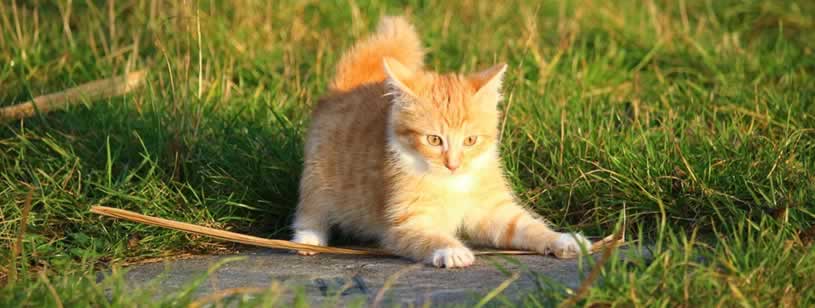
The domestic cat (Felis catus) is a mammal descended mainly from African wildcat ancestors. Cats keep strong hunting behaviours and have specialised senses. Their health and behaviour depend on individual needs and care.
Thanks to its independent nature, its adaptability and its affectionate relationship with people, the cat has become a symbol of mystery, elegance and curiosity. Throughout history it has been worshipped in some cultures and persecuted in others, and today it is a trusted companion for millions of people.
Quick facts
| Common name | Cat |
| Scientific name | Felis catus |
| Typical lifespan | 12-18 years (depending on breed and care) |
| Maximum speed | About 45-50 km/h over short distances |
| Height | About 23-25 cm at the shoulder |
| Length | 46-51 cm (without the tail) |
| Weight | Usually 2.5-7 kg (varies by breed) |
| Diet type | Obligate carnivore |
| Main predators | Dogs, birds of prey, snakes, coyotes and foxes (for outdoor cats) |
| Conservation status | Domestic animal; conservation of domestic breeds is separate from the assessment of wild relatives |
| Geographical distribution | Worldwide, from deserts to cold northern regions |
| Social behaviour | Independent, but can live in small groups |
| Special adaptations | Excellent night vision, agility, sensitive whiskers, retractable claws |
- Primary category:Mammals
- Explore this animal's categories:
Interesting facts
- Cats are superb jumpers - Thanks to their strong hind legs and flexible spine, they can jump several times their own body length.
- Cats can turn their ears about 180° - Each ear is moved by about 30 muscles, so a cat can point its ears in different directions at once.
- They see very well in the dark - A cat's eyes have a reflective layer called the tapetum lucidum, which improves night vision.
- Every cat has a unique nose - The pattern of ridges on a cat's nose is said to be as individual as a human fingerprint.
- They sweat only through their paw pads - Cats have sweat glands mainly on their paws, which play a small role in cooling them down.
- Cats make many different sounds - They meow, purr, chirp, trill, growl and hiss, and some cats have a large repertoire of calls.
Records and remarkable features
- The domestic cat (Felis catus) is a mammal descended mainly from African wildcat ancestors. Cats keep strong hunting behaviours and have specialised senses. Their health and behaviour depend on individual needs and care.
Characteristics
Cats are extremely agile, flexible and intelligent animals, with bodies built for hunting and exploring. From excellent night vision to retractable claws and sensitive whiskers, each feature helps them survive and adapt to different environments.
Appearance
- Size - The body is usually about 46-51 cm long, and the tail adds about 25-30 cm.
- Weight usually 2.5-7 kg - Small breeds such as the Singapura are lighter, while large breeds such as the Maine Coon can weigh more than 10 kg.
- Coats of many lengths and textures - There are short-haired cats (Siamese, Bengal), semi-long-haired cats (Ragdoll) and long-haired cats (Persian, Maine Coon).
- Retractable claws - Kept in sheaths so they stay sharp, and extended only when needed for hunting, defence or climbing.
- Pupils that change dramatically - They adapt quickly to changes in light and help give cats excellent night vision.
- Long, sensitive whiskers - Help cats find their way in the dark and sense air currents.
- A very flexible spine - Allows cats to twist and land safely after a fall.
Special adaptations
- The righting reflex - Cats can twist their bodies in mid-air to land on their feet.
- A silent walk - Their soft paw pads let them move quietly, which makes them effective hunters.
- Good memory - Cats can remember where food is, the way home and familiar people for a long time.
- Surviving falls - Thanks to their light, flexible skeleton and the righting reflex, cats sometimes survive falls from great heights.
- Hearing high sounds - Cats can hear the high-pitched squeaks of rodents, which people cannot hear.
Habits and behaviour
Cats are territorial and independent, but they can form strong bonds with people and other animals. Their behaviour includes hunting, playing and communicating with body language and sounds.
Social behaviour
- Territorial and often solitary - Many cats hunt alone, but feral cats can live in groups, called colonies, usually made up of related females.
- Selective attachment - Cats often bond closely with their owner but may be reserved with strangers.
- Marking - They mark their territory by rubbing their heads, scratching surfaces and spraying scent.
- Activity - Cats are most active at dawn and dusk.
Communication and body language
- Meowing - Used to get attention, ask for food and communicate with people.
- Purring - Usually a sign of relaxation and contentment, but sometimes also of pain or stress.
- Tail held high - A sign of confidence and friendliness.
- Pawing or gentle biting - Sometimes part of play, sometimes a way of saying "stop".
Defence and survival techniques
- Escaping and hiding - When a cat feels threatened, it runs away and hides in hard-to-reach places.
- Arching the back and fluffing up the fur - Makes the cat look bigger to scare off enemies.
- Scratching and biting - If attacked, a cat defends itself fiercely with its claws and teeth.
Habitat and geographic distribution
Cats are very adaptable and live on every continent except Antarctica, in deserts, forests, cold regions and cities.
| Region | Types of cat | Typical habitat |
|---|---|---|
| Europe | Domestic cats; the European wildcat is a related wild species | Countryside, towns, forests |
| North and South America | Domestic cats, American breeds (Maine Coon, American Shorthair) | Cities, farms, mountains |
| Asia | Domestic cats, Asian breeds (Siamese and others) | Tropical areas, large cities |
| Africa | Domestic cats; the African wildcat, their main ancestor | Deserts, savannas, villages |
| Australia | Domestic cats and introduced feral cats | Forests, cities, remote islands |
Types of habitat
- Towns and cities - Most pet cats live in flats, houses and urban neighbourhoods.
- Farms and countryside - Many cats live on farms and in barns, where they catch rodents.
- Forests and wild areas - Feral cats live in forests and fields, where they hunt small animals.
Human impact and problems
- Too many stray cats - Without neutering, stray cat populations grow quickly.
- Harm to wildlife - In some areas, especially on islands and in Australia, feral cats threaten birds, reptiles and small mammals.
- Abandonment and cruelty - Many pet cats are abandoned and face many dangers.
- Road accidents - Cats that roam outdoors are often hit by cars.
Diet and feeding
Cats are obligate carnivores, which means they need a diet rich in animal protein to survive. They hunt by instinct, even when they are not hungry, which explains why their play looks so much like hunting.
What do cats eat?
| Type of food | Examples |
|---|---|
| Meat | Chicken, beef, turkey, rabbit |
| Fish | Salmon, tuna, sardines (in moderation) |
| Organ meat | Liver, heart, kidney (sources of vitamins) |
| Rodents and small birds | Mice, sparrows (for cats that hunt) |
| Eggs (occasionally) | A source of protein and fat; should be cooked |
| Dry and wet food | Complete foods made for pet cats |
| Dairy (with caution) | Some cats tolerate a little yoghurt or cheese, but milk often upsets their digestion |
Hunting and feeding techniques
- Stalking and pouncing - Cats creep up on their prey, then catch it with a sudden leap and a quick bite.
- Play as practice - Even pet cats practise hunting skills through play.
- Leaving food for later - Some cats leave or hide part of their prey to come back to later.
- Eating small bones - Cats that hunt eat the small bones of their prey, which provide calcium and minerals.
Adapting to food supply
- Cats need regular food - Unlike some animals, cats should not go without food for long, because fasting can cause serious liver problems.
- Eating grass - Cats sometimes chew grass, which may help them bring up hairballs.
- Food preferences - Pet cats may refuse new foods if they are used to a particular diet.
Reproduction and life cycle
Cats breed quickly and can have several litters a year. Mother cats have strong instincts to protect their kittens.
| Feature | Details |
|---|---|
| Age at maturity | 4-6 months |
| Breeding season | Mainly spring and summer, but cats can breed all year round |
| Type of reproduction | Live birth (mammal) |
| Kittens per litter | Usually 3-6, sometimes up to 9 or more |
| Pregnancy | About 63-67 days |
| Nursing | About 6-8 weeks (until weaning) |
| Lifespan | 12-18 years (sometimes 20 or more) |
Breeding
- Female cats come into heat every 2-3 weeks in the breeding season until they become pregnant.
- Female cats can mate with several males - so kittens in the same litter can have different fathers.
- Kittens are born blind and deaf - Their eyes open after about 7-10 days, and their hearing develops over the following weeks.
- Nursing lasts up to about 8 weeks - Kittens start eating solid food at about 4-5 weeks but keep suckling until they are weaned.
- Early socialisation is essential - Kittens that are handled by people between about 2 and 9 weeks old usually become friendlier adults.
Survival strategies
- Moving the kittens - Mother cats often move their kittens to a new hiding place to protect them from danger.
- Focusing on the strongest - When food is scarce, a mother may neglect weak kittens and care for the stronger ones.
- Early independence - At 10-12 weeks old, kittens can feed themselves and explore on their own.
Name and history
Cats have lived with people for thousands of years and have been worshipped, feared and loved in different cultures.
Origin of the name
- The word "cat" comes from the late Latin cattus; its earlier origin is uncertain, but it may come from a North African language.
- The scientific name Felis catus was given in 1758 by the Swedish naturalist Carl Linnaeus.
The cat in human history
- The first cats - Cats began living alongside people about 10,000 years ago in the Near East, when farmers' grain stores attracted mice.
- Ancient Egypt - Cats were greatly honoured and linked with the goddess Bastet, protector of the home and of fertility.
- The Roman Empire - Cats were valued for keeping mice and rats under control.
- The Middle Ages - In parts of Europe, black cats were linked with witchcraft and persecuted; some historians have suggested that fewer cats may have helped rats spread disease.
- Asia and the Middle East - Cats were often seen as guardians and as symbols of good luck.
The cat in folklore and superstition
- Black cats bring bad luck (or good luck) - In some cultures they are seen as unlucky, in others as bringers of good fortune and protection.
- Sensing people's moods - Many people believe cats can sense their owners' feelings.
- Comforting the sick - In some European traditions, a cat that settles at the feet of a sick person is said to protect them.
Cultural significance and mythology
Throughout history, the cat has been a powerful symbol in many cultures, linked with luck and protection as well as with mystery and the supernatural.
The cat in mythology and religion
- Ancient Egypt - Cats were deeply respected, and the goddess Bastet, protector of the home, fertility and joy, was often shown as a cat or with a cat's head. Killing a cat was a serious crime.
- Norse mythology - The goddess Freyja, linked with love and fertility, rode in a chariot pulled by two large cats.
- Celtic legends - Cats were sometimes linked with the spirit world, and some stories tell of fairy cats such as the Cat Sìth.
- Japan - Cats are symbols of good luck, and the Maneki-neko ("beckoning cat") figurine is a charm believed to bring prosperity.
- Medieval Europe - Cats, especially black ones, were linked with witches and the devil, which led to their persecution.
The cat in folklore and superstition
- A black cat is a sign of good luck in Britain, but often a sign of bad luck in the United States and parts of Europe.
- A cat crossing your path is a bad sign in some cultures and a sign of protection in others.
- Many people believe that cats can "see spirits" or sense unusual events before they happen.
- In Japan, a cat washing its face with its paw is said to mean that a visitor will come.
Conservation status and threats
The domestic cat is not threatened, but some wild cat populations and relatives are in danger.
| Status | Species or population | Region |
|---|---|---|
| Domestic animal, not threatened | Domestic cat (Felis catus) | Worldwide |
| Least Concern (IUCN) | African wildcat (Felis lybica) | Africa, Middle East, Central Asia |
| Critically threatened locally | Scottish wildcat (a population of the European wildcat), threatened mainly by interbreeding with domestic cats | Scotland |
| Critically Endangered (national assessment) | Iriomote cat (Prionailurus bengalensis iriomotensis) | Japan |
Main threats
- Impact on wildlife - Feral and free-roaming cats kill large numbers of small birds, mammals and reptiles, especially on islands.
- Habitat loss for wild cats - Development reduces the habitat of wild cat species in Europe and Asia.
- Uncontrolled breeding - Stray cat populations grow quickly in many cities, causing welfare and health problems.
- Abandonment - Many pet cats end up on the streets because of irresponsible owners.
Conservation efforts
- Neutering and adoption - Many countries run campaigns to neuter stray cats and control their numbers.
- Protecting wild cats - Conservation programmes protect wildcats from interbreeding with domestic cats.
- Education - Animal welfare organisations promote responsible adoption and proper care of cats.
In popular culture
Cats are among the most popular animals in art, literature, films and cartoons, thanks to their charisma and air of mystery.
Literature and fairy tales
- Alice's Adventures in Wonderland (Lewis Carroll, 1865) - The Cheshire Cat is famous for its mysterious grin and its ability to vanish.
- "Puss in Boots" - A classic fairy tale about a clever cat who helps his master become rich and famous.
- Coraline (Neil Gaiman, 2002) - A mysterious black cat helps the heroine uncover the secrets of a parallel world.
- Harry Potter (J. K. Rowling, 1997-2007) - Mrs Norris, the caretaker's cat, and Professor McGonagall, who can turn into a cat, show how important cats are in the magical world.
Films and cartoons
- The Aristocats (Disney, 1970) - An animated film about a family of aristocratic Parisian cats.
- Garfield (created by Jim Davis, 1978) - The famous lazy, sarcastic cat who loves lasagne.
- Shrek 2 (2004) - Puss in Boots became one of the best-loved animated characters.
- Tom and Jerry - Tom the cat became a symbol of the rivalry between cats and mice.
Video games
- Stray (2022) - A game in which the player is a cat exploring a futuristic city.
- Neko Atsume - A Japanese game about collecting and feeding virtual cats.
- The Elder Scrolls V: Skyrim - The cat-like Khajiit are one of the game's best-known races.
The cat as a commercial symbol
- Maneki-neko - The "beckoning cat" is a Japanese symbol of luck and prosperity.
- Hello Kitty - Created in Japan in 1974, she is one of the most popular commercial characters in the world.
- Cats in advertising - Cats are often used to advertise pet food, luxury products and technology because of their elegance and independence.