Little owlAthene noctua — habitat, diet and reproduction
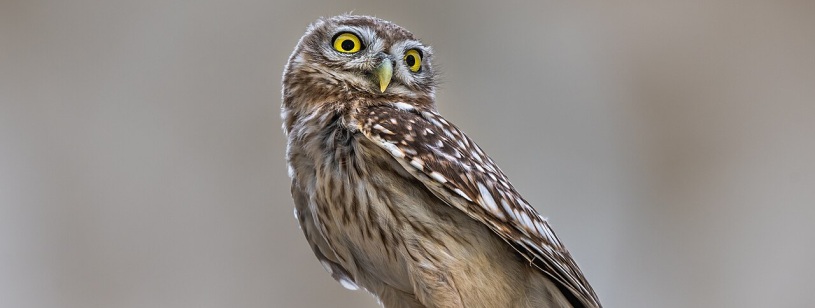
Little owl (Athene noctua) on a rock. · Максат79 / CC BY-SA 4.0 (https://creativecommons.org/licenses/by-sa/4.0). Cropped and resized.
The little owl is a small owl with a flat head, yellow eyes and pale eyebrows that give it a stern look. It lives around villages, orchards, ruins and farmland. Unlike many owls, it is often seen by day, perched on a post or wall.
Quick facts
| Common name | Little owl |
| Scientific name | Athene noctua |
| Lifespan | Usually a few years in the wild |
| Length | About 21–23 cm |
| Weight | About 160–200 g |
| Diet | Carnivore: insects, earthworms, small rodents, sometimes small birds |
| Predators | Larger owls, hawks, martens and cats |
| Conservation status | Least Concern (LC), globally |
| Distribution | Europe, Asia and North Africa |
| Habitat | Open country with old trees, orchards, villages and ruins |
| Family | Strigidae |
| Activity | Mostly at dusk and night, but also by day |
- Primary category:Birds
- Explore this animal's categories:
Interesting facts
- When alarmed, the little owl bobs its whole body up and down, like a bow.
- It can run on the ground after beetles and earthworms.
- Coins of ancient Athens showed a little owl, the symbol of the goddess Athena.
- In Romanian folk tradition, its call was considered a bad omen.
Characteristics
The little owl has a stocky body, short tail and rounded wings. The plumage is brown with white spots on the head and back and streaks on the breast. The facial disc is less obvious than in other owls, and there are no ear tufts.
Males and females look almost identical. The large yellow eyes face forward, as in all owls, helping it judge distances.
Behaviour
It is sedentary: a pair stays in the same territory all year. It hunts mostly at dusk and night but also by day, especially when feeding chicks.
It watches from a raised perch and drops onto prey. The usual call is a plaintive, repeated “kiew”, heard especially in spring. When disturbed, it crouches or flies low, in bounds, to the next cover.
Habitat and distribution
The little owl lives across much of Europe, in Asia as far as China and in North Africa. People introduced it to Britain and New Zealand in the nineteenth century.
In Romania it is widespread in lowlands and hills, in villages, farms, orchards, cemeteries and old buildings. It avoids dense forests and high mountains.
Diet and feeding
Its food changes with the season. In summer it eats many large insects, such as beetles and grasshoppers, plus earthworms. In winter it more often catches voles and other small rodents.
It sometimes takes small birds, frogs or lizards. Undigested bones and fur are coughed up as pellets. By eating rodents and insects, it helps farmers.
Reproduction and life cycle
The nest is a cavity: a tree hole, a gap in a wall, a loft or a burrow in a bank. No nest material is added.
The female usually lays 3–5 white eggs and incubates them for about four weeks while the male brings food. Chicks leave the nest after about a month but are fed for several more weeks. A pair normally raises one brood a year.
Name and history
The scientific name Athene noctua means “Athena of the night”. The bird was linked to the goddess Athena and the city of Athens, and appeared on silver coins called tetradrachms.
This is the origin of the owl as a symbol of wisdom. Today a little owl also appears on the Greek one-euro coin. In Romanian villages, its call near a house was once seen as a bad sign, a superstition about a useful bird.
Conservation and threats
The species is assessed globally as Least Concern. In parts of western Europe, numbers have fallen sharply in recent decades.
Main causes include the loss of old trees with cavities, renovation of old buildings, pesticide use and road traffic. Nest boxes in orchards have helped local populations. Like all owls, it is protected in Romania.
Frequently asked questions
Is the little owl an owl?
Yes. It belongs to the typical owl family (Strigidae) and is one of Europe’s smallest owls.
Is the little owl active by day?
Yes. It hunts mostly at dusk and night but is often seen by day on posts, walls or roofs.
What does a little owl sound like?
The usual call is a long, plaintive “kiew”, repeated especially in spring.
Is the little owl a bad omen?
No. That belief is an old superstition; the bird eats insects and rodents and is legally protected.