Black Russian TerrierCharacteristics, history, training and care
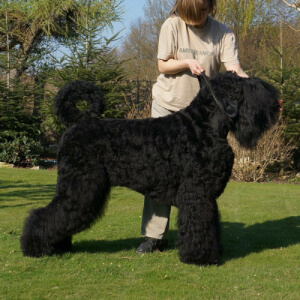
The Black Russian Terrier is a large, powerful black dog. It was created in the USSR, at the Red Star military kennel, in the late 1940s and the 1950s. The FCI standard describes it as dignified and self-assured, in control of itself in any situation. It defends itself resolutely when necessary, but calms down quickly once the danger has passed.
Quick facts
| Common name | Black Russian Terrier |
| Scientific name | Canis lupus familiaris |
| Country of origin | Russia (former USSR) |
| Official recognition | FCI, definitively since 29 September 1983 (group 2, pinschers, schnauzers and molossoid breeds; standard no. 327) |
| Lifespan | 10.9 years on average, according to a 2024 UK study; the AKC gives 10–12 years |
| Size (males) | 72–76 cm at the withers; 50–60 kg |
| Size (females) | 68–72 cm at the withers; 45–50 kg |
| Coat type | Double, harsh and dense, with a beard and eyebrows |
| Common colours | Black, with a few grey hairs |
| Energy level | High |
| Suited to an apartment? | Only with plenty of daily exercise |
| Temperament | Dignified, self-assured, calm, friendly, hard-working |
| Tendency to aggression | Average; protective of its family, suspicious of strangers |
| Good with children | Good, with supervision, because of its size |
| Good with other animals | Average; early socialisation is needed |
| Genetic predispositions | Hip and elbow dysplasia, hyperuricosuria, juvenile laryngeal paralysis |
- Primary category:Dog breeds
- Explore this animal's categories:
History and origin
After the Second World War, the Soviet army needed large, hardy guard dogs. According to Wikipedia, about 17 breeds were used at the Red Star state kennel (Krasnaya Zvezda). Among them were the Giant Schnauzer, the Airedale Terrier, the Rottweiler and the Newfoundland.
The first dogs were shown at an exhibition in Moscow in 1955, and the first standard appeared in 1958. The FCI recognised the breed definitively on 29 September 1983. The American Kennel Club recognised it in July 2004.
Although it is called a “terrier”, according to Wikipedia it is really a working dog, closer to the schnauzers than to true terriers.
How the breed developed
- Late 1940s – Work on the breed begins at the Red Star kennel.
- 1955 – The first dogs at an exhibition in Moscow.
- 1958 – The first breed standard.
- 29 September 1983 – Definitive FCI recognition.
- July 2004 – Recognised by the American Kennel Club.
Breed rating
| Feature | Stars |
|---|---|
| Training and intelligence | ★★★★☆ |
| Easy to train | ★★★★☆ |
| Intelligence | ★★★★☆ |
| Independence | ★★★☆☆ |
| Stubbornness | ★★★☆☆ |
| Behaviour and temperament | ★★★☆☆ |
| Affectionate with family | ★★★★☆ |
| Friendly with children | ★★★☆☆ |
| Good with other dogs | ★★★☆☆ |
| Good with cats and other animals | ★★☆☆☆ |
| Loyalty | ★★★★★ |
| Tendency to be aggressive | ★★★☆☆ |
| Tendency to bark | ★★★☆☆ |
| Needs and care | ★★★☆☆ |
| Shedding | ★★☆☆☆ |
| Needs frequent grooming | ★★★★☆ |
| Activity and lifestyle | ★★★★☆ |
| Energy level | ★★★★☆ |
| Daily exercise needs | ★★★★☆ |
| Suited to apartment life | ★★★☆☆ |
| Health and longevity | ★★★☆☆ |
| Life expectancy | ★★★☆☆ |
| Predisposition to genetic diseases | ★★★☆☆ |
| Working abilities and uses | ★★★★☆ |
| Good guard dog | ★★★★★ |
| Good companion dog | ★★★☆☆ |
Indicative rating: 5 stars means the highest level. The rating is based on the breed's AKC profile (watchdog 5 out of 5, trainability 4 out of 5, grooming 4 out of 5) and on the FCI standard.
Physical characteristics
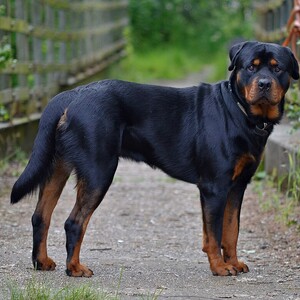
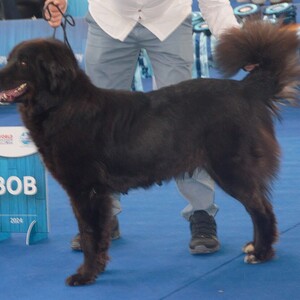
The FCI standard describes it as a large dog, above medium size, robust and powerful, with massive bones and well-developed muscles. The body is slightly longer than it is tall. Males are more massive than females.
General appearance
The coat is double: a harsh, dense outer coat and a soft undercoat. On the muzzle it forms a beard, moustache and eyebrows, and on the neck and withers a mane, fuller in males. According to Wikipedia, the coat is trimmed to a length of 5–15 cm.
| Feature | Black Russian Terrier |
|---|---|
| Size | Very large |
| Height at the withers | males: 72–76 cm; females: 68–72 cm (FCI) |
| Weight | males: 50–60 kg; females: 45–50 kg |
| Coat | Double, harsh, sheds little |
| Colour | Black |
| Face | Beard, moustache and eyebrows |
The colour is black. The standard also accepts a few scattered grey hairs, on no more than a third of the body.
Training and socialisation
The standard describes it as friendly, clever and easy to train, hard-working and reliable. According to Wikipedia, it has a strong “work ethic” and needs a job to be happy. It responds well to firm, consistent training.
As it was created for guarding, early socialisation with new people and dogs is essential. It does very well at obedience, agility and schutzhund (a dog sport combining tracking, obedience and protection).
Tips for effective training
- Start training early. It grows big and strong.
- Be firm and consistent. It responds well to clear rules.
- Socialise it a lot. It is suspicious of strangers.
- Give it a job. It needs work.
Activity needs and lifestyle
It is a working dog that needs long walks and mental activity every day. Its AKC profile gives it 4 stars out of 5 for energy. It adapts easily to different climates, including the cold.
| Activity | How often | Why it matters |
|---|---|---|
| Long walks | daily | Fitness |
| Training or dog sports | several times a week | A busy mind |
| Play with the family | daily | The bond with its owners |
Tips for a balanced life
- Suited to experienced owners.
- A house with a well-fenced yard.
- Include it in family life.
Care and health
Coat and skin care
The coat sheds little, but it must be brushed several times a week and trimmed regularly. Its AKC profile gives it 4 stars out of 5 for grooming. The beard is cleaned after meals, as it holds water and bits of food.
Common health problems
A 2024 study in the United Kingdom found a life expectancy of 10.9 years, compared with 12.7 years on average for purebred dogs. Wikipedia names the main problems as:
| Condition | Description | Common symptoms |
|---|---|---|
| Hip dysplasia | The hip joint forms incorrectly and, over time, arthritis develops | Limping, difficulty getting up or jumping, hip pain |
| Elbow dysplasia | The elbow joint develops incorrectly and arthritis appears | Limping on the front legs, especially after exercise |
| Hyperuricosuria | Too much uric acid in the urine, which can form stones | Urinates often or with blood, pain when urinating |
| Juvenile laryngeal paralysis | An inherited nerve disease that affects the larynx in young dogs | Noisy breathing, easily out of breath with exercise |
Other care
- Ask for the parents' hip, elbow and DNA tests.
- Clean its beard and ears.
- Go for yearly check-ups.
Diet and nutrition
A very large dog needs good-quality food suited to its age and activity. Puppies grow fast and need large-breed food, so that they do not grow too quickly.
Tips for a healthy diet
The table gives a starting estimate, calculated with the formula from the Merck Veterinary Manual. The first two calorie columns show the calories per day for a healthy adult dog. The last column shows what this means in dry food with 3,500–4,000 kcal per kilogram.
| Dog's weight | Calories per day (neutered) | Calories per day (not neutered) | Dry food per day (approximate) |
|---|---|---|---|
| 45 kg | 1,950 kcal | 2,190 kcal | 490–630 g |
| 52 kg | 2,170 kcal | 2,440 kcal | 540–700 g |
| 60 kg | 2,410 kcal | 2,720 kcal | 600–780 g |
- Split the food into two meals a day.
- Do not let it run right after a meal.
- A dog is at the right weight when you can feel its ribs under the coat without pressing hard.
Foods to avoid
Some human foods are dangerous for dogs: chocolate, coffee, grapes and raisins, onions, garlic, xylitol (a sweetener used in chewing gum), macadamia nuts and alcohol.
Reproduction and development
Physical and emotional maturity
In dogs, sexual maturity usually comes between 6 and 12 months, but in large breeds it can be delayed until about two years. Very large breeds become adults only at around 2 years.
Mating and pregnancy
Pregnancy lasts about 63 days, counted from ovulation. Mating a female on her first heat is not recommended. The FCI standard requires that only healthy dogs of typical breed appearance are used for breeding.
Caring for the puppies
In large breeds, a litter has around 7 puppies on average. The puppies grow very fast, so they need growth food suited to large breeds. Socialisation starts in the first weeks.
Interesting facts
- Created by the army. Until 1957 it was bred only at the Red Star state kennel in Moscow.
- About 17 ancestral breeds. Among them, the Giant Schnauzer and the Rottweiler.
- A terrier in name only. It is really a working dog.
- Beard and eyebrows. They give it a very expressive face.
- Good in the cold. The double coat protects it from Russian winters.
Frequently asked questions
Is it a true terrier?
No; it was created as a working dog, closer to the schnauzers.
Does it shed a lot?
Little, but the coat must be brushed often and trimmed regularly.
How big does it get?
Males measure 72–76 cm and weigh 50–60 kg.
Is it suited to beginners?
Less so; it is big and strong and needs an experienced owner.