Crested porcupineHystrix cristata — habitat, diet and reproduction
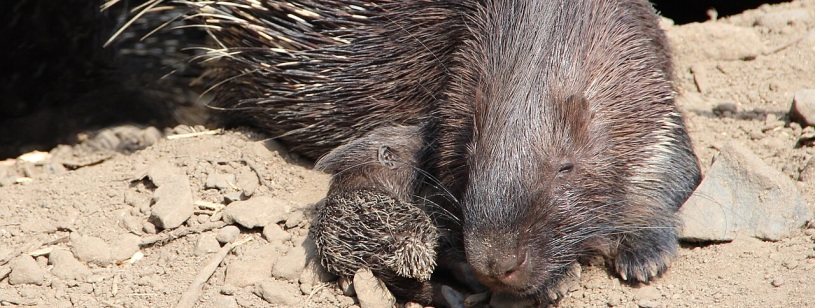
Crested porcupines (Hystrix cristata) resting on the ground. · Jean-Pol GRANDMONT / CC BY-SA 3.0 (https://creativecommons.org/licenses/by-sa/3.0). Cropped and resized. Source: https://commons.wikimedia.org/wiki/File:0_Hystrix_cristata_-_Porc-%C3%A9pics_%C3%A0_cr%C3%AAte_(1).JPG
The crested porcupine (Hystrix cristata) is a large rodent armed with long, banded quills. It lives in Africa and Italy, forages mainly at night and shelters in burrows. When threatened, it raises its quills and presents its well-defended rear.
Quick facts
| Common name | Crested porcupine |
| Scientific name | Hystrix cristata |
| Lifespan | Can reach around 15 years in the wild; approximately 28-year captive record |
| Length | 60–93 cm head and body, plus an 8–17 cm tail |
| Weight | 10–30 kg |
| Diet | Mainly roots, tubers, bark and fruit |
| Predators | Large carnivores, including lions where their ranges overlap |
| Conservation status | Least Concern globally |
| Distribution | Africa and Italy, including Sicily |
| Habitat | Vegetated and rocky areas, woodland and farmland |
| Family | Hystricidae |
| Reproduction | Gestation around 66 days; litters usually contain 1–4 young |
- Primary category:Rodents
- Explore this animal's categories:
Interesting facts
- Quills are modified hairs used for defence.
- Hollow quills at the tail tip produce a warning rattle.
- Pairs and young can share a burrow system.
- Newborn quills are soft and harden after birth.
Records and extremes
At up to 30 kg, the crested porcupine is a large rodent, though smaller than the capybara.
AnAge records an individual that lived approximately 28 years in captivity. This exceptional case is distinct from normal lifespan.
Characteristics
Coarse dark bristles cover the head, limbs and underside. Long hairs form a crest, while sturdier banded quills protect the back and sides.
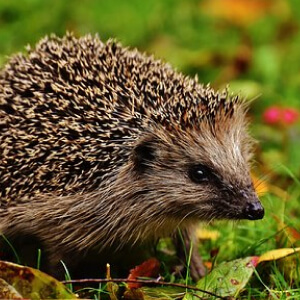
Short legs, strong digging claws and long whiskers suit ground-level life. Front incisors gnaw food. Porcupines are rodents, whereas hedgehogs belong to a different mammal group.
Behaviour
The animal rests in a burrow, cave or rock crevice by day and forages mostly at night. Family groups provide prolonged care for young.
A threatened porcupine raises its quills, stamps and rattles its tail. It may back towards a persistent attacker. Quills can detach on contact; they are not fired through the air.
Habitat and distribution
The range includes North Africa and many sub-Saharan regions, together with mainland Italy and Sicily. Shelter and food determine local occurrence.
Woodland, savanna, scrub, rocky ground and farmland can all be used. Existing cavities or excavated burrows may provide shelter for years.
American porcupines belong to a separate family, and many are more arboreal. The crested species is mainly terrestrial.
Diet and feeding
Roots, bulbs, tubers, fallen fruit and bark form the main diet. Digging exposes underground foods, assisted by a strong sense of smell.
Crop feeding can create conflict with farmers. Bones may be gnawed and animal food taken occasionally. Continually growing incisors are worn during gnawing and feeding.
Reproduction and life cycle
Pairs share shelter with their young. The female gives birth in a protected chamber after around 66 days of gestation.
Usually 1–4 young are born with soft quills that subsequently harden. They receive milk and family care, later accompanying adults to forage.
Name and history
Linnaeus described Hystrix cristata in 1758. The common name refers to the crest of long hairs on the head and neck.
The name porcupine also covers American species in Erethizontidae. They share protective quills with Old World porcupines but differ in anatomy and behaviour.
Conservation and threats
IUCN classifies the species as Least Concern globally. Hunting, crop conflict and habitat loss can still affect local populations.
Quills deter many predators but do not remove all risks. Large carnivores can attack, and human activities add pressure.
Allow wild porcupines room to retreat. Blocking their route or approaching closely can provoke defensive contact.
Frequently asked questions
Can it shoot its quills?
No. Quills may detach on contact but are not launched.
Is it closely related to a hedgehog?
Porcupines are rodents; hedgehogs belong to a different mammal group.
Does it live in Europe?
Hystrix cristata occurs in mainland Italy and Sicily.
What does it eat?
Mostly roots, tubers, bark and fruit, with occasional animal food.
How are young born safely?
Their quills are soft at birth and harden afterwards.
When is it active?
Mostly at night, resting in shelter during the day.